July 19

What was advertised in a colonial American newspaper 250 years ago today?
Jul 19 - 7:19:1769 Georgia Gazette
Georgia Gazette (July 19, 1769).

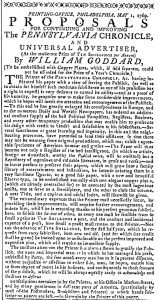
“PROPOSALS FOR CONTINUING AND IMPROVING The PENNSYLVANIA CHRONICLE.”

In the spring of 1769, William Goddard launched an advertising campaign intended to garner subscriptions for the Pennsylvania Chronicle from throughout the colonies. In outlining its contents, Goddard described a weekly publication that prospective subscribers may have considered as much a magazine as a newspaper. He proclaimed, “Several Gentlemen of great learning and ingenuity, in this and the neighbouring provinces, have promised to lend their assistance, so that there may not be wanting dome original productions, which may exhibit agreeable specimens of American humour and genius.” That being the case, Goddard did not produce a local or regional newspaper that merely delivered news reprinted from one newspaper to another, but instead a “Repository of ingenious and valuable literature, in prose and verse.” Goddard intended for subscribers to preserve their copies of the Pennsylvania Chronicle, pledging to distribute a title page, index, and two copperplate engravings (one for use as a frontispiece) to be bound together with the several issues each year. Such plans paralleled those distributed by magazine publishers in eighteenth-century America.

Goddard’s “PROPOSALS FOR CONTINUING AND IMPROVING The PENNSYLVANIA CHRONICLE” radiated out from Philadelphia. They first found their way into newspapers published in New York and then others published in New England. Eventually they appeared in newspapers published in southern colonies. Dated “May 1, 1769,” Goddard’s “PROPOSALS” did not run in the Georgia Gazette, the newspaper most distant from Philadelphia, until July 19, eleven weeks later. Goddard envisioned what Benedict Anderson termed an imagined community of readers. Although dispersed geographically, readers formed a sense of community and common interests through exposure to the same information via print culture. Colonial newspapers served this purpose as printers established networks for exchanging their publications and liberally reprinting news and other content from one to another. Goddard presented an even more cohesive variation: subscribers throughout the colonies reading the same information in a single publication and feeling a sense of community because they knew that other subscribers in faraway places read the same news and literature contained in the Pennsylvania Chronicle, rather than whichever snippets from other publications an editor happened to choose to reprint for local and regional consumption.

Creating an imagined community depended in part on establishing a sense of simultaneity, that readers were encountering the same content at the same time. Communication and transportation technologies in the eighteenth century made true simultaneity impossible, as seen in the lag between Goddard composing his “PROPOSALS” on May 1 and their eventual publication in the Georgia Gazette on July 19. Yet readers could experience a perceived simultaneity from knowing that they read the same publication as subscribers in other colonies. Reprinting items from one newspaper to another already contributed to this, but the widespread distribution of a single publication made that perceived simultaneity much more palpable and certain. Readers encountered Goddard’s “PROPOSALS” in several newspapers published in cities and towns throughout the colonies, but they could experience the same contents, pitched as political and cultural and distinctively American, in the pages of the publication that Goddard made such great effort to distribute as widely as possible.

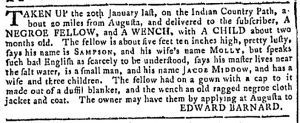
Slavery Advertisements Published July 19, 1769

The Slavery Adverts 250 Project chronicles the role of newspaper advertising in perpetuating slavery in the era of the American Revolution. The project seeks to reveal the ubiquity of slavery in eighteenth-century life from New England to Georgia by republishing advertisements for slaves – for sale, wanted to purchase, runaways, captured fugitives – in daily digests on this site as well as in real time via the @SlaveAdverts250 Twitter feed, utilizing twenty-first-century media to stand in for the print media of the eighteenth century.

The project aims to provide modern audiences with a sense of just how often colonists encountered these advertisements in their daily lives. Enslaved men, women, and children appeared in print somewhere in the colonies almost every single day. Those advertisements served as a constant backdrop for social, cultural, economic, and political life in colonial and revolutionary America. Colonists who did not own slaves were still confronted with slavery as well as invited to maintain the system by purchasing slaves or assisting in the capture of runaways. The frequency of these newspaper advertisements suggests just how embedded slavery was in colonial and revolutionary American culture in everyday interactions beyond the printed page.

These advertisements also testify to the experiences of enslaved men, women, and children, though readers must consider that those experiences have been remediated through descriptions offered by slaveholders rather than the slaves themselves. Often unnamed in the advertisements, enslaved men, women, and children were not invisible or unimportant in early America.

These advertisements appeared in colonial American newspapers 250 years ago today.

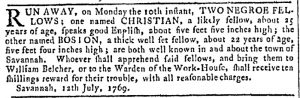
Jul 19 - Georgia Gazette Slavery 1
Georgia Gazette (July 19, 1769).

**********

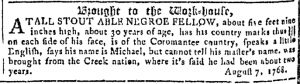
Jul 19 - Georgia Gazette Slavery 2
Georgia Gazette (July 19, 1769).

**********

Jul 19 - Georgia Gazette Slavery 3
Georgia Gazette (July 19, 1769).

**********

Jul 19 - Georgia Gazette Slavery 4
Georgia Gazette (July 19, 1769).

**********

Jul 19 - Georgia Gazette Slavery 5
Georgia Gazette (July 19, 1769).

**********

Jul 19 - Georgia Gazette Slavery 6
Georgia Gazette (July 19, 1769).

July 18

What was advertised in a colonial American newspaper 250 years ago today?

Jul 18 - 7:18:1769 Essex Gazette
Essex Gazette (July 18, 1769).

“John Prince HAS a Quantity of the best Isle of May SALT.”

The number of advertisements and the amount of space devoted to advertising varied significantly from newspaper to newspaper in colonial America. Some newspapers operated as delivery mechanisms for advertising, often giving as much or more space to paid notices than to news items, editorials, and other content. Other newspapers featured far less advertising on their pages.

Consider the Essex Gazette, published by Samuel Hall in Salem, Massachusetts. The July 18, 1769, edition included only four advertisements. Three ran at the bottom of the final column on the last page. John Prince hawked salt and wine, David Britton announced the sale of the late John Dampney’s real estate, and John Simnet promoted himself as a watchmaker of note. The fourth advertisement, a runaway notice concerning “an indented servant Lad, named Robert Kilby,” appeared near the bottom of the last column on the previous page, sandwiched between the shipping news from the customs house for the port of Salem and Marblehead and the shipping news from the customs house in Boston. Unlike the advertisements that filled the pages of many other newspapers, these had the appearance of filler that occupied the space necessary to complete the issue. In total, they accounted for less than a column of that issue.

Hall certainly did not operate the Essex Gazette on revenue generated from advertising, though many other colonial printers found selling advertising space more lucrative than selling subscriptions. In addition, Hall did not use one common method of cultivating advertising for his newspaper. Other printers concluded each issue with a call for advertisements (as well as subscriptions and news items) in the colophon. However, the colophon for the Essex Gazette failed to invite colonists to submit advertisements for the newspaper; instead, it focused on selling subscriptions, making clear that subscribers were expected to pay half in advance.

The masthead for the Essex Gazette proclaimed that it contained “the freshest Advices, both foreign and domestic.” Many other newspapers invoked the same claim in their own mastheads. For some, those “Advices” included advertisements. Legal notices updated readers on local events. Advertisements for consumer goods and services were indicators of both commerce and changing fashions. Notices about wives who “eloped” from their husbands told of marital strife among friends and neighbors. Advertisements about runaway servants or enslaved people who escaped bondage put the community on alert and drafted readers into providing surveillance on behalf of the advertiser. The Essex Gazette, however, featured far fewer advertisements. Instead of having some of the news filtered through the notices placed by fellow colonists, readers of the Essex Gazette encountered “Advices” selected almost exclusively by the editor.

July 17

What was advertised in a colonial American newspaper 250 years ago today?

Jul 17 - 7:17:1769 Newport Mercury
Newport Mercury (July 17, 1769).

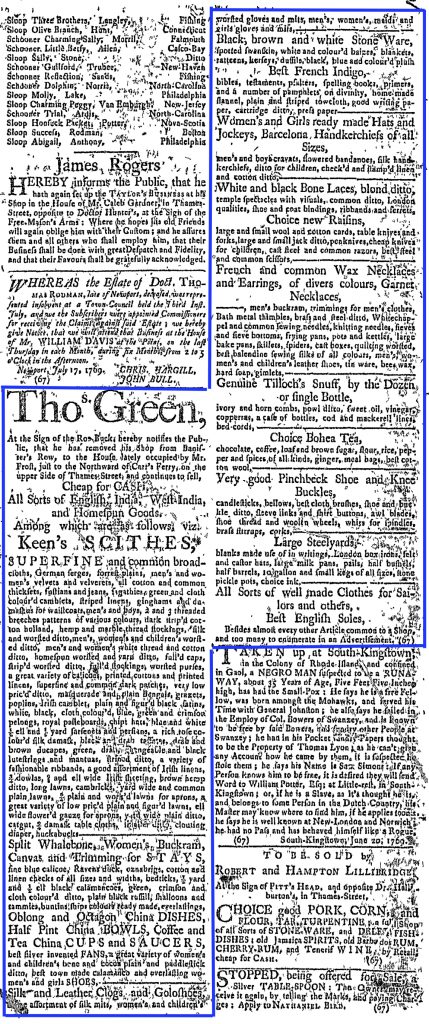
“Almost every other Article common to a Shop, and too many to enumerate in an Advertisement.”

Thomas Green inserted a lengthy advertisement for “All Sorts of English, India, West-India, and Homespun Goods” in the July 17, 1769, edition of the Newport Mercury. Although the advertisement listed hundred of items available at his shop at the Sign of the Roe Buck, Green concluded with a note that he also carried “almost every other Article common to a Shop, and too many to enumerate in an Advertisement.” Prospective customers could hardly have doubted that this shopkeeper offered choices to suit their own tastes.

Green did “enumerate” so many items that his advertisement extended more than a column, which was relatively rare even for the most extensive list-style advertisements of the period. At a glance, however, it may not have looked as dense and difficult to navigate as other advertisements. The compositor, likely with instructions from Green, devised a unique format that gave much of the advertisement the appearance of a series of shorter notices. Each section concluded with a line that ran across the remainder of the column, creating a visual effect similar to the lines that separated notices from each other. In addition each new section commenced with one or two lines in a larger font, similar to the format for the headers for other advertisements. This technique highlighted particular goods for sale while also breaking this advertisement into shorter segments that readers could more easily peruse.

Compare Green’s advertisement to another lengthy advertisement in the same issue of the Newport Mercury. Gideon Sisson sold similar merchandise at his shop on Thames Street. His advertisement fell a few lines shy of filling an entire column. Below the header, it featured only two sections of equal length, approximately half a column each. Many readers likely found the format imposing compared to the inviting layout of Green’s advertisement. Sisson required prospective customers to work harder when examining his inventory of goods.

Without close examination, many readers may have found it difficult to determine where Green’s advertisement ended. Encountering a series of shorter segments forced readers whose attention fixed on any particular section to scan backwards until they determined that it was part of Green’s lengthy advertisement. This exposed them to the rest of the advertisement, sometimes repeatedly if they happened to note more than one section of Green’s advertisement as they made their way through the newspaper. Such reiterative viewing would have introduced prospective customers to even more merchandise Green stocked at the Sign of the Roe Buck while simultaneously underscoring the extent of the choices he presented to consumers.

The format of Green’s advertisement played an important role in introducing prospective customers to his wares and increasing the likelihood that they took notice of his advertisement. Copy and layout played off each other to increase the effectiveness of both.

Slavery Advertisements Published July 17, 1769

The Slavery Adverts 250 Project chronicles the role of newspaper advertising in perpetuating slavery in the era of the American Revolution. The project seeks to reveal the ubiquity of slavery in eighteenth-century life from New England to Georgia by republishing advertisements for slaves – for sale, wanted to purchase, runaways, captured fugitives – in daily digests on this site as well as in real time via the @SlaveAdverts250 Twitter feed, utilizing twenty-first-century media to stand in for the print media of the eighteenth century.

The project aims to provide modern audiences with a sense of just how often colonists encountered these advertisements in their daily lives. Enslaved men, women, and children appeared in print somewhere in the colonies almost every single day. Those advertisements served as a constant backdrop for social, cultural, economic, and political life in colonial and revolutionary America. Colonists who did not own slaves were still confronted with slavery as well as invited to maintain the system by purchasing slaves or assisting in the capture of runaways. The frequency of these newspaper advertisements suggests just how embedded slavery was in colonial and revolutionary American culture in everyday interactions beyond the printed page.

These advertisements also testify to the experiences of enslaved men, women, and children, though readers must consider that those experiences have been remediated through descriptions offered by slaveholders rather than the slaves themselves. Often unnamed in the advertisements, enslaved men, women, and children were not invisible or unimportant in early America.

These advertisements appeared in colonial American newspapers 250 years ago today.

Jul 17 - Boston Evening-Post Slavery 1
Boston Evening-Post (July 17, 1769).

**********

Jul 17 - New-York Gazette Weekly Mercury Slavery 1
New-York Gazette and Weekly Mercury (July 17, 1769).

**********

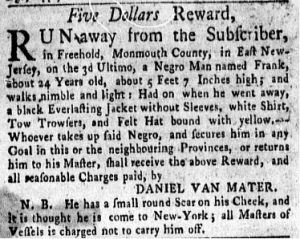
Jul 17 - New-York Gazette Weekly Mercury Slavery 2
New-York Gazette and Weekly Mercury (July 17, 1769).

**********

Jul 17 - New-York Gazette Weekly Mercury Slavery 3
New-York Gazette and Weekly Mercury (July 17, 1769).

**********

Jul 17 - New-York Gazette Weekly Mercury Slavery 4
New-York Gazette and Weekly Mercury (July 17, 1769).

**********

Jul 17 - New-York Gazette Weekly Mercury Slavery 5
New-York Gazette and Weekly Mercury (July 17, 1769).

**********

Jul 17 - New-York Gazette Weekly Mercury Slavery 6
New-York Gazette and Weekly Mercury (July 17, 1769).

**********

Jul 17 - New-York Gazette Weekly Post-Boy Slavery 1
New-York Gazette or Weekly Post-Boy (July 17, 1769).

**********

Jul 17 - Newport Mercury Slavery 1
Newport Mercury (July 17, 1769).

**********

Jul 17 - Newport Mercury Slavery 2
Newport Mercury (July 17, 1769).

**********

Jul 17 - Pennsylvania Chronicle Slavery 1
Pennsylvania Chronicle (July 17, 1769).

**********

Jul 17 - Pennsylvania Chronicle Slavery 2
Pennsylvania Chronicle (July 17, 1769).

**********

Jul 17 - Pennsylvania Chronicle Slavery 3
Pennsylvania Chronicle (July 17, 1769).

**********

Jul 17 - Pennsylvania Chronicle Slavery 4
Pennsylvania Chronicle (July 17, 1769).

**********

Jul 17 - Pennsylvania Chronicle Slavery 5
Pennsylvania Chronicle (July 17, 1769).

**********

Jul 17 - South-Carolina and American General Gazette Slavery 1
South-Carolina and American General Gazette (July 17, 1769).

**********

Jul 17 - South-Carolina and American General Gazette Slavery 2
South-Carolina and American General Gazette (July 17, 1769).

**********

Jul 17 - South-Carolina and American General Gazette Slavery 3
South-Carolina and American General Gazette (July 17, 1769).

**********

Jul 17 - South-Carolina and American General Gazette Slavery 4
South-Carolina and American General Gazette (July 17, 1769).

**********

Jul 17 - South-Carolina and American General Gazette Slavery 5
South-Carolina and American General Gazette (July 17, 1769).

**********

Jul 17 - South-Carolina and American General Gazette Slavery 6
South-Carolina and American General Gazette (July 17, 1769).

July 16

What was advertised in a colonial American newspaper 250 years ago this week?

Jul 16 - 7:13:1769 Massachusetts Gazette Draper
Massachusetts Gazette [Draper] (July 13, 1769).
Confectioner and Distiller from London.”

In the summer of 1769 Peter Lorent, a confectioner and distiller, provided a variety of sweet treats to the residents of Boston. In addition to “Cakes of all kind,” he made and sold macaroons, sugar plums, candied fruits, syrups, and cordials.

As part of his marketing efforts, Lorent underscored the quality of his confections. He introduced himself to prospective customers as a “Confectioner and Distiller from London,” hoping readers would associate him with his counterparts in the most cosmopolitan city in the empire. Advertisers from many occupations, especially artisans and doctors, frequently deployed this strategy, implying that their origins testified to skills and expertise gained from training or employment on the other side of the Atlantic. They also prompted consumers to imbue their goods or services with the cachet of having been acquired from a purveyor “from London.” Advertisers like Lorent invoked their origins as a means of asserting status; they suggested that customers could demonstrate and enhance their own status by making purchases from the right providers of goods and services.

Lorent helped consumers reach the intended conclusions about the cakes, candies, and cordials they could acquire from a confectioner “from London.” He trumpeted that he made all of his treats “in as great Perfection as in Europe” and underscored that he had the requisite exposure to make that claim since he previously “worked in England, France, and Italy.” Lorent aimed to impress prospective customers with his experience that ranged beyond England to other countries often associated with taste and fashion. He also attempted to ease their anxieties about residing far from the center of the empire. Residents of Boston did not need to worry that they lived in a provincial backwater, not when they could consumer confections as fine as those enjoyed by the genteel ladies and gentlemen of London.

July 15

What was advertised in a colonial American newspaper 250 years ago today?

Jul 15 - 7:15:1769 Providence Gazette
Providence Gazette (July 15, 1769).

“All Manner of PRINTING-WORK is performed on reasonable Terms.”

The colophons that appeared on the final pages of colonial newspapers ranged from simple to elaborate. Consider the colophons for newspapers published in July 1769. The colophon for the New-London Gazette, for instance, briefly stated, “Printed by TIMOTHY GREEN.” Similarly, the colophon for the Boston Evening-Post succinctly informed readers of the printers and place of publication: “BOSTON: Printed by T. and J. FLEET.” Yet the colophons for other newspapers filled several lines and provided much more information about the business of printing in early America, as seen in these examples:

Boston Chronicle:BOSTON: PRINTED every MONDAY and THURSDAY, (Price only SIX SHILLINGS and EIGHT PENCE Lawful, per Annum) by MEIN and FLEEMING, at their PRINTING-OFFICE in Newbury-Street, where, and at the LONDON BOOK-STORE North-side of King-Street, Subscriptions[,] ADVERTISEMENTS, ARTICLES and LETTERS OF INTELLIGENCE, are gratefully received.—All Manner PRINTING Work performed at the most reasonable Rates.”

Essex Gazette:SALEM: Printed by Samuel Hall, at his Printing-Office a few Doors above the Town-House; where Subscriptions for this GAZETTE, at Six Shillings and Eight Pence per Annum, are taken in;–3s. 4d. to be paid at Entrance.”

Georgia Gazette: “SAVANNAH: Printed by JAMES JOHNSTON, at the Printing-Office in Broughton-Street, where Advertisements, Letters of Intelligence and Subscriptions for this Paper, are taken in.—Hand-Bills, Advertisements, &c. printed at the shortest Notice.”

Newport Mercury: “NEWPORT, RHODE-ISLAND: Printed by SOLOMON SOUTHWICK, in Marlborough-Street, at the Third House below the Gaol: Where may be had all Kinds of BLANKS commonly used in this Colony.”

New-York Chronicle: “NEW-YORK: Printed by ALEXANDER and JAMES ROBERTSON, at the Corner of Beaver-Street, nearly opposite General GAGE’S, where all Sorts of Printing Work is done in the neatest Manner, with Care and Expedition. Advertisements of no more Length and breadth are inserted for Five Shillings, four Weeks, and One Shilling for each Week after, and larger Advertisements in the same Proportion.”

New-York Gazette or Weekly Post-Boy:NEW-YORK: Printed by JAMES PARKER, at the NEW PRINTING-OFFICE in Beaver-Street, where Subscriptions, and Advertisements, &c. for this Paper are Taken in.”

New-York Journal: “NEW-YORK: Printed by JOHN HOLT, at the Printing-Office near the Exchange, in Broad-Street, where all Sorts of Printing Work is done in the neatest Manner, with Care and Expedition. Advertisements of no more Length than Breadth are inserted for Five Shillings, four Weeks, and One Shilling for each Week after, and larger Advertisements in the same Proportion.”

Pennsylvania Chronicle:PHILADELPHIA: Printed by WILLIAM GODDARD, at the NEW PRINTING-OFFICE in Market-Street, near the Post-Office, and opposite Mr. John Wister’s, where Subscriptions, (at TEN SHILLINGS per Annum)[,] Advertisements, Articles and Letters of Intelligence are gratefully received for this Paper, and where all Manner of Printing Work is performed with Care, Fidelity and Expedition.—Blanks and Hand-Bills in particular are done on the shortest Notice, in a neat, correct and conspicuous Manner.”

Providence Gazette:PROVIDENCE, in New-England: Printed by JOHN CARTER, at his PRINTING-OFFICE, the Sign of Shakespear’s Head; where Subscriptions, Advertisements, Articles and Letters of Intelligence, &c. are received for this Paper, and where all Manner of PRINTING-WORK is performed on reasonable Terms, in a neat and correct Manner with Fidelity and Expedition.”

Virginia Gazette: “WILLIAMSBURG: Printed by WILLIAM RIND, at the NEW PRINTING-OFFICE on the Main-Street. All Persons may be supplied with this GAZETTE at 12s 6 per Year. ADVERTISEMENTS of a moderate Length are inserted for 3s. the First Week, and 2s. each Time after: And long ones in Proportion.”

These ten colophons did more than record the printer and place of publication for their respective newspapers. Some of them specified subscription rates while others set advertising rates. Some called on readers to become subscribers or submit items for publication. Some promoted goods and services available at the printing office, including printing advertisements in other formats (like handbills and broadsides). In each case, the colophon appeared on the final page of their newspaper, running across all the columns, just as a masthead appeared on the first page and ran across all the columns. Each of these colophons served as an advertisement for the printer and the newspaper at the end of an edition. No matter how many advertisements an issue of any of these newspapers carried, it concluded with the printer promoting his own business to subscribers and other readers.

Slavery Advertisements Published July 15, 1769

The Slavery Adverts 250 Project chronicles the role of newspaper advertising in perpetuating slavery in the era of the American Revolution. The project seeks to reveal the ubiquity of slavery in eighteenth-century life from New England to Georgia by republishing advertisements for slaves – for sale, wanted to purchase, runaways, captured fugitives – in daily digests on this site as well as in real time via the @SlaveAdverts250 Twitter feed, utilizing twenty-first-century media to stand in for the print media of the eighteenth century.

The project aims to provide modern audiences with a sense of just how often colonists encountered these advertisements in their daily lives. Enslaved men, women, and children appeared in print somewhere in the colonies almost every single day. Those advertisements served as a constant backdrop for social, cultural, economic, and political life in colonial and revolutionary America. Colonists who did not own slaves were still confronted with slavery as well as invited to maintain the system by purchasing slaves or assisting in the capture of runaways. The frequency of these newspaper advertisements suggests just how embedded slavery was in colonial and revolutionary American culture in everyday interactions beyond the printed page.

These advertisements also testify to the experiences of enslaved men, women, and children, though readers must consider that those experiences have been remediated through descriptions offered by slaveholders rather than the slaves themselves. Often unnamed in the advertisements, enslaved men, women, and children were not invisible or unimportant in early America.

These advertisements appeared in colonial American newspapers 250 years ago today.

Jul 15 - Providence Gazette Slavery 1
Providence Gazette (July 15, 1769).

July 14

What was advertised in a colonial American newspaper 250 years ago today?

Jul 14 - New-Hampshire Gazette Jul 14
New-Hampshire Gazette (July 14, 1769).

“Finisher to Mr. GRAY and Mr. ELLICOT, WATCH-MAKERS to his late and present MAJESTY.”

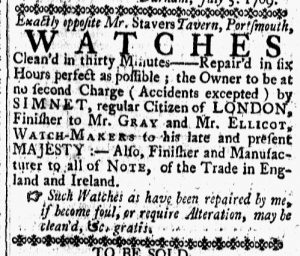
John Simnet was an industrious advertiser, perhaps in part due to competition with a rival watchmaker in Portsmouth, New Hampshire. Their competition descended into a feud that took place via their advertisements in the public prints in 1769. Simnet regularly published new advertisements rather than instructing the printers of the New-Hampshire Gazette to once again insert notices that previously appeared in the pages of their newspaper. As a result, the copy in Simnet’s advertisements featured greater variation than readers encountered in notices placed by others who regularly advertised consumer goods and services. His new advertisements often contained variations on appeals he previously presented to prospective clients and new information intended to entice those not yet convinced by what they already knew about the watchmaker and his business.

Such was the case for an advertisement in the July 14, 1769, edition of the New-Hampshire Gazette. Simnet reiterated a promise that he had previously presented: “Such Watches as have been repaired by me, if become foul, or require Alteration, may be clean’d, &c. gratis.” In other words, Simnet offered a guarantee for his work and pledged free service and maintenance if he did not manage to completely fix the problem the first time. As for new appeals to prospective clients, the watchmaker emphasized convenience by providing a timetable for his services: “WATCHES Clean’d in thirty Minutes—Repair’d in six Hours.” Customers did not even need to part with their watches overnight. That same week he announced this timetable in an advertisement in the Essex Gazette, but he had not previously discussed the amount of time necessary to make repairs except to state that he did his work “expeditiously.” Finally, Simnet expanded on an appeal that he deployed in earlier advertisements. He had noted his twenty-five years of experience in London, but in his newest advertisement he associated himself with prominent watchmakers, declaring that he had worked as “Finisher and Manufacturer to all of NOTE” in the watchmaking trade in England and Ireland. Most significantly, Simnet proclaimed that he had previously been employed as “Finisher to Mr. GRAY and Mr. ELLICOT, WATCH-MAKERS to his late and present MAJESTY.” He had worked on watches for George II and George III. Simnet did not name his local rival in this advertisement, but the competition almost certainly could not claim to have served such eminent clients! Supplying this additional information enhanced the reputation Simnet cultivated throughout his advertising campaign.

July 13

What was advertised in a colonial American newspaper 250 years ago today?

Jul 13 - 7:13:1769 Pennsylvania Gazette
Pennsylvania Gazette (July 13, 1769).

“At Mr. JOSEPH SOLOMAN’S … in Lancaster, by the appointment of Mr. HAMILTON, Surgeon Dentist.”

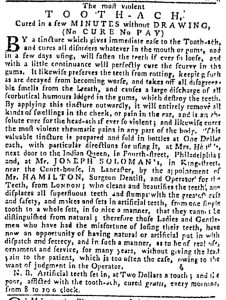
At the same time that advertisements for Mr. Hamilton’s amazing tincture for curing toothaches and other maladies ran in multiple newspapers in New York in July 1769, it also appeared in the Pennsylvania Gazette, a newspaper published in Philadelphia with circulation far beyond that city. The copy in the Pennsylvania Gazette matched the New York advertisements almost exactly – including the guarantee of “No CURE No PAY” – except for instructions about where customers could acquire the tincture for themselves. Readers of newspapers printed in New York were directed to “Mrs. Buskirk’s, the corner of Wall-Street, near the Coffe-house,” where they could consult directly with Mr. Hamilton, “Surgeon Dentists and Operator for the Teeth from LONDON.” The variant in the Pennsylvania Gazette, on the other hand, gave directions to local agents in Pennsylvania. Readers could purchase the tincture “at Mrs. [illegible], next door to the Indian Queen, in Fourth-street, Philadelphia; and, at Mr. JOSEPH SOLOMAN’s, in King-street, near the Court-house, in Lancaster.” Purveyors of the tincture in Pennsylvania stocked and sold it “by the appointment of Mr. HAMILTON.”

Inserting advertisements in all of the newspapers published in New York was ambitious on its own, but designating local agents and branching out to yet another newspaper in another colony was even more innovative. In eighteenth-century America, most providers of goods and services confined their marketing efforts to newspapers that served their own city or town. Printers and publishers were an important exception; they frequently placed subscription notices in newspapers throughout the colonies to gauge the market and generate sufficient interest to move forward with printing a book, magazine, or other publication. This involved designating local agents to receive subscriptions, collect payment, and distribute publications after they went to press, but those agents were usually fellow printers who already participated in networks for exchanging newspapers and information. Still, this was a model that need not work for printers exclusively. Hamilton experimented with designating local agents in Philadelphia and Lancaster as a means of enlarging the market for his tincture.

Doing so required prospective customers to place trust in the local agents in addition to Hamilton, especially when it came to the “No CURE No PAY” guarantee. Clients in New York used the tincture under the direction of Hamilton and could appeal to him directly if the medicine did not produce the desired effect. Clients in Philadelphia and Lancaster, in contrast, had to depend on fair dealing by local agents who may not have possessed Hamilton’s experience or expertise. After all, the advertisement described Hamilton as a “Surgeon Dentist,” but did not indicate the occupations of his local agents in Pennsylvania. Other portions of the advertisement may have alleviated some concerns by presenting a portrait of Hamilton’s character. In addition to describing Hamilton’s tincture, the advertisement provided an overview of the services he provided in New York. Hamilton “cleans and beautifies teeth” and “makes and sets in artificial teeth.” He served his clients “with dispatch and secrecy.” The advertisement concluded with a nota bene that depicted Hamilton as a humanitarian: “the poor, afflicted with the tooth-ach, cured gratis, every morning, from 8 to 10 o clock.” Was such information about Hamilton’s practice in New York superfluous in an advertisement placed in the Pennsylvania Gazette? Readers in Philadelphia and, especially, Lancaster were unlikely to travel to New York to have Hamilton clean their teeth or fit them with artificial teeth. The poor were even less likely to make such a journey. Hamilton could have reduced the costs of advertising in the Pennsylvania Gazette if he had eliminated that portion of the advertisement, yet that information was not superfluous. It testified to Hamilton’s competence and professional demeanor, allowing him to cultivate a reputation that might have made faraway readers more inclined to trust his description of his toothache tincture and, in turn, deal with local agents who sold it on his behalf.