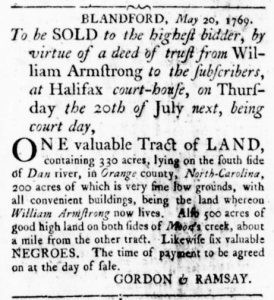
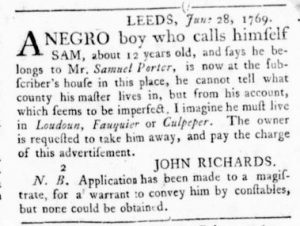
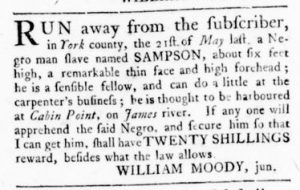
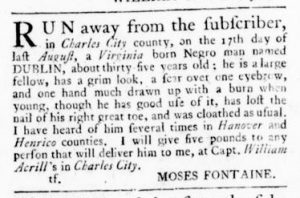
The Slavery Adverts 250 Project chronicles the role of newspaper advertising in perpetuating slavery in the era of the American Revolution. The project seeks to reveal the ubiquity of slavery in eighteenth-century life from New England to Georgia by republishing advertisements for slaves – for sale, wanted to purchase, runaways, captured fugitives – in daily digests on this site as well as in real time via the @SlaveAdverts250 Twitter feed, utilizing twenty-first-century media to stand in for the print media of the eighteenth century.
The project aims to provide modern audiences with a sense of just how often colonists encountered these advertisements in their daily lives. Enslaved men, women, and children appeared in print somewhere in the colonies almost every single day. Those advertisements served as a constant backdrop for social, cultural, economic, and political life in colonial and revolutionary America. Colonists who did not own slaves were still confronted with slavery as well as invited to maintain the system by purchasing slaves or assisting in the capture of runaways. The frequency of these newspaper advertisements suggests just how embedded slavery was in colonial and revolutionary American culture in everyday interactions beyond the printed page.
These advertisements also testify to the experiences of enslaved men, women, and children, though readers must consider that those experiences have been remediated through descriptions offered by slaveholders rather than the slaves themselves. Often unnamed in the advertisements, enslaved men, women, and children were not invisible or unimportant in early America.
These advertisements appeared in colonial American newspapers 250 years ago today.
What was advertised in a colonial American newspaper 250 years ago today?
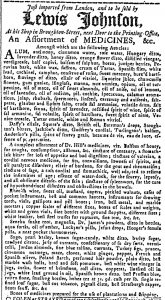
Georgia Gazette (July 12, 1769).
“Boxes of medicines prepared for the use of plantations and shipping.”
Lewis Johnson peddled an “Assortment of MEDICINES” at his shop in Savannah. He carried familiar patent medicines, such as Daffy’s elixir, Bateman’s drops, Stoughton’s bitters, Godfrey’s cordial, Turlington’s balsam, Anderson’s pills, and a “compleat assortment of Dr. Hill’s medicines.” His inventory of patent medicines rivaled what customers could expect to find in apothecary shops in larger cities on both sides of the Atlantic. In addition to those remedies, Johnson carried a variety of supplies for compounding other remedies according to the wishes of the customer or the instructions of a doctor or healer. He also stocked medical equipment, such as lancets, vials, mortars, and weights and scales.
To facilitate sales, Johnson concluded his advertisement with a service available to patrons: “Boxes of medicines prepared for the use of plantations and shipping.” In other words, Johnson produced the eighteenth-century equivalent of the modern first aid kit. He identified prospective customers likely to have particular need of a several medicines for treating a variety of ailments packaged in advance. Johnson’s boxes saved plantation owners and overseers located some distance from Savannah the trouble of sending for remedies every time they had need. For vessels at sea, having a supply of medicines on hand was imperative since they could be weeks from port and unable to acquire new supplies in the meantime. This method also allowed Johnson to boost his sales by bundling together items based on possible need at some future moment rather than certain need at the time of purchase.
For some customers, these “Boxes of medicines” were practically a necessity; for others they were a convenience. In both cases, Johnson did more than merely sell goods to consumers. He offered a service that enhanced the value of his wares. That service required him to contribute his own knowledge of medicines and their effects in selecting or recommending items to include in the boxes. Beyond the medicines and other supplies, Johnson’s expertise was an important component of the boxes he prepared for customers.
The Slavery Adverts 250 Project chronicles the role of newspaper advertising in perpetuating slavery in the era of the American Revolution. The project seeks to reveal the ubiquity of slavery in eighteenth-century life from New England to Georgia by republishing advertisements for slaves – for sale, wanted to purchase, runaways, captured fugitives – in daily digests on this site as well as in real time via the @SlaveAdverts250 Twitter feed, utilizing twenty-first-century media to stand in for the print media of the eighteenth century.
The project aims to provide modern audiences with a sense of just how often colonists encountered these advertisements in their daily lives. Enslaved men, women, and children appeared in print somewhere in the colonies almost every single day. Those advertisements served as a constant backdrop for social, cultural, economic, and political life in colonial and revolutionary America. Colonists who did not own slaves were still confronted with slavery as well as invited to maintain the system by purchasing slaves or assisting in the capture of runaways. The frequency of these newspaper advertisements suggests just how embedded slavery was in colonial and revolutionary American culture in everyday interactions beyond the printed page.
These advertisements also testify to the experiences of enslaved men, women, and children, though readers must consider that those experiences have been remediated through descriptions offered by slaveholders rather than the slaves themselves. Often unnamed in the advertisements, enslaved men, women, and children were not invisible or unimportant in early America.
These advertisements appeared in colonial American newspapers 250 years ago today.
What was advertised in a colonial American newspaper 250 years ago today?
Essex Gazette (July 11, 1769).
“WATCHES CLEANED in 30 Minutes.”
John Simnet, a watchmaker from London, made his presence in Portsmouth known in 1769 with a series of advertisements in the New-Hampshire Gazette. Initially he inserted notices with the intention of cultivating his clientele, but over the course of several months he found himself engaged in a public feud with Nathaniel Sheaff Griffith, a local watchmaker who took exception to Simnet intruding in his territory. For the most part, Simnet confined his advertisements to the New-Hampshire Gazette, though shortly after his arrival in New England he had placed one notice in the Boston Weekly News-Letter in an attempt to draw on that market. To that end, he offered to “pay the Carriage to and fro” for clients in Boston who sent their watches to him in Portsmouth via “Mr. Noble’s Stage.” In the summer of 1769, Simnet made another attempt to enlarge his market by placing an advertisement in the Essex Gazette.
Simnet advanced many of the same appeals that he had consistently deployed in his previous notices, but he also supplied new information for prospective customers. To establish his credentials, he proclaimed that he previously worked as “Finisher to Mr. Tompion, Graham, Storey, Toulmin; and every other Maker (of Note) in London.” Simnet had not previously mentioned the names of his former associates, only noted that he had followed his occupation in London for some time before migrating to New England. He likely did not expect colonists to recognize all of the watchmakers he listed, but did intend to impress them with the assertion that he had worked alongside and been entrusted by the most prominent watchmakers in the most cosmopolitan city in the empire. As a newcomer in New England, Simnet was largely unfamiliar to his prospective customers, making it all the more necessary to convince them of the reputation he had previously established in London.
In addition, Simnett made several other appeals. He promised convenience and quality, pledging to clean watches in thirty minutes and “perfectly” repair them in six hours. Prospective customers would not have to part with their watches for days or weeks while he worked on them. He set prices that matched those charged in London, but also offered a guarantee. When he promised “no future Expence (Accidents excepted),” prospective customers understood that he would perform further repairs for free if he did not successfully fix watches the first time. This deal, however, applied only to recurring problems that Simnet did not manage to resolve, not to new issues caused by “Accidents” or wear and tear. Finally, Simnet declared, “Security deposited in Hand for Watches, if required.” In other words, he provided collateral of some sort when customers entrusted him with their watches. This had not been part of Simnet’s first advertisements, but after his rival Griffith accused him of stealing watches Simnet began incorporating such assurances into his marketing efforts.
In a short advertisement, Simnet advanced multiple appeals to convince prospective customers to hire him to clean and repair their watches. He underscored his own skill and experience by trumpeting the names of prominent watchmakers in London who had previously employed him. He also emphasized convenience, quality, and price while offering two types of guarantees. For the first, he made additional repairs for free if his initial efforts were not successful. For the second, he supplied collateral when accepting watches for repair. Simnet included some of the most common appeals that appeared in advertisement placed by artisans in eighteenth-century America, yet he also adapted his notice to address his own recent experiences with a rival who attempted to undermine his business.
What was advertised in a colonial American newspaper 250 years ago today?
New-York Gazette or Weekly Post-Boy (July 10, 1769).
“No CURE No PAY.”
As part of his marketing efforts, Mr. Hamilton, “Surgeon Dentist and Operator for the Teeth, from LONDON,” offered prospective patients a guarantee: “No CURE No PAY.” If his tincture for toothaches did not yield the desired results by relieving the pain in just a few minutes then clients did not have to pay for Hamilton’s services. Colonial consumers were rightfully suspicious of quack doctors and remedies that seemed too good to be true, so Hamilton made a pitch intended to help prospective patients overcome their skepticism and give his tincture a chance, figuring that they did not lose anything if it did not work.
Given Hamilton’s description of his tincture and its effects, leading with the guarantee was probably a smart move. It did sound too good to be true. In addition to curing toothaches without drawing (or pulling) teeth it also “cures all disorders whatever in the mouth or gums.” For instance, after just a few applications the tincture “will fasten the teeth if ever so loose.” Hamilton also proclaimed that his tincture “will perfectly cure the scurvy in the gums” as well as prevent teeth from rotting, preserve “such as are decayed from becoming worse,” and eliminate “disagreeable smells from the breath.” But wait, there’s more! Hamilton’s amazing tincture did mote than relieve maladies of the mouth. When applied elsewhere, it had the power to “entirely remove all kinds of swellings in the cheek or pain in the ear.” It could cure violent headaches as well as “the most violent rheumatic pains in any part of the body.” Hamilton drew in patients with the promise of relieving toothaches. His guarantee covered only that service, but it opened the door for promoting his tincture for other uses. It very well could have included an ingredient that provided temporarily relief for toothaches, giving Hamilton an opportunity to make a hard sell to patients. For just “One Dollar each,” consumers could purchase Hamilton’s “valuable tincture.” If it relieved toothaches, even if only temporarily, then why not acquire a bottle to experiment with other ailments?
Hamilton went all in with this marketing strategy. In July 1769, he inserted identical advertisements trumpeting “No CURE No PAY” in all the newspapers published in New York, the New-York Chronicle, the New-York Gazette and Weekly Mercury, the New-York Gazette or Weekly Post-Boy, and the New-York Journal. Colonists who read more than one newspaper could hardly avoid Hamilton’s advertisements. Increased exposure to his promise of “No CURE No PAY” may have also played a role in convincing some prospective patients to give his tincture a try.
The Slavery Adverts 250 Project chronicles the role of newspaper advertising in perpetuating slavery in the era of the American Revolution. The project seeks to reveal the ubiquity of slavery in eighteenth-century life from New England to Georgia by republishing advertisements for slaves – for sale, wanted to purchase, runaways, captured fugitives – in daily digests on this site as well as in real time via the @SlaveAdverts250 Twitter feed, utilizing twenty-first-century media to stand in for the print media of the eighteenth century.
The project aims to provide modern audiences with a sense of just how often colonists encountered these advertisements in their daily lives. Enslaved men, women, and children appeared in print somewhere in the colonies almost every single day. Those advertisements served as a constant backdrop for social, cultural, economic, and political life in colonial and revolutionary America. Colonists who did not own slaves were still confronted with slavery as well as invited to maintain the system by purchasing slaves or assisting in the capture of runaways. The frequency of these newspaper advertisements suggests just how embedded slavery was in colonial and revolutionary American culture in everyday interactions beyond the printed page.
These advertisements also testify to the experiences of enslaved men, women, and children, though readers must consider that those experiences have been remediated through descriptions offered by slaveholders rather than the slaves themselves. Often unnamed in the advertisements, enslaved men, women, and children were not invisible or unimportant in early America.
These advertisements appeared in colonial American newspapers 250 years ago today.
Boston Evening-Post (July 10, 1769).
**********
Boston Post-Boy (July 10, 1769).
**********
Connecticut Courant (July 10, 1769).
**********
New-York Gazette and Weekly Mercury (July 10, 1769).
**********
New-York Gazette and Weekly Mercury (July 10, 1769).
**********
New-York Gazette and Weekly Mercury (July 10, 1769).
**********
New-York Gazette and Weekly Mercury (July 10, 1769).
**********
New-York Gazette or Weekly Post-Boy (July 10, 1769).
**********
Newport Mercury (July 10, 1769).
**********
Newport Mercury (July 10, 1769).
**********
Newport Mercury (July 10, 1769).
**********
Pennsylvania Chronicle (July 10, 1769).
**********
Pennsylvania Chronicle (July 10, 1769).
**********
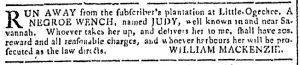
South-Carolina and American General Gazette (July 10, 1769).
**********
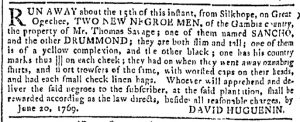
South-Carolina and American General Gazette (July 10, 1769).
**********
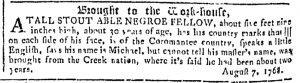
South-Carolina and American General Gazette (July 10, 1769).
**********
South-Carolina and American General Gazette (July 10, 1769).
**********
South-Carolina and American General Gazette (July 10, 1769).
What was advertised in a colonial American newspaper 250 years ago this week?
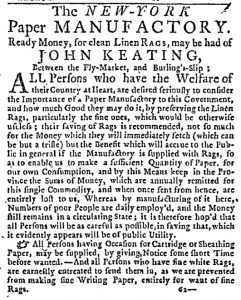
New-York Journal (July 6, 1769).
“Ready Money, for clean Linen RAGS.”
By the first week of July in 1769, John Keating’s advertisement for the “NEW-YORK Paper MANUFACTORY” became a familiar sight in the New-York Journal. Keating called on colonists, especially “ALL Persons who have the Welfare of their Country at Heart,” to collect clean linen rags and turn them over to the paper manufactory to be made into paper. He offered “Ready Money” for rags, but encouraged readers to deliver rags “not so much for the Money they will immediately fetch” but instead for “the Benefit which will accrue to the Public in general” if the manufactory received enough rags “to make a sufficient Quantity of Paper, for our own Consumption.”
This was particularly important in the late 1760s because the Townshend Acts levied duties on imported paper. As part of their resistance efforts, colonists boycotted a vast array of imported goods, not just those subject to the new taxes, and encouraged “domestic manufactures” or local production as an alternate means of acquiring goods while simultaneously bolstering the colonial economy. Keating argued that consumers who purchased paper from the New-York Paper Manufactory kept “Sums of Money” in the colony that were otherwise “annually remitted” across the Atlantic. Furthermore, the manufactory employed “Numbers of poor People” who kept that money “in a circulating State” in the colony, rather than lost to merchants, manufacturers, and Parliament in Britain. Keating deployed a “Buy American” campaign during the imperial crisis, before thirteen colonies declared independence.
In its most recent iteration, Keating’s advertisement appeared in the New-York Journal at least once a month since its first insertion on February 9, 1769. It also ran on February 16, March 23, April 20, May 18, June 8, and July 6. This copy for this iteration, for the most part, replicated a similar advertisement that ran in the summer of 1768. Over the course of a year, Keating was consistent in the message he communicated to colonists, encouraging them to participate in both the production and consumption of paper from the New-York Paper Manufactory.
The sporadic appearance of his advertisement in the New-York Journal raises questions about the arrangements Keating made with John Holt, the newspaper’s printer. Holt and others who worked at his printing office kept the type set over the course of several months, intending to insert the advertisement repeatedly. It ran once a month, but not on a regular schedule, such as in the first issue of the month. Did it appear when Keating ran low on rags and instructed Holt to run the advertisement once again in hopes of obtaining the materials he needed to operate his business? Did Holt insert Keating’s advertisement when running low on other content and needing to fill space? Did the two offer in-kind services to each other, such a supply of paper in exchange for advertising? Did Holt charge reduced advertising rates for Keating? After all, as a printer, Holt had a particular interest in having access to paper that may have prompted him to cultivate a relationship with the proprietor of the New-York Paper Manufactory.
By itself, any insertion of Keating’s advertisement tells a story of politics and the production and consumption of paper when colonists answered the Townshend Acts with nonimportation agreements. The repeated insertion of the advertisement, however, hints at another story about the business practices at both the New-York Journal and the New-York Paper Manufactory. Ledgers and correspondence, if they still exist, might shed more light on Keating’s advertising campaign. Without additional sources, the sporadic yet frequent insertion of the same advertisement for the New-York Paper Manufactory in the New-York Journal over the course of several months testifies to a message regularly communicated to readers while obscuring some of the decisions made by both the printer and the paper manufacturer in the process of presenting arguments in favor of supporting this local enterprise.
What was advertised in a colonial American newspaper 250 years ago today?
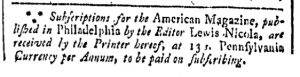
Providence Gazette (July 8, 1769).
“Subscriptions for the American Magazine, published in Philadelphia.”
On behalf of Lewis Nicola, the editor of the American Magazine, John Carter inserted a brief advertisement in the July 8, 1769, edition of the Providence Gazette. In just four lines, it advised readers in Rhode Island that “Subscriptions for the American Magazine, published in Philadelphia by the Editor Lewis Nicola, are received by the Printer hereof, at 13 s. Pennsylvania Currency per Annum, to be paid on subscribing.” This notice was much less extensive than some that appeared in other newspapers. An advertisement that ran in the New-York Journal almost two months earlier informed prospective subscribers of the length of each issue and promised a title page and index with the final edition for the year. Another much more extensive advertisement appeared in Richard Draper’s Massachusetts Gazette at the end of May. It described magazines as “the Taste of the Age” and provided an overview of the publication’s purpose and contents. The editor aimed “To instruct, and innocently amuse” readers. The magazine served as “a Repository for the many small, tho’ valuable Pieces that would otherwise be lost to the World.”
Though vastly different in length and content, these advertisements provide an example of the networks that members of the book trades established in eighteenth-century America. Realizing that local markets alone would not sustain some of their enterprises, printers and publishers banded together, sometimes formally but often informally, to assist each other. This included exchanging newspapers and then liberally reprinting content from one to another, but disseminating information was not the extent of the work accomplished by these networks. Note that Carter, the printer of the Providence Gazette, served as a local agent for Nicola in Providence, as did Draper, the printer of the Massachusetts Gazette, in Boston, and John Holt, the printer of the New-York Journal, in New York. These printers did not merely publish Nicola’s advertisement; they also informed him of the subscribers in their cities, collected subscription fees, and likely aided in the distribution of the American Magazine.
Publishing books, magazines, and other printed materials in eighteenth-century America often depended on these networks of cooperation among members of the book trades, especially printers and publishers. Sometimes such networks played a significant role in the success of an endeavor; other times, they were not enough to overcome other factors that ultimately led to the failure of publications. Nicola’s American Magazine ceased publication within three months of the advertisement in the Providence Gazette. Yet his efforts provided an important marketing model that other magazine publishers successfully deployed after the American Revolution.
The Slavery Adverts 250 Project chronicles the role of newspaper advertising in perpetuating slavery in the era of the American Revolution. The project seeks to reveal the ubiquity of slavery in eighteenth-century life from New England to Georgia by republishing advertisements for slaves – for sale, wanted to purchase, runaways, captured fugitives – in daily digests on this site as well as in real time via the @SlaveAdverts250 Twitter feed, utilizing twenty-first-century media to stand in for the print media of the eighteenth century.
The project aims to provide modern audiences with a sense of just how often colonists encountered these advertisements in their daily lives. Enslaved men, women, and children appeared in print somewhere in the colonies almost every single day. Those advertisements served as a constant backdrop for social, cultural, economic, and political life in colonial and revolutionary America. Colonists who did not own slaves were still confronted with slavery as well as invited to maintain the system by purchasing slaves or assisting in the capture of runaways. The frequency of these newspaper advertisements suggests just how embedded slavery was in colonial and revolutionary American culture in everyday interactions beyond the printed page.
These advertisements also testify to the experiences of enslaved men, women, and children, though readers must consider that those experiences have been remediated through descriptions offered by slaveholders rather than the slaves themselves. Often unnamed in the advertisements, enslaved men, women, and children were not invisible or unimportant in early America.
These advertisements appeared in colonial American newspapers 250 years ago today.
What was advertised in a colonial American newspaper 250 years ago today?
Connecticut Journal (July 7, 1769).
“Hugh Glassford … now carries on his Business, at Glen and Gregory’s.”
Moving to a new location prompted Hugh Glassford, a leather breeches and glove maker in New Haven, to place an advertisement in the Connecticut Journal in the summer of 1769. Glassford stated that he resided with Mr. Beers for the past year, but he “now carries on his Business, at Glen and Gregory’s.” He reported that he served customers “much to their Satisfaction” at his former location, suggesting that he would offer the same quality of service at his new location. It does not appear that Glassford inserted an advertisement in the local newspaper when he first arrived in New Haven. He likely engaged customers via word of mouth. After building a clientele for his leather breeches and gloves and cultivating a reputation in the town and beyond, however, he likely considered an advertisement worth the investment. Advising the public of his new location would help Glassford retain current customers as well as encourage new ones to seek out his services.
To quickly discover if Glassford had previously advertised, I did a keyword for his last name in all 2752 issues of the Connecticut Journal, spanning dates from October 23, 1767 to December 26, 1820, available in America’s Historical Newspapers database. That search yielded zero results, but that did not surprise me since I had searched for the breeches and glove maker’s name as I read it – Glassford – rather than as optical character recognition software would interpret it – Glafsford. As a person with experience working with eighteenth-century newspapers, I possess knowledge and creativity that the software lacks. I easily recognize the long s commonly used in the eighteenth century and effortlessly translate “Glafsford” into “Glassford.” The database’s OCR does not.
Armed with that knowledge, I did a second keyword search, this time for “Glafsford.” It yielded five results, all of them for the advertisement Glassford ran in the summer of 1769. According to the keyword search, his notice appeared five times: June 30, July 7, 14, and 28, and August 25. In order to produce these results, I had to adopt a methodology that tricked the software into doing what I needed. This is a valuable lesson that I pass along to students when we work with primary sources. Beyond our usual manner of thinking, we also have to think like people from the era we are investigating and think like the tools we deploy in doing our work. For the latter, sometimes that means thinking about how a cataloger might have organized a collection of documents, but other times it means thinking about the shortcomings of optical character recognition.