July 6

What was advertised in a colonial American newspaper 250 years ago today?

Jul 6 - 7:6:1769 Pennsylvania Gazette
Pennsylvania Gazette (July 6, 1769).

“DANIEL GRANT … HAS now opened a HOUSE of ENTERTAINMENT.”

A nascent hospitality and tourism industry emerged in America in the late eighteenth century. Its expansion occurred, in part, as a result of advertisements that encouraged consumers to partake in a variety of leisure activities at venues in their own towns and in places located some distance away. On July 6, 1769, Samuel Francis (better known today as Samuel Fraunces) inserted advertisements in the New-York Chronicle and the New-York Journal to invite visitors to Vauxhall Gardens to enjoy coffee, tea, and pastries “at any Hour in the Day,” evening concerts, a ballroom for parties, “Dinners or Suppers dressed in the most elegant Manner,” and, of course, the gardens “fitted up in a very genteel, pleasing Manner.” Advertisements for Vauxhall Gardens became a familiar sight in New York’s newspapers in the late 1760s.

On the same day, Daniel Grant advertised his own “HOUSE of ENTERTAINMENT, at the Sign of the Buck” in Moyamensing on the outskirts of Philadelphia. Grant first presented his credentials for opening his own establishment, asserting that he worked for seven years as “a Bar-keeper to Mr. John Biddle, at the Indian King.” He had gained the requisite experience to launch his own enterprise. Grant offered many of the same amenities at the Buck as Francis did at Vauxhall Gardens. The spacious house had three rooms on each floor as well as “a large hall in each story.” In addition to those accommodations, guests could also enjoy the gardens and “summer-houses” that, in particular, made the Buck “an agreeable place to resort in the summer season.” Grant served “the best tea, chocolate, [and] coffee” for breakfast and in the afternoon, but he also had on hand “the best liquors of all kinds.” He invited prospective customers to plan parties or “large entertainments” at his venue, assuring them that events could be arranged “by giving short notice.” As was the case for anyone working in hospitality, service was a cornerstone for Grant’s business. He pledged to “make it his constant endeavour to give the best attendance to those who please to favour him with their company.” Accommodations, amenities, and service: Grant offered a complete experience to guests at his “HOUSE of ENTERTAINMENT.”

Today, many Americans are celebrating the Independence Day weekend with excursions to all sorts of venues that are part of the modern hospitality and tourism industry. Advertising plays a significant role in enticing guests to partake in leisure activities, encouraging them to purchase experiences rather than things. That strategy has origins that date back to a time before Americans declared independence. Entrepreneurs like Grant and Francis promoted themselves as purveyors of entertainment and leisure activities as they welcomed guests to venues like the Buck and Vauxhall Gardens in the eighteenth century.
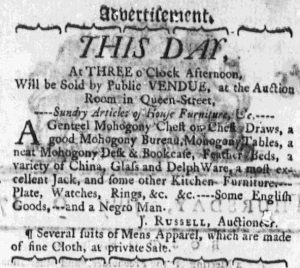
Slavery Advertisements Published July 6, 1769

The Slavery Adverts 250 Project chronicles the role of newspaper advertising in perpetuating slavery in the era of the American Revolution. The project seeks to reveal the ubiquity of slavery in eighteenth-century life from New England to Georgia by republishing advertisements for slaves – for sale, wanted to purchase, runaways, captured fugitives – in daily digests on this site as well as in real time via the @SlaveAdverts250 Twitter feed, utilizing twenty-first-century media to stand in for the print media of the eighteenth century.
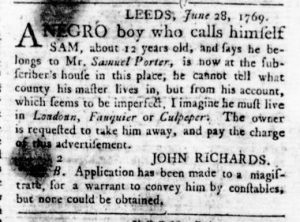
The project aims to provide modern audiences with a sense of just how often colonists encountered these advertisements in their daily lives. Enslaved men, women, and children appeared in print somewhere in the colonies almost every single day. Those advertisements served as a constant backdrop for social, cultural, economic, and political life in colonial and revolutionary America. Colonists who did not own slaves were still confronted with slavery as well as invited to maintain the system by purchasing slaves or assisting in the capture of runaways. The frequency of these newspaper advertisements suggests just how embedded slavery was in colonial and revolutionary American culture in everyday interactions beyond the printed page.

These advertisements also testify to the experiences of enslaved men, women, and children, though readers must consider that those experiences have been remediated through descriptions offered by slaveholders rather than the slaves themselves. Often unnamed in the advertisements, enslaved men, women, and children were not invisible or unimportant in early America.

These advertisements appeared in colonial American newspapers 250 years ago today.

Jul 6 - Massachusetts Gazette Draper Slavery 1
Massachusetts Gazette [Draper] (July 6, 1769).

**********

Jul 6 - New-York Chronicle Slavery 1
New-York Chronicle (July 6, 1769).

**********

Jul 6 - New-York Chronicle Slavery 2
New-York Chronicle (July 6, 1769).

**********

Jul 6 - New-York Journal Slavery 1
New-York Journal (July 6, 1769).

**********

Jul 6 - New-York Journal Supplement Slavery 1
Supplement to the New-York Journal (July 6, 1769).

**********

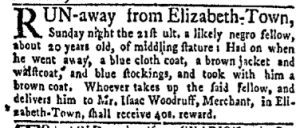
Jul 6 - Pennsylvania Gazette Slavery 1
Pennsylvania Gazette (July 6, 1769).

**********

Jul 6 - Pennsylvania Gazette Slavery 2
Pennsylvania Gazette (July 6, 1769).

**********

Jul 6 - Pennsylvania Gazette Slavery 3
Pennsylvania Gazette (July 6, 1769).

**********

Jul 6 - Pennsylvania Gazette Slavery 4
Pennsylvania Gazette (July 6, 1769).

**********

Jul 6 - Pennsylvania Gazette Slavery 5
Pennsylvania Gazette (July 6, 1769).

**********

Jul 6 - Virginia Gazette Purdie and Dixon Slavery 1
Virginia Gazette [Purdie and Dixon] (July 6, 1769).

**********

Jul 6 - Virginia Gazette Purdie and Dixon Slavery 2
Virginia Gazette [Purdie and Dixon] (July 6, 1769).

**********

Jul 6 - Virginia Gazette Purdie and Dixon Slavery 3
Virginia Gazette [Purdie and Dixon] (July 6, 1769).

**********

Jul 6 - Virginia Gazette Purdie and Dixon Slavery 4
Virginia Gazette [Purdie and Dixon] (July 6, 1769).

**********

Jul 6 - Virginia Gazette Purdie and Dixon Slavery 5
Virginia Gazette [Purdie and Dixon] (July 6, 1769).

**********

Jul 6 - Virginia Gazette Rind Slavery 1
Virginia Gazette [Rind] (July 6, 1769).

**********

Jul 6 - Virginia Gazette Rind Slavery 2
Virginia Gazette [Rind] (July 6, 1769).

**********

Jul 6 - Virginia Gazette Rind Slavery 3
Virginia Gazette [Rind] (July 6, 1769).

**********

Jul 6 - Virginia Gazette Rind Slavery 5
Virginia Gazette [Rind] (July 6, 1769).

**********

Jul 6 - Virginia Gazette Rind Slavery 4
Virginia Gazette [Rind] (July 6, 1769).

July 5

What was advertised in a colonial American newspaper 250 years ago today?

Jul 5 - 7:5:1769 Georgia Gazette
Georgia Gazette (July 5, 1769).

“He will sell so as shopkeepers can afford to retail them again.”

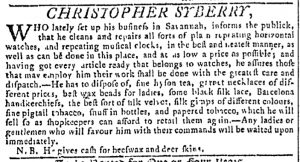
When watchmaker Christopher Syberry announced to the public that he “lately set up his business” in Savannah in 1769, he also informed prospective customers that he simultaneously sold a variety of goods. His inventory included “fine hyson tea, garnet necklaces of different prices, best wax beads for ladies, some black silk lace, Barcelona handkerchiefs, the best sort of silk velvet, silk gimps of different colours, fine pigtail tobacco, snuff in bottles, and papered tobacco.” Selling these items provided an additional revenue stream in case Syberry could not drum up enough business to support himself cleaning and repairing clocks and watches.

Syberry made it clear that he did not merely retail the items listed in his advertisement; he also acted as a wholesaler who distributed goods to shopkeepers in the small port and throughout the rest of the colony. He did not emphasize price as much as many other advertisers during the period, but he did pledge to sell his wares “so as shopkeepers can afford to retail them again.” Although unstated, this may have included discounts for purchasing in volume. Syberry implicitly presented himself as an alternative to merchants in England who fulfilled orders by letter. Shopkeepers who opted to acquire goods from him gained the advantage of examining the merchandise in his shop and choosing those items they considered good prospects for retailing themselves. Syberry emphasized quality in his advertisement, repeatedly describing items as “fine” or “best,” but shopkeepers did not have to accept his assessment. They could examine those goods before buying them to retail. Those who visited Syberry’s shop saw and selected their wares rather than describing what they wished to order in a letter or instructing correspondents to send the latest fashions and then hoping for the best.

Other colonists who advertised similar goods in the Georgia Gazette operated as both merchants and shopkeepers, wholesalers and retailers, but Syberry distinguished his business by explicitly addressing shopkeepers and assuring them that he offered reasonable prices for his wares so they could “retail them again.” He may have anticipated that shopkeepers would make more substantial purchases than consumers, providing greater security for an entrepreneur who had “lately” launched a new enterprise in Savannah.

Slavery Advertisements Published July 5, 1769

The Slavery Adverts 250 Project chronicles the role of newspaper advertising in perpetuating slavery in the era of the American Revolution. The project seeks to reveal the ubiquity of slavery in eighteenth-century life from New England to Georgia by republishing advertisements for slaves – for sale, wanted to purchase, runaways, captured fugitives – in daily digests on this site as well as in real time via the @SlaveAdverts250 Twitter feed, utilizing twenty-first-century media to stand in for the print media of the eighteenth century.

The project aims to provide modern audiences with a sense of just how often colonists encountered these advertisements in their daily lives. Enslaved men, women, and children appeared in print somewhere in the colonies almost every single day. Those advertisements served as a constant backdrop for social, cultural, economic, and political life in colonial and revolutionary America. Colonists who did not own slaves were still confronted with slavery as well as invited to maintain the system by purchasing slaves or assisting in the capture of runaways. The frequency of these newspaper advertisements suggests just how embedded slavery was in colonial and revolutionary American culture in everyday interactions beyond the printed page.

These advertisements also testify to the experiences of enslaved men, women, and children, though readers must consider that those experiences have been remediated through descriptions offered by slaveholders rather than the slaves themselves. Often unnamed in the advertisements, enslaved men, women, and children were not invisible or unimportant in early America.

These advertisements appeared in colonial American newspapers 250 years ago today.

Jul 5 - Georgia Gazette Slavery 1
Georgia Gazette (July 5, 1769).

**********

Jul 5 - Georgia Gazette Slavery 2
Georgia Gazette (July 5, 1769).

**********

Jul 5 - Georgia Gazette Slavery 3
Georgia Gazette (July 5, 1769).

**********

Jul 5 - Georgia Gazette Slavery 4
Georgia Gazette (July 5, 1769).

**********

Jul 5 - Georgia Gazette Slavery 5
Georgia Gazette (July 5, 1769).

**********

Jul 5 - Georgia Gazette Slavery 6
Georgia Gazette (July 5, 1769).

**********

Jul 5 - Georgia Gazette Slavery 7
Georgia Gazette (July 5, 1769).

July 4

Who was the subject of an advertisement in a colonial American newspaper 250 years ago today?

Jul 4 - 7:4:1769 South-Carolina and American General Gazette
South-Carolina and American General Gazette (July 4, 1769).

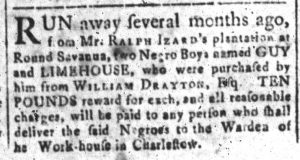
“RUN away … two Negro Boys named GUY and LIMEHOUSE.”

American colonists engaged in a variety of resistance activities in response to new legislation passed by Parliament with the intention of better regulating the vast British Empire in the years after the Seven Years War concluded. Colonial legislatures passed resolutions asserting the rights of American and submitted petitions encouraging Parliament to reconsider. Merchants and shopkeepers organized nonimportation agreements, disrupting commerce as a means of achieving political goals. Extending those efforts, consumers boycotted goods imported from Britain. Many colonists also expressed their political views by participating in public demonstrations, some of them culminating in violence. The colonial press chronicled all of these efforts, contributing to the creation of an imagined community from New England to Georgia. Print culture played an important role in creating a sense of a common cause for many colonists.

Yet white colonists were not the only ones thinking about liberty and those were not the only means of seeking freedom. Enslaved Africans and African Americans did not need newspaper reports about petitions, nonimportation agreements, and public demonstrations to inform them of the ideals of liberty and the meaning of freedom. Many engaged in their own acts of resistance, seizing their own liberty by escaping from bondage. Such was the case for “two Negro Boys named GUY and LIMEHOUSE.” Late in the winter or early in the spring of 1769, these two young men decided to make their escape from Ralph Izard’s plantation. For weeks, Izard ran advertisements in South Carolina’s newspapers, including in the July 4, 1769, edition of the South-Carolina and American General Gazette. He offered a reward of ten pounds each for the capture and return of Guy and Limehouse, instructing that they should be delivered “to the Warden of [t]he Work-house in Charlestow[n].”

Other than their names (presumably names bestowed on the young men by their enslavers), Izard provided little information about the young men. He described them as “Boys,” but did not offer even an approximation of their ages. Izard indicated that he had purchased Guy and Limehouse from William Drayton, but did not report how much time had elapsed between that transaction and their escape. For at least a couple of months, the young men experienced freedom, though they likely never felt secure. Guy and Limehouse’s stories, as told by Izard, were exceptionally truncated compared to the stories they would have told about themselves. Still, their determination to free themselves demonstrates that the spirit of liberty was not confined to white colonists aggrieved over the actions of Parliament.

That spirit of liberty, however, existed in stark contrast to the realities of enslavement during the imperial crisis, throughout the American Revolution, and beyond. Advertisements for enslaved men, women, and children who attempted to seize their own liberty highlight that paradox of the American founding. Many historians address the tension between liberty and enslavement in the era of the American Revolution, both in projects intended mainly for their colleagues in the academy and projects intended to engage the general public. On July 4, as Americans celebrate Independence Day, the Adverts 250 Project seeks to add to that conversation by presenting the stories of enslaved people who made their escape from bondage at the same time that white colonists protested for their rights and freedom from figurative enslavement to Parliament. In addition to the stories of Guy and Limehouse, learn more about Caesar, advertised in the Providence Gazette on July 4, 1767, and Harry, advertised in the Pennsylvania Chronicle on July 4, 1768. Celebrations of Independence Day should acknowledge the complexity of American history and commemorate the courage and conviction of enslaved people who pursued their own means of achieving freedom in an era of revolutionary fervor.

Slavery Advertisements Published July 4, 1769

The Slavery Adverts 250 Project chronicles the role of newspaper advertising in perpetuating slavery in the era of the American Revolution. The project seeks to reveal the ubiquity of slavery in eighteenth-century life from New England to Georgia by republishing advertisements for slaves – for sale, wanted to purchase, runaways, captured fugitives – in daily digests on this site as well as in real time via the @SlaveAdverts250 Twitter feed, utilizing twenty-first-century media to stand in for the print media of the eighteenth century.
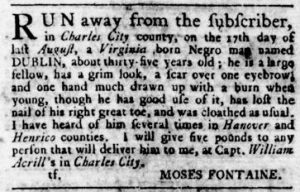
The project aims to provide modern audiences with a sense of just how often colonists encountered these advertisements in their daily lives. Enslaved men, women, and children appeared in print somewhere in the colonies almost every single day. Those advertisements served as a constant backdrop for social, cultural, economic, and political life in colonial and revolutionary America. Colonists who did not own slaves were still confronted with slavery as well as invited to maintain the system by purchasing slaves or assisting in the capture of runaways. The frequency of these newspaper advertisements suggests just how embedded slavery was in colonial and revolutionary American culture in everyday interactions beyond the printed page.

These advertisements also testify to the experiences of enslaved men, women, and children, though readers must consider that those experiences have been remediated through descriptions offered by slaveholders rather than the slaves themselves. Often unnamed in the advertisements, enslaved men, women, and children were not invisible or unimportant in early America.

These advertisements appeared in colonial American newspapers 250 years ago today.

Jul 4 - South-Carolina and American General Gazette Slavery 1
South-Carolina and American General Gazette (July 4, 1769).

**********

Jul 4 - South-Carolina and American General Gazette Slavery 2
South-Carolina and American General Gazette (July 4, 1769).

**********

Jul 4 - South-Carolina and American General Gazette Slavery 3
South-Carolina and American General Gazette (July 4, 1769).

**********

Jul 4 - South-Carolina and American General Gazette Slavery 4
South-Carolina and American General Gazette (July 4, 1769).

**********

Jul 4 - South-Carolina and American General Gazette Slavery 5
South-Carolina and American General Gazette (July 4, 1769).

**********

Jul 4 - South-Carolina and American General Gazette Slavery 6
South-Carolina and American General Gazette (July 4, 1769).

July 3

What was advertised in a colonial American newspaper 250 years ago today?

Jul 3 - 7:3:1769 Boston-Gazette
Boston-Gazette (July 3, 1769).

“AMERICAN GRINDSTONES.”

Benjamin Edes and John Gill, printers of the Boston-Gazette, operated a partisan press that supported the American cause during the imperial crisis. The news and editorials they presented to readers encouraged resistance to abuses perpetrated by Parliament and played a significant role in shaping public opinion in favor of declaring independence. Yet expressions of political sentiments were not confined to the pages of the Boston-Gazette devoted to news and editorials. Some colonists voiced political views, sometimes explicitly but often implicitly, in advertisements for goods and services they offered for sale.

The first two advertisements in the July 3, 1769, edition relied on popular discourse about boycotting goods imported from Britain and encouraging “domestic manufactures” as an alternative. Henry Bass advertised “AMERICAN GRINDSTONES” for sale “at his Store adjoining the Golden-Ball Tavern” and Peter Etter hawked stockings and other garments that he “manufactured … At his Room over the Dancing-School, near the Custom-House.” Later in the issue, Isaac Greenwood continued promoting umbrellas he “Made and Sold” at his shop in the North End.

Bass’s advertisement demonstrated that colonists thought broadly about what qualified as domestic manufactures. His “AMERICAN GRINDSTONES” were “MAnufactured in Nova-Scotia,” a colony that experienced its own demonstrations against the Stamp Act a few years earlier. Many colonists in Massachusetts and Nova Scotia believed they shared a common cause during the years of the imperial crisis, though the northern province did not ultimately join the thirteen colonies that declared independence. In 1769, however, the ties between the two were strong enough for grindstones produced in Nova Scotia to count as “AMERICAN” in Boston. Bass acknowledged that they were slightly more expensive (or “near as cheap”) as grindstones imported from Britain; whenever possible, advertisers who promoted domestic manufactures assured prospective customers that their wares were less expensive than imported goods. Unable to adopt that strategy, Bass instead chose another means of persuading readers to pay a little bit more for grindstones from Nova Scotia. He emphasized quality, proclaiming that the “best Judges” considered his grindstones “vastly superior” to those imported from Britain. The price may have been nominally higher, but the quality justified the investment in encouraging domestic manufactures. Bass’s advertisement, along with those placed by Etter and Greenwood, prompted readers to consider the relationship between politics and their own participation in commerce and consumption.

Slavery Advertisements Published July 3, 1769

The Slavery Adverts 250 Project chronicles the role of newspaper advertising in perpetuating slavery in the era of the American Revolution. The project seeks to reveal the ubiquity of slavery in eighteenth-century life from New England to Georgia by republishing advertisements for slaves – for sale, wanted to purchase, runaways, captured fugitives – in daily digests on this site as well as in real time via the @SlaveAdverts250 Twitter feed, utilizing twenty-first-century media to stand in for the print media of the eighteenth century.
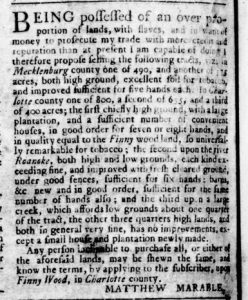
The project aims to provide modern audiences with a sense of just how often colonists encountered these advertisements in their daily lives. Enslaved men, women, and children appeared in print somewhere in the colonies almost every single day. Those advertisements served as a constant backdrop for social, cultural, economic, and political life in colonial and revolutionary America. Colonists who did not own slaves were still confronted with slavery as well as invited to maintain the system by purchasing slaves or assisting in the capture of runaways. The frequency of these newspaper advertisements suggests just how embedded slavery was in colonial and revolutionary American culture in everyday interactions beyond the printed page.
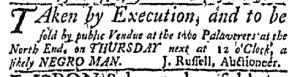
These advertisements also testify to the experiences of enslaved men, women, and children, though readers must consider that those experiences have been remediated through descriptions offered by slaveholders rather than the slaves themselves. Often unnamed in the advertisements, enslaved men, women, and children were not invisible or unimportant in early America.

These advertisements appeared in colonial American newspapers 250 years ago today.

Jul 3 - Boston Evening-Post Supplement Slavery 1
Supplement to the Boston Evening-Post (July 3, 1769).

**********

Jul 3 - Boston-Gazette Slavery 1
Boston-Gazette (July 3, 1769).

**********

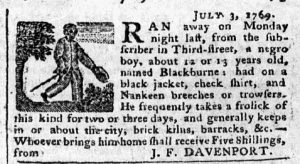
Jul 3 - Boston Post-Boy Slavery 1
Boston Post-Boy (July 3, 1769).

**********

Jul 3 - Boston Post-Boy Slavery 2
Boston Post-Boy (July 3, 1769).

**********

Jul 3 - Boston Post-Boy Slavery 3
Boston Post-Boy (July 3, 1769).

**********

Jul 3 - Connecticut Courant Slavery 1
Connecticut Courant (July 3, 1769).

**********

Jul 3 - Massachusetts Gazette Green and Russell Slavery 1
Massachusetts Gazette [Green and Russell] (July 3, 1769).

**********

Jul 3 - New-York Gazette Weekly Mercury Slavery 1
New-York Gazette and Weekly Mercury (July 3, 1769).

**********

Jul 3 - New-York Gazette Weekly Mercury Slavery 2
New-York Gazette and Weekly Mercury (July 3, 1769).

**********

Jul 3 - New-York Gazette Weekly Mercury Slavery 3
New-York Gazette and Weekly Mercury (July 3, 1769).

**********

Jul 3 - New-York Gazette Weekly Mercury Slavery 4
New-York Gazette and Weekly Mercury (July 3, 1769).

**********

Jul 3 - New-York Gazette Weekly Mercury Slavery 5
New-York Gazette and Weekly Mercury (July 3, 1769).

**********

Jul 3 - Newport Mercury Slavery 1
Newport Mercury (July 3, 1769).

**********

Jul 3 - Newport Mercury Slavery 3
Newport Mercury (July 3, 1769).

**********

Jul 3 - Newport Mercury Slavery 2
Newport Mercury (July 3, 1769).

**********

Jul 3 - Pennsylvania Chronicle Slavery 1
Pennsylvania Chronicle (July 3, 1769).

**********

Jul 3 - Pennsylvania Chronicle Slavery 2
Pennsylvania Chronicle (July 3, 1769).

**********

Jul 3 - Pennsylvania Chronicle Slavery 3
Pennsylvania Chronicle (July 3, 1769).

**********

Jul 3 - Pennsylvania Chronicle Slavery 4
Pennsylvania Chronicle (July 3, 1769).

**********

Jul 3 - Pennsylvania Chronicle Slavery 5
Pennsylvania Chronicle (July 3, 1769).

July 2

What was advertised in a colonial American newspaper 250 years ago this week?

Jul 2 - 6:29:1769 New-York Journal
New-York Journal (June 29, 1769).

“Doing so was contrary to the Non-Important Agreement.”

The success of the nonimportation agreements adopted during the imperial crisis depended not only on the cooperation of merchants and consumers but also on surveillance and enforcement, both formal and informal. Committees of merchants and traders devised the nonimportation agreements and then set about policing themselves, but colonists also observed their friends and neighbors to assess whether they complied and, when necessary, shame them in public and deprive them of business as punishment for not adhering to the agreement.

The June 26, 1769, edition of the New-York Journal carried an advertisement that testified to the stakes of following the nonimportation agreement. It told a story about Peter Clopper, “Merchant of this City, whose Zeal for promoting he good of his Country, has never been called in Question.” To that end, he was one of the first merchants in New York to sign the nonimportation agreement. About two weeks before the advertisement ran in the New-York Journal, Clopper traveled to Philadelphia to attend to “Business of Importance” and, while there, purchased “one Piece of Callico, two Pieces of coloured, and one Piece of black Persian.” He did not intend to sell these fabrics in New York, instead acquiring them “principally for the Use of his Family.” Still, this violated the nonimportation agreement, as Clopper soon realized. He then packaged up the textiles and sent them back to Philadelphia, yet that was not the end of atoning for his transgression. He voluntarily approached the Committee of Inspection into the Importation of Goods to relay the entire story and received credit for his honesty since the infraction “otherwise in all Probability never [would have] come to Light.”

In response to this incident, the committee determined that Clopper’s purchase was an “involuntary Transaction” that “ought not to be imputed to him as a Crime.” Having returned the merchandise and then presented himself to the committee of his own accord, he was “intitled to the Favour of the Committee for his candid Behaviour.” Yet Clopper did not seek the “Favour of the Committee” alone. He also wished to defend and maintain his reputation among the residents of New York, colonists who were also current and prospective customers. The introduction to the account of Clopper’s indiscretion and remedy depicted the alternatives. On the one hand, “it must afford great Satisfaction to every Friend of the American Colonies” to know the “Indignation and Abhorrence” that would be incurred by anyone who “willfully and personally” behaved in a manner “to counteract the Agreement entered into” for the “common Preservation” of the entire colony. On the other hand, “it must also give them Pleasure to know how cautious and fearful Individuals are of incurring the Censure of the Public.”

The merchants and traders who signed and enforced the nonimportation agreement were not Clopper’s only concern when he took action to fix his supposedly inadvertent mistake. He also worried about maintaining his reputation among the general public and avoiding the “Censure of the Public” that could spell ruin for his business. Yet it was not only commerce at stake. Clopper realized that his error could also affect his social relationships with friends and neighbors who supported the nonimportation agreement. When it came to adhering to that pact, political acts had personal ramifications. The purpose of the advertisement in the New-York Journal was to diffuse those ramifications for Clopper, given his eager cooperation once he realized his transgression, as well as remind others of the consequences if they willfully tried to evade the nonimportation agreement.

July 1

What was advertised in a colonial American newspaper 250 years ago today?

Jul 1 - 7:1:1769 Providence Gazette
Providence Gazette (July 1, 1769).

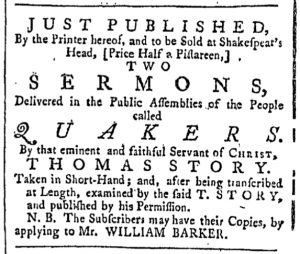
“JUST PUBLISHED … TWO SERMONS.”

John Carter exercised his privilege as printer to have his own advertisement appear first among the advertisements in the July 1, 1769, edition of the Providence Gazette. Carter announced that he had “JUST PUBLISHED” two sermons delivered by Thomas Story to “Public Assemblies of the People called QUAKERS.” Story (1662-1742) became a Quaker convert in 1689. He became friends with William Penn, the founder of the sect. Story spent sixteen years in colonial America, lecturing to Quakers and held several offices in Pennsylvania, before returning to England.

Although Carter called the pamphlet “TWO SERMONS” in the advertisement, he referred to Two Discourses, Delivered in the Public Assemblies of the People Called Quakers. Much of the advertisement seems to have been a transcription directly from the title page (“Taken in Short-Hand; and, after being transcribed at Length, examined by the said T. STORY, and published by his Permission”), but Carter did add a short description of Story (“that eminent and faithful Servant of CHRIST”) as a means of better promoting the book. According to the American Antiquarian Society’s catalog, the discourses included “The Nature and Necessity of Knowing One’s-Self” and “The Insufficiency of Natural Knowledge and the Benefits Arising from that which Is Spiritual.”

The transcription of the title page available via the Evans Early American Imprint Collection’s Text Creation Partnership lists this imprint: “LONDON, Printed. PROVIDENCE, Re-printed and Sold by JOHN CARTER, at Shakespear’s Head. M,DCC,LXIX.” Only one London edition, published in 1738, had appeared during Story’s lifetime, but two others were published in 1744 and 1764. Carter most likely consulted the 1764 edition when reprinting the book in Providence, inspired that a relatively new London edition signaled that there might also be demand for the pamphlet on his side of the Atlantic.

In addition to offering copies for sale, the advertisement also called on subscribers who had pre-ordered the pamphlet to collect their copies. Carter had not simply assumed the risk for printing a collection of lectures originally delivered more then three decades earlier. He first determined that a market existed to make it a worthwhile venture. Like other colonial printers, he did not print the proposed title until after he secured a sufficient number of subscribers who pledged to purchase the pamphlet (and perhaps even made deposits to reserve their copies). Any subsequent sales amounted to an even better return on his investment.