March 3

Who was the subject of an advertisement in a colonial American newspaper 250 years ago today?
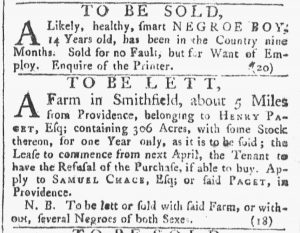
Mar 3 - 3:3:1770 Providence Gazette
Providence Gazette (March 3, 1770).

“TO BE SOLD, A Likely, healthy, smart, NEGROE BOY.”

The Slavery Adverts 250 Project chronicles how newspaper advertising contributed to the perpetuation of slavery during the era of the American Revolution.  Every day the project identifies, remediates, and republishes advertisements about enslaved men, women, and children originally published in British mainland North America 250 years ago that day.  In so doing, the project seeks to undo the forced forgetting of enslavement throughout the thirteen colonies that became the United States, especially northern colonies that became free states through immediate or gradual emancipation in the decades following the Revolution.  Newspaper advertisements demonstrate that slavery was part of everyday life in colonies from New England to Georgia during the first three quarters of the eighteenth century.  Readers regularly encountered notices about enslaved people in the public prints, just as they encountered enslaved people in public and private spaces.

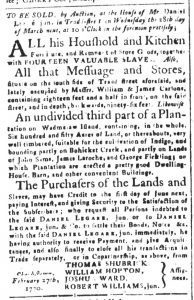
Consider the March 3, 1770 edition of the Providence Gazette.  It contained two advertisements that sought to sell enslaved men, women, and children.  The first announced that an unnamed enslaver wished to sell a “Likely, healthy, smart NEGROE BOY” who had been “in the Country nine Months.”  Presumably he survived the Middle Passage from Africa or transshipment from the Caribbean to arrive in Rhode Island in the summer of 1769.  The anonymous advertiser assured prospective purchasers that the enslaved youth was “Sold for no Fault” other than “Want of Employ.”  In other words, the enslaver did not have enough tasks to keep the “NEGROE BOY” busy and wished to recoup the investment.  The second notice focused primarily on a farm “TO BE LETT” and eventually sold in Smithfield.  Henry Pacet advertised more than the farm “with some Stock thereon.”  In a nota bene, a device deployed to draw particular attention to important information, he announced that he would rent or sell “several Negroes of both Sexes,” if tenants or purchasers wished.  They need not have been part of the deal.  Pacet and prospective buyers would determine whether any of the enslaved men and women would remain on the farm.  Those men and women, reduced to commodities, did not have a say.

Along with an array of other sources, newspaper advertisements demonstrate that slavery was not merely a southern phenomenon.  Enslaved people lived and labored in Rhode Island and elsewhere in New England in the era of the American Revolution.  Although historians and other scholars are well aware of their presence, too often the general public has “forgotten,” perhaps all too conveniently, that enslaved people were part of the fabric of everyday life and commerce in New England in the seventeenth and eighteenth centuries.

Slavery Advertisements Published March 3, 1770

The Slavery Adverts 250 Project chronicles the role of newspaper advertising in perpetuating slavery in the era of the American Revolution. The project seeks to reveal the ubiquity of slavery in eighteenth-century life from New England to Georgia by republishing advertisements for slaves – for sale, wanted to purchase, runaways, captured fugitives – in daily digests on this site as well as in real time via the @SlaveAdverts250 Twitter feed, utilizing twenty-first-century media to stand in for the print media of the eighteenth century.

The project aims to provide modern audiences with a sense of just how often colonists encountered these advertisements in their daily lives. Enslaved men, women, and children appeared in print somewhere in the colonies almost every single day. Those advertisements served as a constant backdrop for social, cultural, economic, and political life in colonial and revolutionary America. Colonists who did not own slaves were still confronted with slavery as well as invited to maintain the system by purchasing slaves or assisting in the capture of runaways. The frequency of these newspaper advertisements suggests just how embedded slavery was in colonial and revolutionary American culture in everyday interactions beyond the printed page.

These advertisements also testify to the experiences of enslaved men, women, and children, though readers must consider that those experiences have been remediated through descriptions offered by slaveholders rather than the slaves themselves. Often unnamed in the advertisements, enslaved men, women, and children were not invisible or unimportant in early America.

These advertisements appeared in colonial American newspapers 250 years ago today.

Mar 3 1770 - Providence Gazette Slavery 1
Providence Gazette (March 3, 1770).

**********

Mar 3 1770 - Providence Gazette Slavery 2
Providence Gazette (March 3, 1770).

March 2

What was advertised in a colonial American newspaper 250 years ago today?

Mar 2 - 3:2:1770 Connecticut Journal
Connecticut Journal (March 2, 1770).

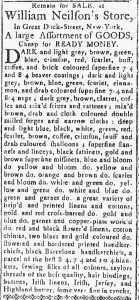
“For SALE at William Neilson’s Store.”

In addition to advertising his wares in the New-York Gazette and Weekly Mercury, the New-York Gazette or Weekly Post-Boy, and the New-York Journal, William Neilson also inserted a notice in the Connecticut Journal and New-Haven Post-Boy.  Yesterday I examined the iteration of the advertisement that appeared in the March 1, 1770, edition of the New-York Journal, focusing on the nota bene about his prices remaining the same as before the nonimportation agreement went into effect.  The version that ran in the Connecticut Journal listed many of the same goods, but did not deploy copy identical to the advertisement in the New-York Journal.  Most significantly, it did not include the nota bene about prices.  Why not?

After further investigation, I discovered that the nota bene was not part of the advertisement when it first appeared in any of newspapers printed in New York.  It first ran in the February 22, 1770, edition of the New-York Journal without the additional note offering assurances that Neilson did not take advantage of the nonimportation agreement to engage in price gouging.  The advertisement did not appear in the new issues of the New-York Gazette and Weekly Mercury and the New-York Gazette or Weekly Post-Boy, published four days later.  Instead, it made its next appearance in the March 1 edition of the New-York Journal, now with the nota bene.  On March 5 the advertisement – identical copy, including the nota bene – did appear in the other two New York newspapers.  The staggered appearance of the advertisements and the addition of the nota bene suggest that Neilson felt some urgency to inform prospective customers and the rest of the community that he did not jack up his prices.  Perhaps he had heard rumors or been confronted directly, prompting him to advertise more widely than he originally intended.  By the time he made that determination, it may have been too late to update the copy he sent to the Connecticut Journal.

Rather than merely noting a benefit to his customers, the nota bene that eventually appeared at the conclusion of Neilson’s advertisements may very well have been an exercise in reputation management.  Rarely did merchants and shopkeepers update their advertisements in the 1760s and 1770s.  They usually submitted copy that ran for weeks or even months.  Yet Neilson made an addition to his advertisement and then published the revised version in its entirety in two more newspapers, increasing the funds he expended on advertising.  If his reputation was at stake, he may have considered doing so a necessity well worth the additional expense.

Slavery Advertisements Published March 2, 1770

The Slavery Adverts 250 Project chronicles the role of newspaper advertising in perpetuating slavery in the era of the American Revolution. The project seeks to reveal the ubiquity of slavery in eighteenth-century life from New England to Georgia by republishing advertisements for slaves – for sale, wanted to purchase, runaways, captured fugitives – in daily digests on this site as well as in real time via the @SlaveAdverts250 Twitter feed, utilizing twenty-first-century media to stand in for the print media of the eighteenth century.

The project aims to provide modern audiences with a sense of just how often colonists encountered these advertisements in their daily lives. Enslaved men, women, and children appeared in print somewhere in the colonies almost every single day. Those advertisements served as a constant backdrop for social, cultural, economic, and political life in colonial and revolutionary America. Colonists who did not own slaves were still confronted with slavery as well as invited to maintain the system by purchasing slaves or assisting in the capture of runaways. The frequency of these newspaper advertisements suggests just how embedded slavery was in colonial and revolutionary American culture in everyday interactions beyond the printed page.

These advertisements also testify to the experiences of enslaved men, women, and children, though readers must consider that those experiences have been remediated through descriptions offered by slaveholders rather than the slaves themselves. Often unnamed in the advertisements, enslaved men, women, and children were not invisible or unimportant in early America.

These advertisements appeared in colonial American newspapers 250 years ago today.

Mar 2 1770 - South-Carolina and American General Gazette Slavery 1
South-Carolina and American General Gazette (March 2, 1770).

**********

Mar 2 1770 - South-Carolina and American General Gazette Slavery 2
South-Carolina and American General Gazette (March 2, 1770).

**********

Mar 2 1770 - South-Carolina and American General Gazette Slavery 3
South-Carolina and American General Gazette (March 2, 1770).

**********

Mar 2 1770 - South-Carolina and American General Gazette Slavery 4
South-Carolina and American General Gazette (March 2, 1770).

**********

Mar 2 1770 - South-Carolina and American General Gazette Slavery 5
South-Carolina and American General Gazette (March 2, 1770).

**********

Mar 2 1770 - South-Carolina and American General Gazette Slavery 6
South-Carolina and American General Gazette (March 2, 1770).

**********

Mar 2 1770 - South-Carolina and American General Gazette Slavery 7
South-Carolina and American General Gazette (March 2, 1770).

**********

Mar 2 1770 - South-Carolina and American General Gazette Slavery 8
South-Carolina and American General Gazette (March 2, 1770).

**********

Mar 2 1770 - South-Carolina and American General Gazette Slavery 9
South-Carolina and American General Gazette (March 2, 1770).

**********

Mar 2 1770 - South-Carolina and American General Gazette Slavery 10
South-Carolina and American General Gazette (March 2, 1770).

March 1

What was advertised in a colonial American newspaper 250 years ago today?

Mar 1 - 3:1:1770 New-York Journal
New-York Journal (March 1, 1770).

“Sold on as low terms, as before the non-importation took place.”

On the first day of March 1770, an advertisement in the New-York Journal informed prospective customers that a “large Assortment” of goods “Remains for SALE, at WILLIAM NEILSON’s STORE.”  Those goods consisted primarily of textiles, everything from “stript and printed linens” to double milled linseys” to “flower’s and border’d printed handkerchiefs.”  Neilson asserted that consumers could have any of this merchandise “Cheap for READY MONEY.”

That was not the only appeal that Neilson made to price.  He concluded the advertisement with a nota bene that informed both prospective customers and the rest of the community that “The above goods will be sold on as low terms, as before the non-importation took place.”  In other words, Neilson did not take advantage of the current political situation to inflate prices.  To protest duties levied on imported paper, glass, paint, lead, and tea in the Townshend Acts, merchants and shopkeepers in New York signed nonimportation agreements, pledging to abstain from importing a much wider array of goods from England for as long as Parliament left those duties in effect.  Neilson’s use of the phrase “Remains for SALE” could have implied that he received all of his merchandise prior to the nonimportation agreement; the nota bene much more explicitly invoked the intersection of commerce and politics.

Colonists suspected some merchants and shopkeepers stocked up on imported goods in advance of the agreement.  Some purveyors of goods may have seen the boycott as an opportunity to reduce surplus inventories, making a virtue of purchasing goods that had lingered on shelves and in storehouses for quite some time.  If this did contribute to a scarcity of goods over time, it had the potential to result in higher retail prices.  That Neilson found it necessary to include his nota bene suggests that conversations about those very circumstances were taking place in New York at the time he placed his advertisement.  Participating in the nonimportation agreement required sacrifices of both purveyors of goods and consumers.  Neilson proclaimed that paying higher prices need not be one of the sacrifices made by his customers.

Slavery Advertisements Published March 1, 1770

The Slavery Adverts 250 Project chronicles the role of newspaper advertising in perpetuating slavery in the era of the American Revolution. The project seeks to reveal the ubiquity of slavery in eighteenth-century life from New England to Georgia by republishing advertisements for slaves – for sale, wanted to purchase, runaways, captured fugitives – in daily digests on this site as well as in real time via the @SlaveAdverts250 Twitter feed, utilizing twenty-first-century media to stand in for the print media of the eighteenth century.

The project aims to provide modern audiences with a sense of just how often colonists encountered these advertisements in their daily lives. Enslaved men, women, and children appeared in print somewhere in the colonies almost every single day. Those advertisements served as a constant backdrop for social, cultural, economic, and political life in colonial and revolutionary America. Colonists who did not own slaves were still confronted with slavery as well as invited to maintain the system by purchasing slaves or assisting in the capture of runaways. The frequency of these newspaper advertisements suggests just how embedded slavery was in colonial and revolutionary American culture in everyday interactions beyond the printed page.

These advertisements also testify to the experiences of enslaved men, women, and children, though readers must consider that those experiences have been remediated through descriptions offered by slaveholders rather than the slaves themselves. Often unnamed in the advertisements, enslaved men, women, and children were not invisible or unimportant in early America.

These advertisements appeared in colonial American newspapers 250 years ago today.

Mar 1 1770 - Maryland Gazette Slavery 1
Maryland Gazette (March 1, 1770).

**********

Mar 1 1770 - Maryland Gazette Slavery 2
Maryland Gazette (March 1, 1770).

**********

Mar 1 1770 - Massachusetts Gazette and Boston Weekly News-Letter Slavery 1
Massachusetts Gazette and Boston Weekly News-Letter (March 1, 1770).

**********

Mar 1 1770 - Pennsylvania Gazette Slavery 1
Pennsylvania Gazette (March 1, 1770).

**********

Mar 1 1770 - Pennsylvania Journal Slavery 1
Pennsylvania Journal (March 1, 1770).

**********

Mar 1 1770 - Pennsylvania Journal Slavery 2
Pennsylvania Journal (March 1, 1770).

**********

Mar 1 1770 - Pennsylvania Journal Slavery 3
Pennsylvania Journal (March 1, 1770).

**********

Mar 1 1770 - Virginia Gazette Rind Slavery 1
Virginia Gazette [Rind] (March 1, 1770).

**********

Mar 1 1770 - Virginia Gazette Rind Slavery 2
Virginia Gazette [Rind] (March 1, 1770).

**********

Mar 1 1770 - Virginia Gazette Rind Slavery 3
Virginia Gazette [Rind] (March 1, 1770).