June 3

What was advertised in a revolutionary American newspaper 250 years ago today?
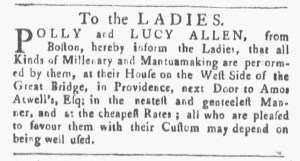
Providence Gazette (June 3, 1775).

“POLLY and LUCY ALLEN, from Boston.”

On June 3, 1775, Polly Allen and Lucy Allen published an advertisement addressed “To the LADIES” in the Providence Gazette.  That notice served as an introduction upon their arrival in the city, informing prospective customers and the community that “all Kinds of Millenary and Mantuamaking are performed by them, at their House on the West Side of the Great Bridge.”  Since the Allens were new to town, they gave further directions that stated their location relative to a resident familiar to readers, stating that they could be found “next door to Amos Atwell’s, Esq.”  New on the scene, they could not rely on their reputation among an established clientele to generate business.  Instead, they assured prospective customers that they made hats and garments “in the neatest and genteelest Manner, and at the cheapest Rates.”  In addition to skillful work on fashionable clothing at the lowest prices, the Allens also pledged exemplary customer service, stating that “all who are pleased to favour them with their Custom may depend on being well used.”

As part of their introduction, the Allens described themselves as “from Boston.”  That made them refugees, of sorts, who had been displaced during the first weeks of the Revolutionary War.  Following the battles at Lexington and Concord on April 19, militias from throughout Massachusetts, joined by companies from other colonies, besieged Boston.  The Massachusetts Provincial Congress, meeting in Watertown, negotiated with General Thomas Gage, the governor, to allow Loyalists who wished to enter the city to do so.  In return, Patriots and other “Inhabitants of the Town of Boston” could leave.  In each case, they could take their effects with them, “excepting their Fire-Arms and Ammunition.”  The Allens apparently took advantage of safe passage out of the city, along with between 12.000 and 13,000 other residents.  When they introduced themselves in the Providence Gazette as “POLLY and LUCY ALLEN, from Boston,” they did not need to say more for readers to piece together why they chose to relocate at that moment.  The Allens may have hoped that their situation would evoke some sympathy among prospective customers or even some curiosity among those who wanted to hear for themselves what conditions had been like since the Boston Port Act closed the harbor a year earlier and, especially, during the siege in recent weeks.  Some clients may have headed to the Allens’ shop in hope of stories as well as new hats and dresses.
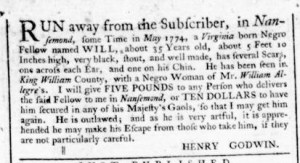
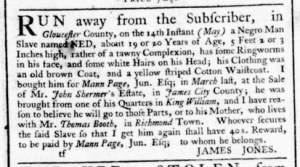
Slavery Advertisements Published June 3, 1775

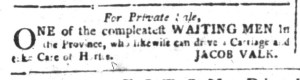
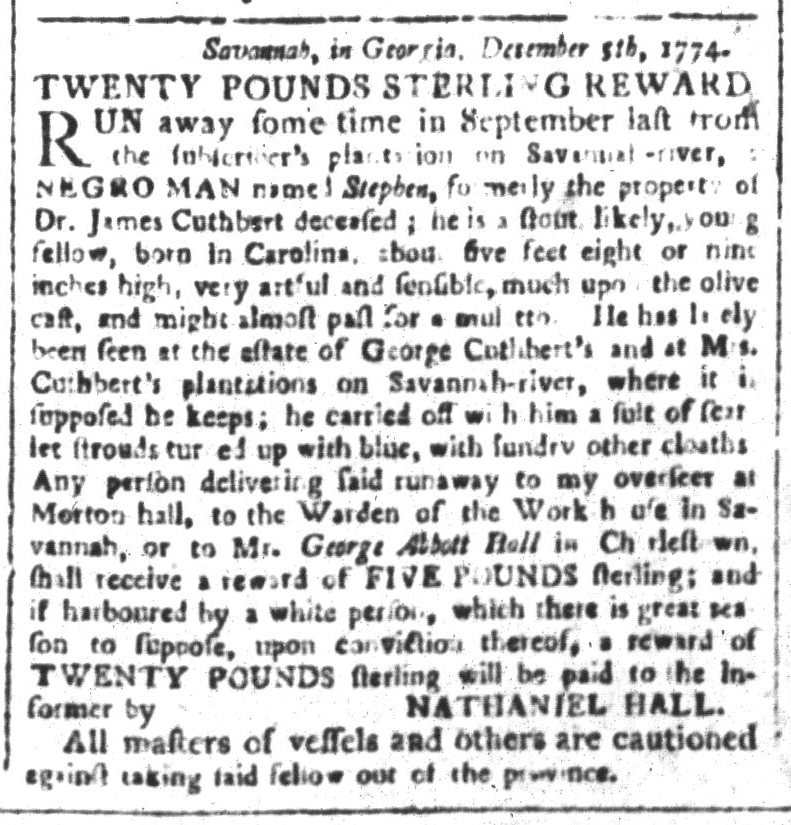
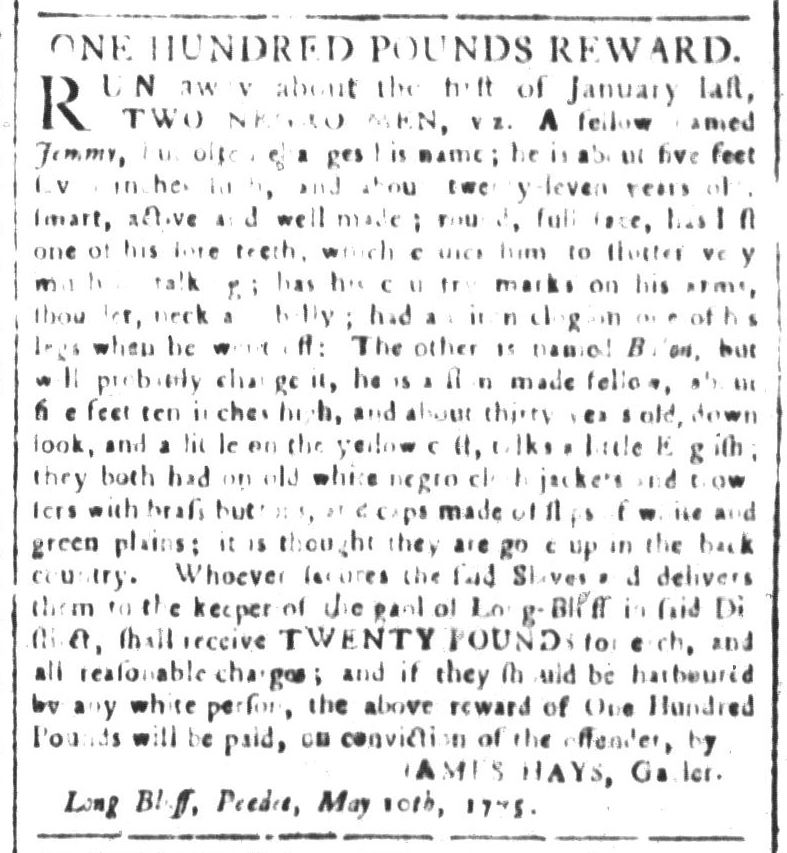
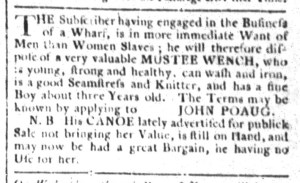
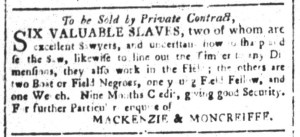
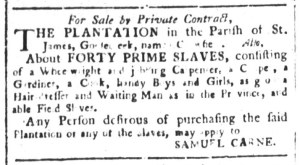
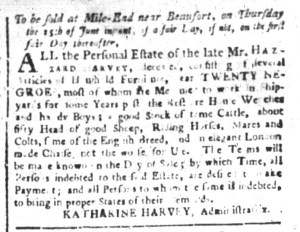
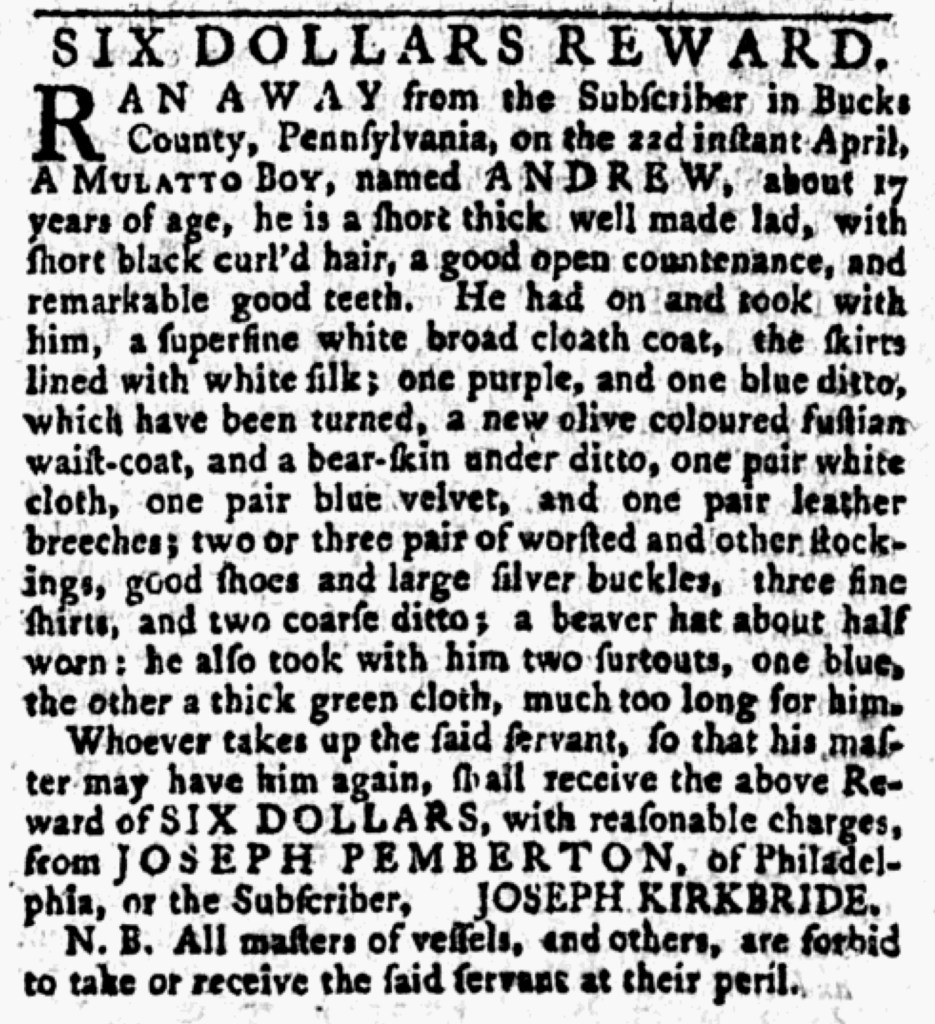
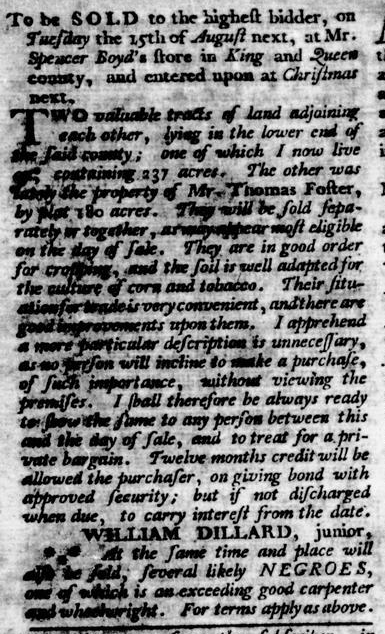
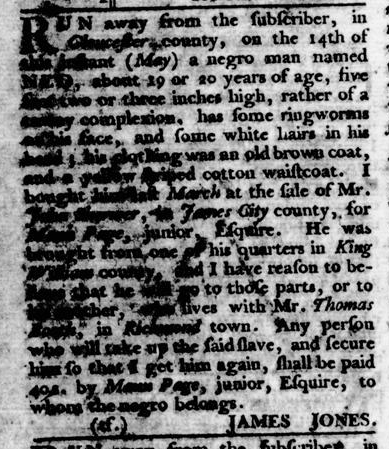
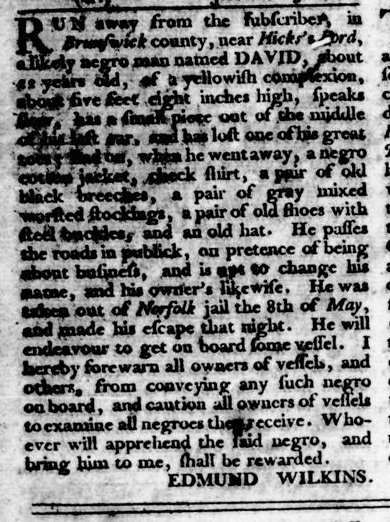
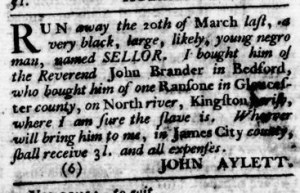
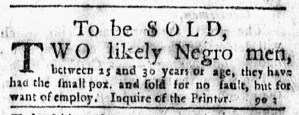
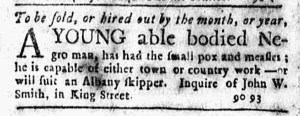
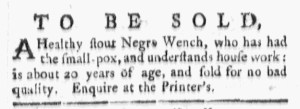
The Slavery Adverts 250 Project chronicles the role of newspaper advertising in perpetuating slavery in the era of the American Revolution. The project seeks to reveal the ubiquity of slavery in eighteenth-century life from New England to Georgia by republishing advertisements about enslaved people – for sale as individuals or in groups, wanted to purchase or for hire for short periods, runaways who liberated themselves, and those who were subsequently captured and confined in jails and workhouses – in daily digests on this site as well as in real time via the @SlaveAdverts250 Twitter feed, utilizing twenty-first-century media to stand in for the print media of the eighteenth century.

The project aims to provide modern audiences with a sense of just how often colonizers encountered these advertisements in their daily lives. Enslaved men, women, and children appeared in print somewhere in the colonies almost every single day. Those advertisements served as a constant backdrop for social, cultural, economic, and political life in colonial and revolutionary America. Colonizers who did not purport to own enslaved people were still confronted with slavery as well as invited to maintain the system by purchasing enslaved men, women, and children or assisting in the capture of so-called “runaways” who sought to free themselves from bondage. The frequency of these newspaper advertisements suggests just how embedded slavery was in colonial and revolutionary American culture in everyday interactions beyond the printed page.
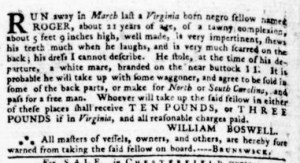
These advertisements also testify to the experiences of enslaved men, women, and children, though readers must consider that those experiences have been remediated through descriptions offered by enslavers rather than enslaved people themselves. Often unnamed in the advertisements, enslaved men, women, and children were not invisible or unimportant in early America.

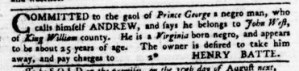
These advertisements appeared in colonial American newspapers 250 years ago today.

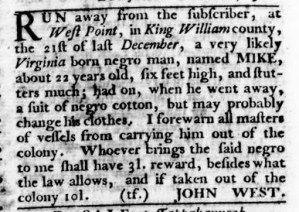
Virginia Gazette [Dixon and Hunter] (June 3, 1775).

**********

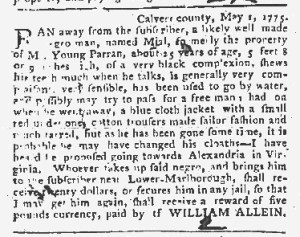
Virginia Gazette [Dixon and Hunter] (June 3, 1775).

**********

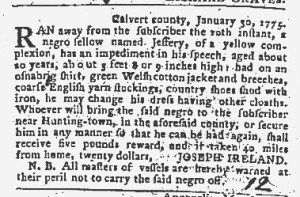
Virginia Gazette [Dixon and Hunter] (June 3, 1775).

**********

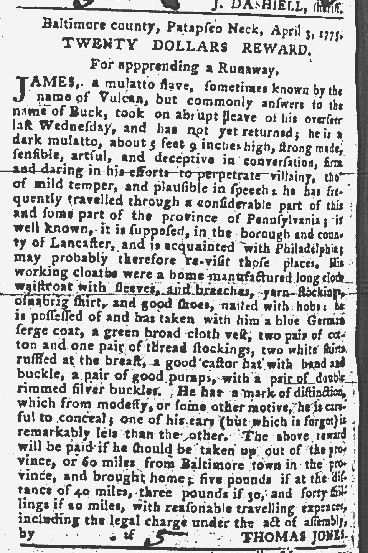
Virginia Gazette [Dixon and Hunter] (June 3, 1775).

June 2

What was advertised in a revolutionary American newspaper 250 years ago today?

Story and Humphreys’s Pennsylvania Mercury (June 2 1775).

“Imported last summer and fall from London [and] Bristol … A VERY large and general assortment of Ironmongery [and] Cutlery.”

James Bringhurst advertised a variety of items available at “his Ware-house on the Bank, below Walnut-street,” in Philadelphia in the summer of 1775.  He stocked a “VERY large and general assortment of Ironmongery [and] Cutlery” that included “knives and forks with or without cases, roasting jacks, bake ovens, preserving pans with covers, sauce pans with ditto, teakettles, skillets, pots, kettles, [and] frying pans.”  He also carried “most sorts of tradesmens tools” along with “compleat Furniture both for house and ship building.”  In addition, his inventory included “sundry other articles too numerous to insert” in a newspaper advertisement.  Bringhurst’s “Ware-house” was an eighteenth-century precursor of a superstore that sold housewares to consumers and equipment and supplies to builders.

Before he gave or his location or presented his list of merchandise, Bringhurst noted when and where he received the goods he sold.  Many merchants and shopkeepers did so in the 1760s and 1770s yet doing so had a new kind of significance once the Continental Association went into effect on December 1, 1774.  The First Continental Congress devised the Continental Association, a nonimportation agreement, in response to the Coercive Acts, hoping to leverage the commercial boycott into political reform.  Colonizers who signed the Continental Association vowed to abide by it until Parliament repealed the Coercive Acts and other legislation that infringed on their rights that had been passed since the end of the Seven Years War.

Bringhurst sent an important signal to prospective customers and the entire community when he specified that his wares had been “Imported last summer and fall from London, Bristol,” and other English ports.  Under other circumstances, wholesalers and retailers would have been unlikely to acknowledge that they sold items that had been on the shelves or in the warehouse for so long; instead, they usually emphasized that they had just the received the newest goods and the newest fashions.  In this case, however, peddling merchandise that had been around for the better part of a year was a virtue.  Bringhurst abided by the Continental Association … and his customers could shop in good conscience knowing that they did so as well.

Slavery Advertisements Published June 2, 1775

The Slavery Adverts 250 Project chronicles the role of newspaper advertising in perpetuating slavery in the era of the American Revolution. The project seeks to reveal the ubiquity of slavery in eighteenth-century life from New England to Georgia by republishing advertisements about enslaved people – for sale as individuals or in groups, wanted to purchase or for hire for short periods, runaways who liberated themselves, and those who were subsequently captured and confined in jails and workhouses – in daily digests on this site as well as in real time via the @SlaveAdverts250 Twitter feed, utilizing twenty-first-century media to stand in for the print media of the eighteenth century.

The project aims to provide modern audiences with a sense of just how often colonizers encountered these advertisements in their daily lives. Enslaved men, women, and children appeared in print somewhere in the colonies almost every single day. Those advertisements served as a constant backdrop for social, cultural, economic, and political life in colonial and revolutionary America. Colonizers who did not purport to own enslaved people were still confronted with slavery as well as invited to maintain the system by purchasing enslaved men, women, and children or assisting in the capture of so-called “runaways” who sought to free themselves from bondage. The frequency of these newspaper advertisements suggests just how embedded slavery was in colonial and revolutionary American culture in everyday interactions beyond the printed page.

These advertisements also testify to the experiences of enslaved men, women, and children, though readers must consider that those experiences have been remediated through descriptions offered by enslavers rather than enslaved people themselves. Often unnamed in the advertisements, enslaved men, women, and children were not invisible or unimportant in early America.

These advertisements appeared in colonial American newspapers 250 years ago today.

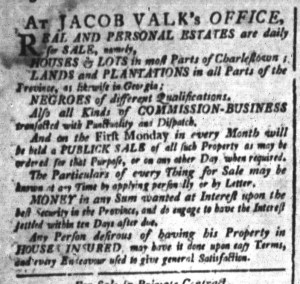
South-Carolina and American General Gazette (June 2, 1775).

**********

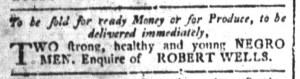
South-Carolina and American General Gazette (June 2, 1775).

**********

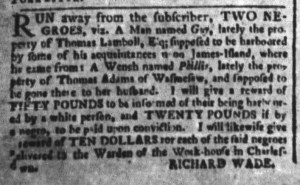
South-Carolina and American General Gazette (June 2, 1775).

**********

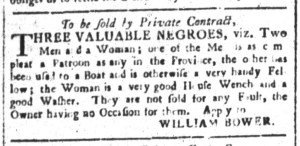
South-Carolina and American General Gazette (June 2, 1775).

**********

South-Carolina and American General Gazette (June 2, 1775).

**********

South-Carolina and American General Gazette (June 2, 1775).

**********

South-Carolina and American General Gazette (June 2, 1775).

**********

South-Carolina and American General Gazette (June 2, 1775).

**********

South-Carolina and American General Gazette (June 2, 1775).

**********

South-Carolina and American General Gazette (June 2, 1775).

**********

South-Carolina and American General Gazette (June 2, 1775).

**********

South-Carolina and American General Gazette (June 2, 1775).

**********

South-Carolina and American General Gazette (June 2, 1775).

**********

South-Carolina and American General Gazette (June 2, 1775).

**********

Story and Humphreys’s Pennsylvania Mercury (June 2, 1775).

**********

Virginia Gazette [Purdie] (June 2, 1775).

**********

Virginia Gazette [Purdie] (June 2, 1775).

**********

Virginia Gazette [Purdie] (June 2, 1775).

**********

Virginia Gazette [Purdie] (June 2, 1775).

**********

Virginia Gazette [Purdie] (June 2, 1775).

June 1

Who was the subject of an advertisement in a revolutionary American newspaper 250 years ago today?

Norwich Packet (June 1, 1775).

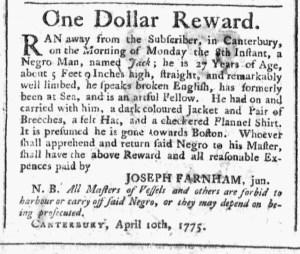
“One Dollar Reward [for] a Negro Man, named Jack.”

Among its other contents, the June 1, 1775, edition of the Norwich Packet carried an advertisement that offered a “One Dollar Reward” for the capture and return of “a Negro Man, named Jack” who had liberated himself by running away from his enslaver, Joseph Farnham, Jr. of Canterbury, Connecticut, on the morning of April 8.  Farnham provided a description that included Jack’s age, height, other physical characteristics, and clothing.  He also stated that Jack “speaks broken English,” hoping that would assist readers in identifying the fugitive seeking freedom.  In addition, Jack “has formerly been at Sea.”  He had experience as a sailor, making it even more important to include the standard warning that “All Masters of Vessels and others are forbid to harbour or carry off said Negro, or they may depend on being prosecuted.”  Farnham suspected that Jack was headed to Boston.  He departed before the battles of Lexington and Concord and the siege of Boston.  Those events may have worked to Jack’s advantage, distracting colonizers from taking too much notice of him.

What they certainly did notice was that the imperial crisis had entered a new stage.  “HOSTILITIES are at length commenced in this colony,” Massachusetts, “by the troops under command of General Gage,” Joseph Warren, president pro tem of the Massachusetts Provincial Congress declared in an address to “the INHABITANTS of GREAT-BRITAIN.”  He considered it vital that “an early, true, and authentic account of this inhuman proceeding should be known to you.”  He then outlined the recent battles, especially the “ravages of the troops” in “General Gage’s army.” Farnham’s advertisement about Jack appeared immediately below Warren’s address in the June 1 edition of the Norwich Packet, though most readers likely did not grapple with the contradictions.  On behalf of the Massachusetts Provincial Congress, Warren lamented that “ministerial vengeance against this colony, for refusing, with her sister colonies, a submission to slavery.”  He meant figurative slavery, yet Farnham’s advertisement concerned the literal enslavement of a Black man, prompted by Jack’s quest for his own liberty.  Time and time again, advertisements about enslaved men, women, and children appeared alongside news and editorials about the dangers that Parliament posed to the freedoms of colonizers.  The revenue from Farnham’s advertisement about Jack, for instance, helped in making it possible for the printers to publish an editorial from the president pro tem of the Massachusetts Provincial Congress.

Slavery Advertisements Published June 1, 1775

The Slavery Adverts 250 Project chronicles the role of newspaper advertising in perpetuating slavery in the era of the American Revolution. The project seeks to reveal the ubiquity of slavery in eighteenth-century life from New England to Georgia by republishing advertisements about enslaved people – for sale as individuals or in groups, wanted to purchase or for hire for short periods, runaways who liberated themselves, and those who were subsequently captured and confined in jails and workhouses – in daily digests on this site as well as in real time via the @SlaveAdverts250 Twitter feed, utilizing twenty-first-century media to stand in for the print media of the eighteenth century.

The project aims to provide modern audiences with a sense of just how often colonizers encountered these advertisements in their daily lives. Enslaved men, women, and children appeared in print somewhere in the colonies almost every single day. Those advertisements served as a constant backdrop for social, cultural, economic, and political life in colonial and revolutionary America. Colonizers who did not purport to own enslaved people were still confronted with slavery as well as invited to maintain the system by purchasing enslaved men, women, and children or assisting in the capture of so-called “runaways” who sought to free themselves from bondage. The frequency of these newspaper advertisements suggests just how embedded slavery was in colonial and revolutionary American culture in everyday interactions beyond the printed page.

These advertisements also testify to the experiences of enslaved men, women, and children, though readers must consider that those experiences have been remediated through descriptions offered by enslavers rather than enslaved people themselves. Often unnamed in the advertisements, enslaved men, women, and children were not invisible or unimportant in early America.

These advertisements appeared in colonial American newspapers 250 years ago today.

Maryland Gazette (June 1, 1775).

**********

Maryland Gazette (June 1, 1775).

**********

Maryland Gazette (June 1, 1775).

**********

New-York Journal (June 1, 1775).

**********

New-York Journal (June 1, 1775).

**********

Norwich Packet (June 1, 1775).

**********

Rivington’s New-York Gazetteer (June 1, 1775).

**********

Rivington’s New-York Gazetteer (June 1, 1775).

**********

Virginia Gazette [Pinkney] (June 1, 1775).

**********

Virginia Gazette [Pinkney] (June 1, 1775).

**********

Virginia Gazette [Pinkney] (June 1, 1775).