

Last week I shared my process for charting which newspapers were published on which days during the third week of January 1766. I did so to demonstrate how I choose the “freshest Advices,” to borrow the tagline included on the Boston Post-Boy’s masthead that week (as well as the masthead of many other American newspapers throughout the eighteenth century).
As a result, I ended up selecting seven advertisements from six newspapers in five cities in four colonies, all of them in New England. Based on the newspapers available via my college’s subscription to Early American Newspapers, I recognize one possible improvement. I could have selected an advertisement from one of two newspapers published in New York, but I had recently featured notices from both of them. In an effort to rotate through newspapers to include relatively even coverage, I opted for publications from other cities. If I were to assess coverage over a month rather than a week, this problem would not be nearly as apparent. (After my students complete their time as guest curators over the next eleven weeks, I will aim to rectify this small problem by choosing newspapers from as many different cities and colonies as possible each week, planning further ahead to make that possible.)

Still, based on when each newspaper was published during the week, even if I had included a newspaper from New York I would have only slightly improved the coverage: seven advertisements from six newspapers in six cities in five colonies. The most significant difference would have been including a newspaper from the Middle Atlantic, but this still would not have increased the geographic scope significantly.
This is especially striking when taking into consideration how many newspapers were published in the colonies in 1766. Here’s a list (with some notations), arranged geographically, from Edward Connery Lathem’s Chronological Tables of American Newspapers, 1690-1820. [1]
New Hampshire
- Portsmouth Mercury (last known issue on September 29)
- [Portsmouth] New-Hampshire Gazette
Massachusetts
- Boston Evening-Post
- Boston Gazette
- Boston Post-Boy
- [Boston] Massachusetts Gazette
Rhode Island
- Newport Mercury
- Providence Gazette (suspended at beginning of year; extra and supplement on March 12; resumed August 9)
Connecticut
- [Hartford] Connecticut Courant
- [New Haven] Connecticut Gazette
- New-London Gazette
New York
- New-York Gazette or Weekly Post-Boy
- New-York Gazette [Weyman’s]
- New-York Journal (began publication on October 16)
- New-York Mercury
Pennsylvania
- [Germantown] Wahre und Wahrscheinliche Begebenheiten (only known issue on February 24)
- Germantowner Zeitung (few known issues)
- [Philadelphia] Pennsylvania Gazette
- [Philadelphia] Pennsylvania Journal
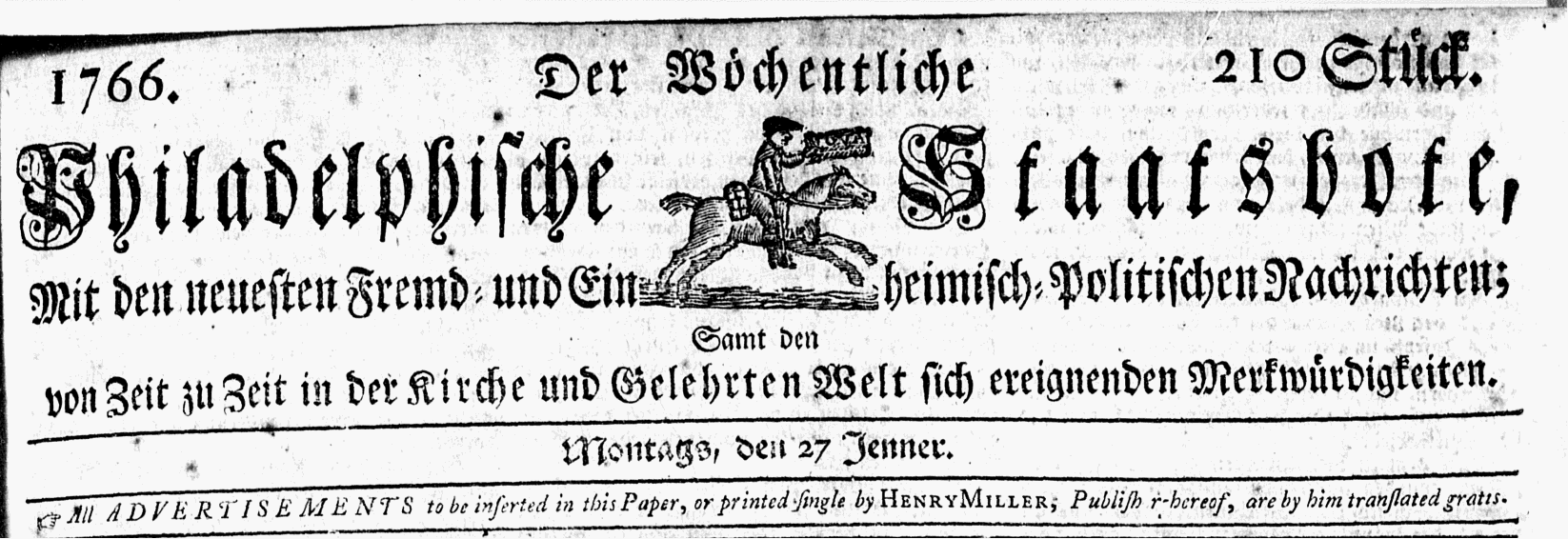
- [Philadelphia] Der Wochentliche Philadelphische Staatsbote
Maryland
- [Annapolis] Maryland Gazette (suspended at beginning of year; issues on January 30, February 20; resumed March 6)
Virginia
- [Williamsburg] Virginia Gazette (Hunter) (suspended at beginning of year; resumed March 7)
- [Williamsburg] Virginia Gazette (Rind) (began publication on May 16)
North Carolina
- [Wilmington] North-Carolina Gazette (last known issue on February 26)
South Carolina
- [Charleston] South-Carolina and American General Gazette
- [Charleston] South-Carolina Gazette (suspended at beginning of year; resumed June 2)
- [Charleston] South-Carolina Gazette and Country Journal
Georgia
- [Savannah] Georgia Gazette (suspended at beginning of year, but resumed May 21)
(Why were so many newspapers suspended at the beginning of the year? Was that unusual? Yes! When the Stamp Act went into effect on November 1, 1765, many newspapers stopped publication out of protest. Others continued in defiance of the Stamp Act. I’m planning to address the Stamp Act and its effects on advertising in a later post.)
Lathem indicates that twenty-eight newspapers were published in fifteen cities in eleven colonies (but not Delaware or New Jersey) in 1766. Eliminating those with few known issues as well as others that had been suspended or had not yet begun publication still leaves nineteen newspapers published in ten cities in eight colonies during the fourth week of January 1766. This includes newspapers published in New England, the Middle Atlantic, and the Lower South (but not the Chesapeake).
Now compare that to the list of newspapers I was able to access via my college’s subscription to Early American Newspapers.
New Hampshire
- [Portsmouth] New-Hampshire Gazette
Massachusetts
- Boston Evening-Post
- Boston Gazette
- Boston Post-Boy
- [Boston] Massachusetts Gazette
Rhode Island
- Newport Mercury
Connecticut
- [Hartford] Connecticut Courant
- New-London Gazette
New York
- New-York Gazette [Weyman’s]
- New-York Mercury
Philadelphia
- [Philadelphia] Der Wochentliche Philadelphische Staatsbote
This list consists of only eleven newspapers in seven cities in six colonies, compared to nineteen newspapers in ten cities in eight colonies actually published during the fourth week of January 1766. No newspapers from the Chesapeake or the Lower South appear on this list. (I am being generous here by including the German newspaper from Philadelphia even though I revealed a few weeks ago that I do not read German and will not be including German-language newspapers and advertisements in this project.)
I claimed last week that the geographic scope of advertisements I select derives from a methodology that is well-crafted and appropriate given the sources available. That claim comes into sharper focus now. I have been experimenting with what is possible using the resources available to me via an Internet connection from my living room or from my office, without stepping into an actual archive to examine original copies of newspapers or dreaded reels of microfilm.


It should now be apparent that I am working with an incomplete archive! Digitization is wonderful in so many ways. I love that I have so many sources available any time I am connected to the Internet. I appreciate that I am able to introduce my students to colonial newspapers in a way that just was not possible when I was an undergraduate. As I think about their tasks as guest curators in the coming weeks and how I might have approached a similar assignment as an undergraduate I realize that it would have been possible, with a lot of effort, at the major research university I attended, with its massive library and banks of microfilm readers. It would not, however, have been possible at the small liberal arts college where I currently teach, at least not without extensively relying on interlibrary loan to procure microfilms of colonial newspapers. My campus library certainly would not possess the budget to purchase all of these microfilms. Even then, the process might have been too cumbersome.
I now find myself on some sort of middle ground. Digitization of early American sources is a significant boon, both for research and teaching, but digital archives need to be approached with full awareness that they do not (yet and may never) replicate all the holdings of the physical collections in libraries, historical societies, and other institutions throughout the United States and beyond.


Next week I’ll explore varying levels of access to Early American Newspapers and how that shapes the scope of this project.
[1] Edward Connery Lathem, compiler, Chronological Tables of American Newspapers, 1690-1820: Being a Tabular Guide to Holdings of Newspaper Published in America through the Year 1820 (Barre, MA: American Antiquarian Society and Barre Publishers, 1972).