

What was advertised in a colonial American newspaper 250 years ago this week?

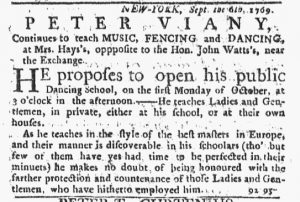
“But few of them have yet had time to be perfected in their minuets.”
During the first week of September 1769, Peter Vianey announced that he “Continues to teach MUSIC, FENCING and DANCING” to the residents of New York. The dancing master periodically placed advertisements in the city’s newspapers as a means of both cultivating his reputation and attracting new clients. In this particular notice, he announced that he would open his “public Dancing School” on the first Monday of October. He also taught private lessons, either at the school or in the homes of pupils.
In addition to publishing his advertisement as an act of self-promotion, Vianey offered another means of enhancing his reputation. He suggested that others could observe the benefits of his instruction in his students. The dancing master declared that “he teaches in the style of the best masters in Europe, and their manner is discoverable in his scholars.” Here Vianey walked a careful line. He expressed confidence in both his own ability and the achievements of his student, yet he hedged his bets when it came to sweeping expressions of approbation for the latter. He asserted that “few of them have yet had time to be perfected in their minuets.” Should any of his pupils falter when observed by others, Vianey supplied an explanation that did not negatively reflect on his instruction: his students made good progress but needed more practice. Furthermore, he guarded his position as an expert by making it clear that he could accurately assess the level of skill exhibited by his students; he was not so blinded by his own regard for his abilities as a dancing master that he could not recognize that his students had not “perfected” their steps. Indeed, his continued employment depended on being the master of his craft, no matter how well his pupils learned to dance. For any of his current and former pupils who encountered his advertisement, Vianey’s acknowledgment that they were not yet “perfected in their minuets” served to coax them to continue under his tutelage in order to remedy such shortcomings. As he coached “Ladies and Gentlemen” in the refined comportment of dancing, Vianey had to demonstrate the benefits of his instruction yet also avoid making his lessons obsolete. He presented himself as a master who always had more to teach, no matter the accomplishments of his pupils.