

What was advertised in a revolutionary American newspaper 250 years ago today?

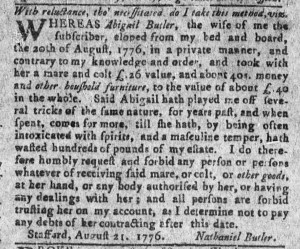
“All persons are forbid trusting her on my account, as I determine not to pay any debts of her contracting.”
Discord reigned in the Butler household in Stafford, Connecticut, getting to the point that Nathaniel found it necessary to publish an advertisement about the misbehavior of his wife, Abigail, in the September 9, 1776, edition of the Connecticut Gazette. He claimed that he did so “With reluctance,” but her actions “necessitated” resorting to “this method.” He certainly was not the only husband who ran a newspaper advertisement that instructed merchants, shopkeepers, and others not to extend credit to a wife who challenged his authority while she remained in their home and then abandoned him. Similar advertisements appeared in newspapers throughout the colonies and states in the eighteenth century and into the nineteenth century.
Yet Nathaniel composed a much more detailed account of Abigail’s infractions than appeared in most advertisements. He used standard language when he stated that she “eloped from my bed and board,” though he had already departed from the model with declaration that he placed the notice “With reluctance.” When Abigail left, she “took with her a mare and colt £. 26 value, and about 40 s[hillings] money and other household furniture, to the value of about £. 40 in the whole.” (That the couple had “household furniture,” a term for housewares, worth so much testified to their participation in the transatlantic consumer revolution. How much to spend at shops and stores may have been a point of contention in the Butler household.) According to Nathaniel, Abigail was a repeat offender who “hath played me off several tricks of the same nature, for years past, and when spent, comes for more.” To make matters worse, she “comes for more, till she hath, by being often intoxicated with spirits, and a masculine temper, hath wasted hundreds of pounds of my estate.” Most aggrieved husbands did not air their family’s dirty laundry by giving so many details, perhaps because they were already embarrassed that they had not managed to assert their patriarchal authority over their wives. No matter how much appeared in print, more stories likely circulated via the rumor mill. Nathaniel’s advertisement may have seemed to confirm some of the gossip and probably inspired more.
After laying out his grievances against his wife, Nathaniel “humbly request[ed]” that no one buy “said mare, or colt, or other goods, at her hand, or any body authorised by her.” Most husbands merely cut off credit, which Nathaniel also did when he declared that “all persons are forbid trusting her on my account,” but that was not sufficient in this case since Abigail absconded with horses and household good. She apparently had a history of selling off items she took with her.
Unlike most husbands in similar circumstances, Nathaniel expressed embarrassment over running the advertisement. His account did not reflect well on Abigail. It may have been an accurate rendering of what occurred, yet readers, then and now, had access to only one side of the story. Abigail may have been the more difficult spouse in that marriage … or Nathaniel may have conveniently left out details that did not reflect well on himself.