

What was advertised in a colonial American newspaper 250 years ago today?

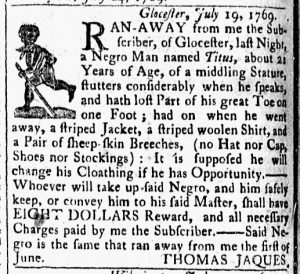
“Said Negro is the same that ran away from me the first of June.”
As white colonists fretted about their figurative enslavement by Parliament in the late 1760s and early 1770s, a “Negro Man named Titus” chafed under literal enslavement on Cape Ann in Massachusetts. In an advertisement from Gloucester in the Essex Gazette, Thomas Jaques announced that Titus made his escape sometime during the night of July 18, 1769. Titus cleverly timed his departure. Like most other colonial newspapers, the Essex Gazette published only one issue each week, distributing it on Tuesdays. Titus made his escape on a Tuesday night, perhaps realizing that Jaques would not be able to place a notice in the public prints for an entire week. With such a delay in mobilizing the power of the press to enlist other colonists in the surveillance necessary to capture him, Titus gained a bit of a head start. Jaques suspected that the young man was clever in other ways as well, cautioning that he would “change his Cloathing if he has Opportunity.” He was also resilient. Jaques indicated that Titus had attempted to escape in June as well.
Despite his best efforts in 1769, however, Titus did not manage to get clear of those who enslaved him. In an exhibition for the Cape Ann Museum, Molly O’Hagan Hardy identified two other advertisements concerning Titus that ran in the Essex Gazette, one in 1772 and the other in 1773. By that time, John Lee enslaved him in nearby Manchester, but Titus had no more intention of remaining under the authority of Lee than he did Jaques. Both advertisements reported that he “RAN away,” but did not acknowledge his repeated attempts to escape as acts of self-determination. These subsequent advertisements do not reveal how long he managed to make good on his escape in 1769, only that he somehow returned to bondage within the next few of years. Yet they also make clear that he was not dissuaded from his efforts to liberate himself. The final advertisement testified to his continued ingenuity, stating that Titus “has with him a false pass or Bill of Sale.” The enslaved man had either forged the document himself or found an accomplice to aid him in his escape. Lee warned “All Masters of Vessels and others” against harboring or transporting Titus “on Penalty of the Law,” but perhaps the forged document or sympathy for his plight or a combination of the two convinced someone to help him. Given that he made at least four attempts to escape, Titus was not the type to give up on freeing himself. The absence of further advertisements documenting additional attempts to escape suggests that Titus may have finally succeeded.