

What was advertised in a colonial American newspaper 250 years ago today?

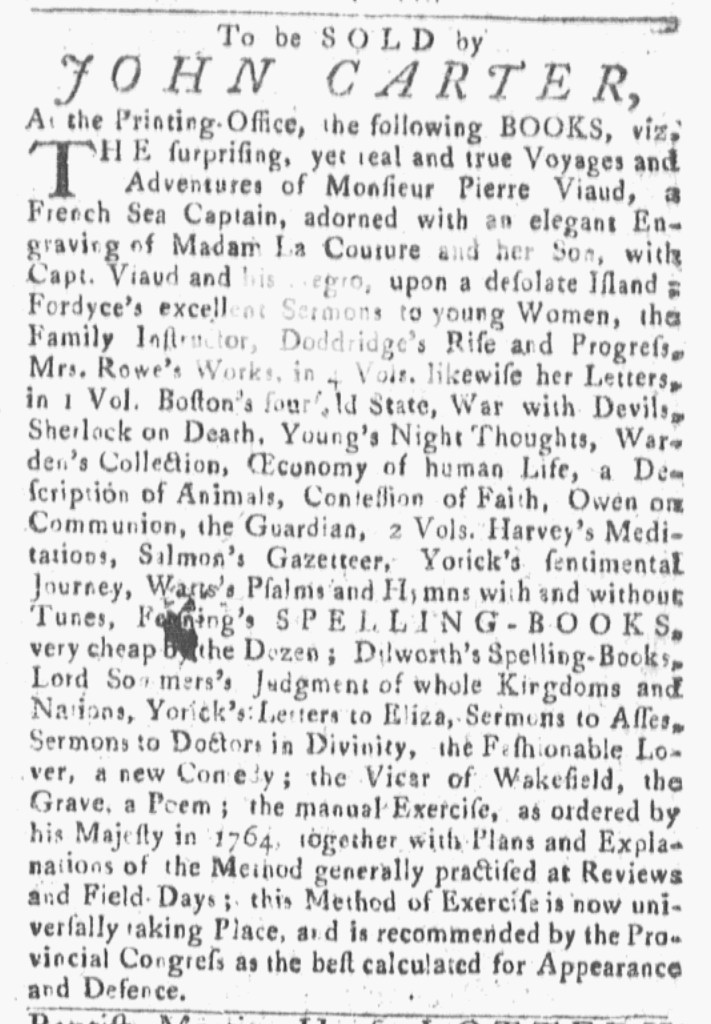
“The Manual Exercise … the best calculated for Appearance and Defence.”
As was often the case, John Carter, the printer of the Providence Gazette, placed several advertisements in his own newspaper on November 5, 1774, hoping to advance other revenue streams in his printing office. He placed five notices of varying lengths.
If they perused the contents of that issue from start to finish, readers first encountered an advertisement for books that Carter sold on the third page. It listed dozens of items, starting with “THE surprising, yet real and true Voyages and Adventures of Monsieur Pierre Viaud, a French Sea Captain, adorned with an elegant engraving of Madam La Couture and her Son, with Capt. Viaud and his Negro, upon a desolate island” that previously had been featured separately in a much more extensive advertisement and concluded with “the Manual Exercise, as ordered by his Majesty in 1764, together with Plans and Explanations of the Method generally practised at Reviews and Field Days,” a publication that had recently received some attention in Boston as well. Carter added a short note, advising that “this Method of Exercise is now universally taking Placer, and is recommended by the Provincial Congress as the best calculated for Appearance and Defence.” The printer did not specify the threat that colonizers faced; as the imperial crisis intensified following the passage of the Coercive Acts, readers understood the context for promoting that book.
On the fourth page, the second and third columns began and ended with advertisements from Carter. At the top of the second column, he declared that he had “JUST PUBLISHED” Benjamin West’s “NEW-ENGLAND A[L]MANACK, OR, Lady’s and Gentleman’s DIARY, For the Year of our LORD, 1775.” Two weeks earlier, he inserted a notice that publication of this annual collaboration with West, an astronomer and mathematician, was imminent. Carter completed the column with a short advertisement for “BLANKS of various Kinds to be sold by the Printer hereof.” The fourth column featured an advertisement addressed to the “FRIENDS of LIBERTY and USEFUL KNOWLEDGE,” alerting them that they could acquire copies of “ENGLISH LIBERTIES, OR, The free-born Subject’s INHERITANCE” at Carter’s printing office. He published that volume by subscription, a project that took quite some time. Upon publication, this advertisement appeared regularly in the Providence Gazette. The column ended with a call for “clean Linen Rags … and old Sail-Cloth” to supply the “PAPER MANUFACTORY in Providence.” Carter offered the “best Prices” to colonizers who supplied these items so essential to the printing trade.
In addition to his own advertisements, the printer inserted a brief note that “Advertisements omitted will be in our next.” How many advertisements did not appear? Did Carter’s own notices crowd out paid notices submitted by customers? Or had some advertisements arrived at the printing office too late to include in the November 5 edition? Carter had to weigh the advantages and disadvantages of giving too much space to advertisements concerning his own endeavors when others wished to pay for space in his newspaper.