

What was advertised in a revolutionary American newspaper 250 years ago today?

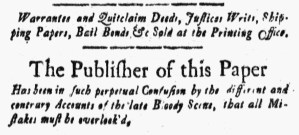
“Warrantee and Quitclaim Deeds, Justices Writs … Sold at the Printing Office.”
Daniel Fowle, the printer of the New-Hampshire Gazette, used one of his own advertisements to fill the space near the bottom of the last column on the final page of the April 21, 1775, edition. He devoted two lines to announcing, “Warrantee and Quitclaim Deeds, Justices Writs, Shipping Papers, Bail Bonds &c Sold at the Printing Office.” Many printers adopted a similar strategy, promoting goods they sold and services they provided when they had extra space in their newspapers.
Yet that advertisement was not the last word from the printer in that issue of the New-Hampshire Gazette. Fowle followed it with a notice that stated, “The Publisher of this Paper Has been in such perpetual Confusion by the different and contrary Accounts of the late Bloody Scene, that all Mistakes must be overlook’d.” He referred to the skirmishes at Lexington and Concord that occurred two days earlier on April 19. As the masthead proclaimed, Fowle published the “Freshest ADVICES,” but that meant going to press with the information that he received even if some reports contradicted others. Fowle anticipated that he would offer a clear account of events over time. For the moment, however, he did his best with the “different and contrary” stories to keep readers informed of what he recognized as momentous events even if all the details were not yet clear.


To that end, the first column on the first page not only began with a rare headline but one that demanded attention: “BLOODY NEWS.” In an introductory note, the printer explained that “Early this Morning,” on April 20, “we were alarmed with an Express from Newbury-Port, with the following Letter, to the Chairman of the Committee of Correspondence in this Town.” That letter relayed “Reports of the TROOPS having marched out of Boston to make some Attack in the Country.” Those reports “in general concur, in part, in [British troops] having been at Lexington.—And it is very generally said they have been at Concord.” The rider who brought that letter supplement it with his own version of what he had heard. Fowle also published updated information from two other express riders who arrived in Portsmouth on April 20, one in the afternoon and the other in the evening. He devoted an entire column to breaking news from Lexington and Concord.
Many of the readers that Fowle hoped would purchase the various printed blanks that he advertised had no doubt heard that something had happened at Lexington and Concord before they saw the April 21 edition of the New-Hampshire Gazette, yet they would have looked to it for confirmation and additional details. Fowle gave them more details, but stopped short of confirming the accuracy of all of them. In the coming weeks, he would sift through even more accounts as events continued to unfold, chronicling the Revolutionary War as it happened.