

What was advertised in a revolutionary American newspaper 250 years ago today?

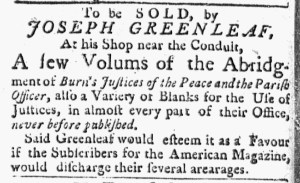
“A Variety of Blanks for the Use of Justices … never before published.”
Joseph Greenleaf, a printer and bookseller, placed an advertisement in the July 25, 1776, edition of the New-England Chronicle to advise prospective customers that he had for sale a “few Volums of the Abridgment of Burn’s Justices of the Peace and the Parish Officer” at his shoo “near the Conduit,” a water reservoir in Boston. He also stocked a “Variety of Blanks” (or forms) “for the Use of Justices, in almost every part of their Office, never before published.” Greenleaf did not explain what he meant by blanks “never before published.” Officials, attorneys, and merchants regularly purchased blanks for all sorts of legal, financial, and commercial transactions because they featured standardized language and thus saved the time and expense of writing everything out by hand. Instead, the interested parties filled in the blank spaces with the relevant information. Perhaps Greenleaf devised new blanks based on templates or instructions that appeared in the abridgement of Richard Burn’s manual for justices of the peace. Given the news that recently arrived from Philadelphia, he may have also included references to the state of Massachusetts in the wake of the Continental Congress declaring independence from Great Britain.
The printer and bookseller added a request at the end of his advertisement: “Said Greenleaf would esteem it as a Favour if the Subscribers for the American Magazine would discharge their several arearages.” Greenleaf acquired the Royal American Magazine from Isaiah Thomas in the summer of 1774. Thomas fell behind on publishing and distributing new issues as the imperial crisis intensified, especially after the Boston Port Act closed the harbor on June 1 of that year. Greenleaf worked diligently to serve subscribers, eventually catching up on the overdue issues, but then the outbreak of the war with the skirmishes as Lexington and Concord made it impossible for him to continue the magazine. Greenleaf fled from the city and made his way to Watertown as the siege of Boston began, advertising in the Essex Journal in June 1775 that he had been “driven from his house and business by the perfidious [General Thomas] Gage.” In that same notice, he asked for subscribers in “Newbury, Newbury-Port, and the vicinity” to pay what they owed for the magazines they received. A few months later, his son, Thomas, made a similar request to subscribers in “this and the neighbouring towns” in the Providence Gazette. Greenleaf tried once again in July 1776, his pleas echoing those of newspaper printers who so often called on subscribers who had not made payments in years.