What was advertised in a revolutionary American newspaper 250 years ago today?
New-England Chronicle (September 5, 1776).
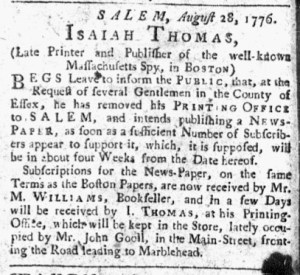
“ISAIAH THOMAS … has removed his PRINTING OFFICE to SALEM.”
Isaiah Thomas had plans to establish a new newspaper in Salem in the fall of 1776. He announced his intention in an advertisement in the September 5 edition of the New-England Chronicle, declaring that “at the Request of several Gentlemen in the County of Essex, he has removed his PRINTING OFFICE to SALEM” and would begin publishing a newspaper there “as soon as a sufficient Number of Subscribers appear to support it.” Thomas described himself as the “Late Printer and Publisher of the well-known Massachusetts Spy, in BOSTON,” but he did not mention that he had also left Boston just before the battles at Lexington and Concord and printed the Massachusetts Spy in Worcester throughout the siege of Boston. Not long after the British evacuated Boston in March 1776, Thomas made plans to return to the coast and leased the Massachusetts Spy to William Stearns and Daniel Bigelow. He had more experience printing a newspaper that supported the American cause than he acknowledged in his advertisement.
To make his new newspaper competitive with others printed in and near Boston, Thomas pledged that customers could purchase subscriptions “on the same Terms as the Boston Papers.” M. Williams, a bookseller, already collected subscriptions. The printer anticipated that he would soon take in subscriptions at his printing office in the store previously occupied by John Gooll “in the Main-Street, fronting the Road leading to Marblehead.” He estimated that it would take about four weeks to gather enough subscribers to support the newspaper. Despite his efforts and experience, however, the new newspaper never materialized. Thomas recounted what happened only briefly in his History of Printing in America(1810), stating that “many obstructions to the plan arising in consequence of the war” caused him to sell “the printing materials which he carried to that town.” In 1778, he returned to Worcester, “took into possession the press which he had left there, and resumed the publication” of the Massachusetts Spy.[1] People clamored for the news, as a notice from Stearns and Bigelow in the Massachusetts Spy demonstrated, yet that was not necessarily enough to make printing a newspaper a viable enterprise. Whether or not Thomas attracted enough subscribers, a variety of challenges, including shortages of paper during the Revolutionary War, prevented him from launching a newspaper in Salem.
**********
[1] Isaiah Thomas, The History of Printing in America: With a Biography of Printers and an Account of Newspapers (1810; New York: Weathervane Books, 1970), 181.
What was advertised in a revolutionary American newspaper 250 years ago today?
New-England Chronicle (August 2, 1776).
“The Sale of the CARGO of the Prize Ship Lady JULIANA, from Jamaica.”
On August 2, 1776, Joseph Russell, an auctioneer, placed advertisements about an upcoming sale in both newspapers published in Boston, the Continental Journal and the New-England Chronicle. He advised readers that “the Sale of the CARGO of the Prize Ship Lady JULIANA, from Jamaica,” would begin in the morning on the following Wednesday. That cargo included “choice Sugars,” rum, ginger, “568 Jamaica Hides, very large,” “63 Planks of Mohogony,” cocoa, tortoise shell, “old Copper, Brass and Pewter,” and “17 Elephants Teeth.” Russell noted that the ship was “now laying at the Honourable JOHN HANCOCK, Esqr’s Wharf,” but did not indicate whether prospective bidders were welcome to examine the cargo before it went up for bids.
He did, however, provide a list of “CONDITIONS of SALE.” That was unusual in an advertisement for an auction, but Russell may have considered it necessary since this auction concerned the cargo of a prize ship rather than a private auction. Some of the proceeds would be divided among the privateers who captured the ship with the remainder going to the government. In other instances, bidders sought the best possible bargains, but the “CONDITIONS” for this auction required that “every Bidder shall advance 5-per Cent. on every Bid.” That made bids increase more substantially than smaller increments that bidders might have otherwise preferred. Russell also informed prospective bidders that “every Purchaser shall pay down as Earnest Money, 10-per Cent. and the Remainder in three Days after the Purchase.” The auctioneer had no intention of extending credit for long periods. The winning bidders had to put down a deposit immediately and submit the rest of the payment within three days. Failure to do so meant not only losing the goods but also “Forfeiture of the advance Money.” Such “CONDITIONS” warned prospective bidders not to conduct themselves according to the resources available to them on the day of the auction. The final condition concerned disputes “between two or more Bidders.” In such cases, “the Article in Dispute shall be put up again.” The auctioneer expected good behavior and an orderly process. Those who did not abide risked losing out on the cargo they hoped to acquire at the auction.
What was advertised in a revolutionary American newspaper 250 years ago today?
New-England Chronicle (July 25, 1776).
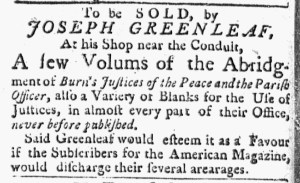
“A Variety of Blanks for the Use of Justices … never before published.”
Joseph Greenleaf, a printer and bookseller, placed an advertisement in the July 25, 1776, edition of the New-England Chronicle to advise prospective customers that he had for sale a “few Volums of the Abridgment of Burn’s Justices of the Peace and the Parish Officer” at his shoo “near the Conduit,” a water reservoir in Boston. He also stocked a “Variety of Blanks” (or forms) “for the Use of Justices, in almost every part of their Office, never before published.” Greenleaf did not explain what he meant by blanks “never before published.” Officials, attorneys, and merchants regularly purchased blanks for all sorts of legal, financial, and commercial transactions because they featured standardized language and thus saved the time and expense of writing everything out by hand. Instead, the interested parties filled in the blank spaces with the relevant information. Perhaps Greenleaf devised new blanks based on templates or instructions that appeared in the abridgement of Richard Burn’s manual for justices of the peace. Given the news that recently arrived from Philadelphia, he may have also included references to the state of Massachusetts in the wake of the Continental Congress declaring independence from Great Britain.
The printer and bookseller added a request at the end of his advertisement: “Said Greenleaf would esteem it as a Favour if the Subscribers for the American Magazine would discharge their several arearages.” Greenleaf acquired the Royal American Magazine from Isaiah Thomas in the summer of 1774. Thomas fell behind on publishing and distributing new issues as the imperial crisis intensified, especially after the Boston Port Act closed the harbor on June 1 of that year. Greenleaf worked diligently to serve subscribers, eventually catching up on the overdue issues, but then the outbreak of the war with the skirmishes as Lexington and Concord made it impossible for him to continue the magazine. Greenleaf fled from the city and made his way to Watertown as the siege of Boston began, advertising in the Essex Journal in June 1775 that he had been “driven from his house and business by the perfidious [General Thomas] Gage.” In that same notice, he asked for subscribers in “Newbury, Newbury-Port, and the vicinity” to pay what they owed for the magazines they received. A few months later, his son, Thomas, made a similar request to subscribers in “this and the neighbouring towns” in the Providence Gazette. Greenleaf tried once again in July 1776, his pleas echoing those of newspaper printers who so often called on subscribers who had not made payments in years.
Who was the subject of an advertisement in a revolutionary American newspaper 250 years ago today?
Maryland Gazette (July 4, 1776).
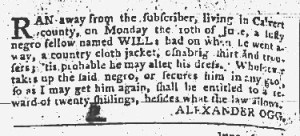
“RUN AWAY … [a] negro fellow named WILL.”
On July 4, 1776, the delegates to the Continental Congress in Philadelphia voted to approve a revised version of a declaration of independence written by Thomas Jefferson, John Adams, Benjamin Franklin, and others appointed for that task. In the 250 years that have passed since that momentous event, the document they approved has become known as the Declaration of Independence and July 4 has been celebrated as the day the colonies, now states, declared their independence from Great Britain. Celebrations and commemorations of that event often overlook other declarations of independence made on July 4, 1776. On that day, American newspapers published more than half a dozen advertisements concerning enslaved people who declared their independence by running away from their enslavers.
Maryland Gazette (July 4, 1776).
The Maryland Gazette, published in Annapolis, carried two such notices. In one, Alexander Ogg of Calvert County offered a reward for the capture and return of Will, a “negro fellow” who liberated himself three weeks earlier on June 10. Ogg described what Will wore when he departed, but he also reported that “‘tis probable he may alter his dress” to avoid detection. In so doing, Ogg acknowledged that Will was clever as well as courageous. In the other advertisement, Anne Gaither of Annapolis sought the return of “a negro fellow named FLANDERS.” She mentioned that he “has been used to go by water,” indicating that he had experience working on boats or ships just like many other enslaved men who lived on or near the Chesapeake Bay. Gaither also reported that Flanders “has no toes,” though she did not elaborate on that detail. Flanders, no doubt, would have told a much more robust story about who he was and what he had experienced if given the opportunity.
New-York Journal (July 4, 1776).
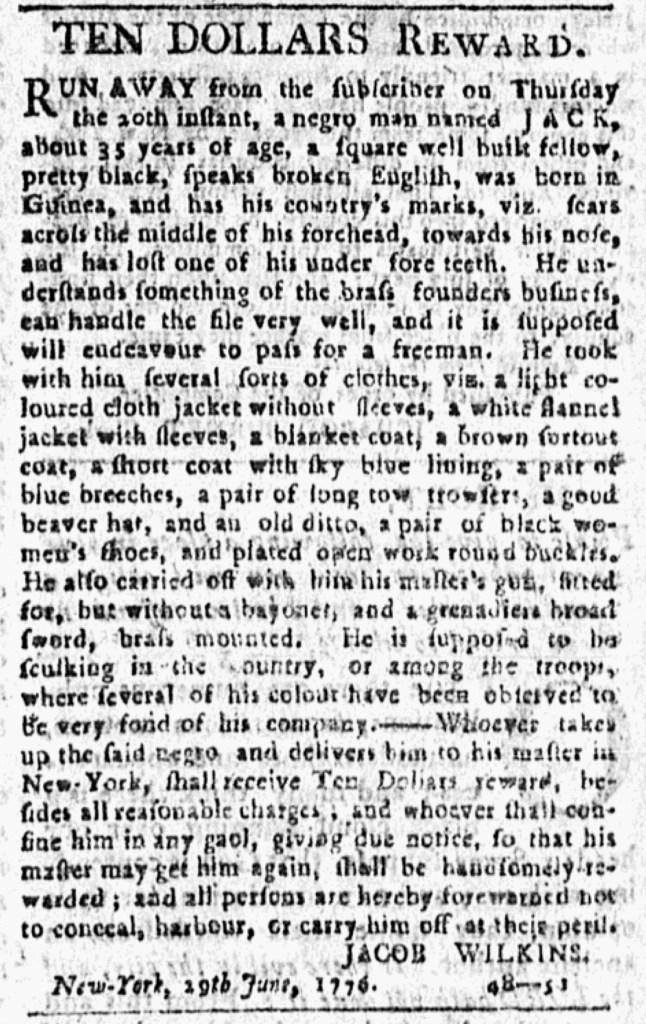
Enslaved people in southern colonies were not the only ones who liberated themselves by running away at the same time that the Continental Congress voted to declare independence. The New-York Journal carried Jacob Wilkins’s advertisement regarding “a negro man named JACK” who liberated himself from his enslaver on June 20. Jack “carried off with him his master’s gun, fitted for, but without a bayonet, and a grenadiers broad sword, brass mounted.” Wilkins suspected that Jack made his way out of the city and was “sculking in the country, or among the troops, where several of his colour have been observed to be very fond of his company.” The many disruptions caused by the war presented opportunities for enslaved people to free themselves by fleeing from their enslavers. To help readers recognize Jack, Wilkins gave his age, “about 35 years,” and mentioned some distinguishing physical characteristics. Having been “born in Guinea,” Jack had “his country’s marks” or ritual scarring “across the middle of his forehead, [and] towards his nose.” At some point, he “lost one of his under fore teeth.” During his enslavement, Jack learned to speak “broken English.” He also developed valuable skills: he “understands something of the brass founders business, [and] can handle the file very well.” Many enslaved people were skilled artisans. Wilkins lamented that Jack “will endeavour to pass for a freeman.” Jack made himself a free man with his decision to escape from Wilkins.
New-York Packet (July 4, 1776).
The New York Packet carried another advertisement, this one regarding “a Negro Man, named BEN,” placed by John Taylor of “New Germantown, Hunterdon county, West Jersey.” Ben liberated himself on June 5 and had evaded capture for a month. Taylor focused primarily on describing Ben and his clothing, noting the young man’s height, age (“twenty-two years old”), and a left leg “considerably larger than the other, with a large scar on the small of said leg.” Ben wore a blue coat, red jacket, black breeches, and “calf skin shoes, [with] a pair of carved silver buckles,” though he also took another coat and jacket, “a fine shirt with ruffles at the bosom, a pair of woollen trowsers, [and] a half worn wool hat” in a bag “marked I.T. near the mouth.” Given a chance to write about himself, Ben certainly would have chosen to a tell a different story than the one that Taylor relayed. If readers detected a young black man carrying a bag with his former enslaver’s initials, Taylor offered a reward for securing him in any jail until he could retrieve him.
Continental Journal (July 4, 1776).
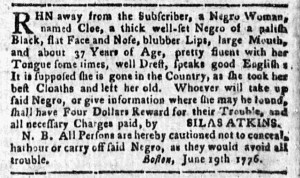
The Continental Journal, published in Boston after the siege of that city ended, carried two advertisements about enslaved people who liberated themselves. Silas Atkins described Cloe, “a Negro Woman” who was “likely gone in the Country, as she took her best Cloaths and left her old.” Atkins gave Cloe’s age (“37 Years’), provided a physical description, and noted that she “speaks good English,” all characteristics that would aid readers in identifying her. Cloe had been gone since the middle of June. Atkins promised that anyone who “will take up said Negro, or give information where she may be found, shall have Four Dollars for their Trouble” as well as any expenses they incurred. In a nota bene, he added a standard warning that appeared in many such advertisements: “All Persons are hereby cautioned not to conceal, harbour or carry off said Negro, as they would avoid all trouble.” The “trouble” would not come from Cloe but rather from legal action undertaken by Atkins.
Continental Journal (July 4, 1776).
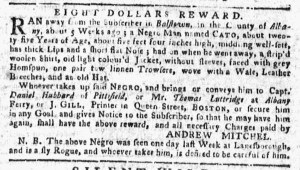
The other advertisement in the Continental Journal concerned “a Negro Man named CATO, about twenty-five Years of Age,” who liberated himself from Andrew Mitchel of “Balstown [Ballston], in the County of Albany, about 5 Weeks ago.” Mitchel described Cato’s features and clothing, but he did not provide other details. He devoted nearly as much space to the network of associates who agreed to aid him by holding Cato until he could retrieve him if a reader managed to capture him. Those seeking the reward could deliver Cato “to Capt. Daniel Hubbard of Pittsfield, [Massachusetts], or Mr. Thomas Luttridge at Albany Ferry, or J. GILL, Printer in Queen Street, BOSTON, or secure him in any Goal [Jail]” and notify Mitchel. In a nota bene, the enslaver reported that Cato “was seen one day last Week at Lanesborough [in western Massachusetts], and is a sly Rogue, and whoever takes him, is desired to be careful of him.” Mitchel meant “sly Rogue” as an insult, not intending to compliment Cato on the ingenuity and perseverance he expected the young Black man to demonstrate in attempting to escape if captured.
New-England Chronicle (July 4, 1776).
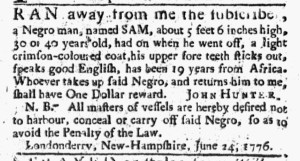
One more advertisement in a newspaper published in Boston, the New-England Chronicle, identified an enslaved man who liberated himself by running away from his enslaver. This one concerned Sam, “a Negro man” who escaped from John Hunter of Londonderry, New Hampshire, in late June. Hunter did not know Sam’s age, estimating that he was “30 or 40 years old,” but he did know that Sam “has been 19 years from Africa” and in that time learned to speak “good English.” Readers might recognize Same from his “upper fore teeth” that stuck out or by the “light crimson-coloured coat” that he wore. Hunter inserted a nota bene with a warning like the one that appeared in Atkins’s advertisement about Cloe: “All masters of vessels are hereby desired not to harbour, conceal or carry off said Negro, so as to avoid the Penalty of the Law.” Hunter included an evocative phrase when he said that Sam “has been 19 years from Africa.” What kind of stories would Sam have told about his own life and his decision to liberate himself after so many years of bondage?
The men who gathered in the Pennsylvania State House (now known as Independence Hall) to declare independence from Great Britain are often called the founders of the nation, yet they were not the only ones who envisioned freedom from oppression. They were members of a founding generation that included soldiers and farmers, women and youth, and many others from diverse backgrounds who contributed to the American cause. Will, Flanders, Jack, Ben, Cloe, Cato, and Sam were all founders as well. They made their own declarations of independence during the era of the American Revolution and their former enslavers published those declarations of independence on July 4, 1776. Will, Flanders, Jack, Ben, Cloe, Cato, and Sam joined countless other enslaved men and women who seized their liberty during the seventeenth, eighteenth, and nineteenth centuries. Those courageous and resilient men and women sought freedom long before the American Revolution and continued seeking freedom long after the American Revolution. Their stories matter and must be told alongside the stories of other founders as we celebrate and commemorate 250 years of independence.
For other stories of enslaved people liberating themselves originally published on July 4 during the era of the American Revolution, see:
What was advertised in a revolutionary American newspaper 250 years ago today?
Continental Journal (June 20, 1776).
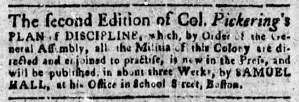
“Col. Pickering’s PLAN of DISCIPLINE, which … all the Militia of this Colony are directed and enjoined to practise.”
When he transferred the New-England Chronicle to Edward E. Powars and Nathaniel Willis in June 1776, Samuel Hall informed the public that “PRINTING in general will be continued at the Subscriber’s Office in School-street [in Boston], and performed with accuracy and dispatch.” Although he would no longer publish a newspaper, Hall continued to earn his livelihood through job printing and other projects. One of those projects was a second edition of Timothy Pickering’s Easy Plan of Discipline for a Militia. Hall and his brother, Ebenezer, published and advertised the first edition nearly a year earlier. As the war continued, the American army needed more copies military manuals, including Pickering’s manual.
On June 20, Hall inserted advertisements in both the Continental Journal and the New-England Chronicle, the only newspapers published in Boston at the time. “The second Edition of Col. Pickering’s PLAN of DISCIPLINE, which by Order of the General Assembly, all the Militia of this Colony are directed and enjoined to practise,” Hall announced, “is not in the Press, and will be published, in about three Weeks.” The advance notice gave interested parties an opportunity to reserve copies. That, in turn, helped Hall determine how many copies to print. After all, he did not publish the manual solely as a service. He aimed to generate revenue with the venture. He did not want an excessive number of surplus copies to eat into profits.
That an “Order of the General Assembly” directed the colony’s militia to consult Pickering’s military manual no doubt helped sales. Yet Pickering received yet another important endorsement for his Easy Plan of Discipline for a Militia. He sent a copy to George Washington following his appointment as commander-in-chief of the Continental Army by the Second Continental Congress. In turn, according to the American Revolution Institute, “Washington promoted the use of several published works, including Timothy Pickering’s An Easy Plan of Discipline for a Militia and Thomas Hanson’s The Prussian Evolutions” in the years before the Baron von Stueben’s Regulations for the Order and Discipline of the Troops of the United States became the first official manual of the Continental Army in 1779. With such support, Hall could feel confident that a second edition of Pickering’s military manual would meet with success.
What was advertised in a revolutionary American newspaper 250 years ago today?
New-England Chronicle (June 13, 1776).
“Rendering due praise and honour to the manly and virtuous supporters of the GLORIOUS CAUSE OF AMERICA.”
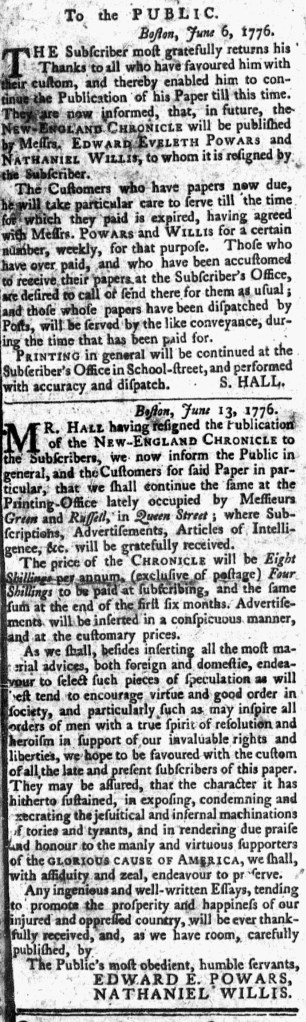
It was the first issue of the New-England Chronicle published by Edward E. Powars and Nathaniel Willis after Samuel Hall transferred the newspaper to them. Their names appeared in the colophon integrated into the masthead at the top of the first page: “BOSTON: Printed by POWARS and WILLIS at their Office opposite the new COURT-HOUSE, Queen-Street.” For the first order of business in the June 13, 1776, edition, the former printer and the new printers reminded readers about the transition in notices that ran in the first column on the first page. They previously made the announcement in separate advertisements in the last issue. Hall’s notice ran again without revisions or additions (except for a salutation, “To the PUBLIC,” and the original date, “Boston, June 6, 1776”) while Powars and Willis took the opportunity to add to their previous advertisement.
In so doing, they vowed to continue the editorial stance practiced by Hall. The public, Powars and Willis promised, “may be assured, that the character [the New-England Chronicle] has hitherto sustained, in exposing, condemning, and execrating the jesuitical and infernal machinations of tories and tyrants, and in rendering due praise and honour to the manly and virtuous supporters of the GLORIOUS CAUSE OF AMERICA, we shall, with assiduity and zeal, endeavour to preserve.” The New-England Chronicle catered to Patriots in Boston less than two months after the siege of that city ended when British troops departed on March 17. Powars and Willis took their responsibilities seriously, stating that they would “select such pieces … as will best tend to encourage virtue and good order in society, and particularly such as may inspire all orders of men with a true spirit of resolution and heroism in support of our invaluable rights and liberties.” With such promises made, they hoped “to be favoured with the custom of all the late and present subscribers of this paper.” In other words, they encouraged readers who previously subscribed to renew their subscriptions and current subscribers to continue receiving the New-England Chronicle. Their previous notice solicited subscribers and advertisers. That portion appeared again, but this time the printers also requested “ingenious and well-written Essays, tending to promote the posterity and happiness of our injured and oppressed country.” Through an eighteenth-century version of crowdsourcing, the public could play a role in maintaining the editorial voice that readers expected from the New-England Chronicle. The publication had new printers, but those new proprietors pledged that the newspaper would remain the same.
What was advertised in a revolutionary American newspaper 250 years ago today?
New-England Chronicle (June 6, 1776).
“After this week, the NEW-ENGLAND CHRONICLE will be published by Messrs. EDWARD EVELETH POWARS and NATHANIEL WILLIS.”
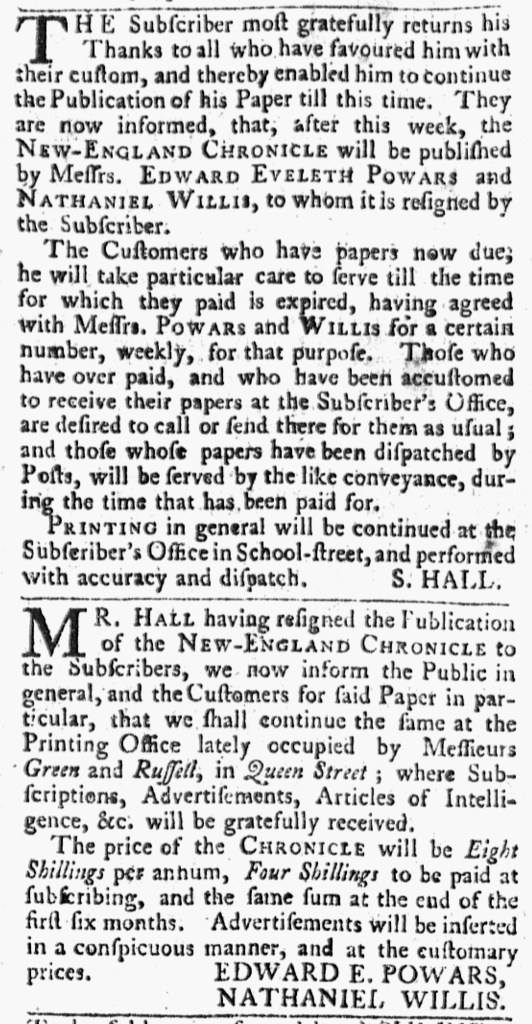
It was the last issue of the New-England Chronicle printed by Samuel Hall, but it would not be the last issue of that newspaper. Instead, Hall “resigned the Publication of the NEW-ENGLAND CHRONICLE” to Edward E. Powars and Nathan Willis. The former publisher and the new publishers informed subscribers and other readers what to expect in advertisements that appeared one after the other in the June 6, 1776, edition.
Hall went first, expressing his appreciation and “Thanks to all who have favoured him with their custom, and thereby enabled him to continue the Publication of his Paper till this time.” Hall and his newspaper had undertaken an interesting journey over the past year and more. In the spring of 1775, Hall and his brother, Ebenezer, were publishing the Essex Gazette in Salem. After the battles at Lexington and Concord on April 19, all the newspapers in Boston folded, suspended publication, or moved to other towns. The Halls published the last issue of the Essex Gazette in Salem on May 2, 1775, just a couple of weeks after the war began. With the siege of Boston underway, the Halls moved to Cambridge, putting them and their newspaper in closer proximity to the army and the provincial congress. The continued publishing their newspaper without a change in numbering but with a new name, the New-England Chronicle, on May 12. Following Ebenezer’s death on February 14, 1776, Samuel continued as the sole printer. The siege of Boston concluded when British forces departed on March 17. Hall published the last issue of the New-England Chronicle in Cambridge on April 4. He then moved into Boston and printed the first issue of the New-England Chronicle in that city on April 25. Loyal customers had indeed “enabled him to continue the Publication of his Paper till this time” when he transferred it to Powars and Willis.
Although Hall no longer printed a newspaper, he continued running a printing office “next to the OLIVER CROMWELL Tavern, in SCHOOL-STREET,” in Boston. In their advertisement, Powars and Willis announced that they would publish the New-England Chronicle “at the Printing Office lately occupied by Messieurs Green and Russell, in Queen Street.” They solicited subscriptions, advertisements, and “Articles of Intelligence” for publication. The new proprietors of the newspaper listed the subscription price, eight shillings per year, but not the price for advertisements. Instead, they promised that notices “will be inserted in a conspicuous manner,” making them worth the investment, “at the customary prices.” Powars and Willis hoped that subscribers would continue with the New-England Chronicle now that they published it.
What was advertised in a revolutionary American newspaper 250 years ago today?
New-England Chronicle (May 9, 1776).
“The Sign of the YANKEE HERO.”
The May 9, 1776, edition of the New-England Chronicle once again carried an advertisement for the “American Coffee-House,” the establishment that Daniel Jones opened on King Street not long after British troops brought the siege to an end by departing from Boston on March 17. Jones invited the “Gentlemen of the UNITED COLONIES” to enjoy the “best of liquors, lodgings, and a variety of provisions” in addition to coffee. Jones made clear that the “American Coffee-House” was a place for patriots to gather.
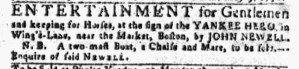
That was also the case at the tavern that John Newell ran “in Wing’s-Lane, near the Market.” He published a short advertisement that announced, “ENTERTAINMENT for Gentlemen and keeping for Horses, at the sign of the YANKEE HERO.” That name honored the accomplishments and the sacrifices made in Massachusetts over the past year and throughout the imperial crisis. It included the victims of the Boston Massacre on March 5, 1770, and the Sons of Liberty who tossed tea into the harbor on December 16, 1773. The “YANKEE HERO” referred to the men involved in the first battles of the war, the battles at Lexington and Concord on April 19, 1775. Some had been killed, but others forced the British back into Boston where they were besieged for nearly a year. The “YANKEE HERO” referred to the men from Massachusetts and throughout New England who left their towns to participate in the siege. It also referred to the men who fought at the Battle of Bunker Hill on June 17, 1775, especially the men died in that engagement. Those casualties included Joseph Warren, recently commissioned a major general in the colony’s militia, president of the Massachusetts Provincial Congress, and an advocate of American liberties during the imperial crisis that became a war. Yet Newell did not name his tavern after Warren nor after John Adams, Samuel Adams, John Hancock, or any of the other leaders who had been so active at town meetings in Boston or represented Massachusetts in the Second Continental Congress. Instead, he likely intended for prospective patrons to think of the many men who answered the call to defend their colony and their liberties, some making a final sacrifice to do so, and perhaps even to see themselves in the character of the “YANKEE HERO” as they continued in their resistance to British tyranny. Where they chose to gather to drink, socialize, and discuss politics resonated with an identity shifting from British to American on the eve of declaring independence.
What was advertised in a revolutionary American newspaper 250 years ago this week?
New-England Chronicle (May 2, 1776).
“News-Carriers from Boston to Northampton, Deerfield, &c.”
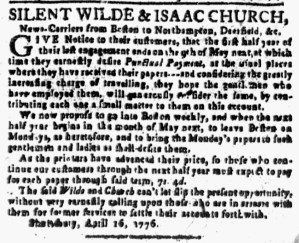
An advertisement that Silent Wilde and Isaac Church inserted in the May 2, 1776, edition of the New-England Chronicletestifies to the infrastructure for disseminating information in Massachusetts as the Revolutionary War entered its second year. These “News-Carriers from Boston to Northampton, Deerfield,” and other towns, as they described themselves, helped in keeping residents in western Massachusetts informed about the latest news from Boston and, via letters from correspondents and items reprinted from newspapers from other colonies, about current events throughout the continent and the Atlantic world.
Wilde and Church stated that they “go into Boston weekly” and “leave Boston on Mondays … to bring the Monday’s papers to such gentlemen and ladies as shall desire them.” By “go into Boston,” they may have meant Watertown, where Benjamin Edes published the Boston-Gazette and Country Journal during the siege of Boston and remained for several months after the British evacuated the city. Edes distributed new issues on Mondays. The “News-Carriers” composed their message on April 16, during a period that Samuel Hall briefly suspended the New-England Chronicle when relocating from Cambridge (with the final issue published there on April 4) to Boston (with the first issue published there on April 25). Whether in Cambridge or Boston, new issues of the New-England Chronicle came out on Thursdays. Wilde and Church apparently planned their service around the Boston-Gazette even though they carried both newspapers printed in the Boston area and picked up Thomas’s Massachusetts Spy (published on Fridays) when they passed through Worcester.
Wilde and Church also reminded their customers that “the printers have advanced” or raised “their price” for subscriptions, so those who availed themselves of the delivery service needed to take that into account when making payment. In addition, due to the “greatly increasing charge of travelling, they hope the gentlemen who have employed them, will generously consider the same, by contributing each one a small matter to them on this account.” In other words, Wilde and Church requested tips to help cover expenses that had gone up since entering into agreements with their customers in Northampton, Deerfield, and other towns in western Massachusetts. They also “can’t let slip the present opportunity without very earnestly calling upon those who are in arrears with them for former services to settle their accounts forthwith.” If customers were not inclined to give the “News-Carriers” a tip, they could at least pay what they owed.
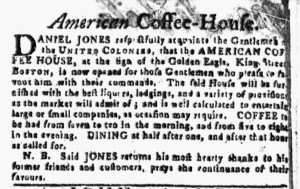
What was advertised in a revolutionary American newspaper 250 years ago today?
New-England Chronicle (May 2, 1776).
“American Coffee-House.”
Not long after British forces departed from Boston on March 17, 1776, and the siege of the city ended, Daniel Jones opened the “American Coffee-House.” At about the same time, Samuel Hall, the printer of the New-England Chronicle, moved his printing office from “Stoughton-Hall, HARVARD-COLLEGE,” in Cambridge into Boston “next to the OLIVER CROMWELL TAVERN, in SCHOOL-STREET.” He printed the first issue in the formerly occupied city on April 25. A week later, Jones ran a notice in which he “respectfully acquaints the Gentlemen of the UNITED COLONIES, that the AMERICAN COFFEE HOUSE, at the sign of the Golden Eagle, King Street, BOSTON, is now opened for those Gentlemen who please to favour him with their commands.”
As much as Jones hoped to offer a place of respite for patrons who joined him for coffee and dining, that opening sentence testified to the uncertainty of the times. The war had entered its second year. When it began, most colonizers sought a redress of their grievances within the imperial system, but over time more and more of them advocated for declaring independence, especially following the publication of Thomas Paine’s Common Sense in Philadelphia in January 1776 and the widespread dissemination of local editions in the following months. In the past, establishments like the one that Jones advertised were often known as the London Coffee House, a nod to the largest and most cosmopolitan city in the empire and, especially, to the transatlantic and even global networks of commerce that converged there. Yet Jones named his establishment the “American Coffee-House” and addressed the “Gentlemen of the UNITED COLONIES,” privileging their American identity and acknowledging that the diverse colonies had banded together. A Continental Congress organized resistance. A Continental Army defended American liberties. Even though Jones associated his new establishment with the American cause, it happened to be located on King Street (which would be renamed State Street shortly after the Treaty of Paris officially ended the Revolutionary War). The “sign of the Golden Eagle,” a familiar device in several towns, one that did not have revolutionary significance, marked the coffeehouse’s location. That the “Gentlemen of the UNITED COLONIES” gathered at the “AMERICAN COFFEE HOUSE” on King Street exemplified the transition taking place as colonizers moved from engaging in resistance to embracing revolution in 1776.