

What was advertised in a revolutionary American newspaper 250 years ago today?

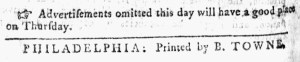
“Advertisements omitted this day will have a good place on Thursday.”
The August 20, 1776, edition of the Pennsylvania Evening Post consisted almost entirely of news. Benjamin Towne, the printer, placed news from London, including an overview of recent events in the House of Commons, on the first page, along with updates from Williamsburg, and Baltimore. Two advertisements, the only ones in that issue, completed the final column on the first page. An “ADDRESS of General ROBERDEAU to the Pennsylvania Associators at Amboy” filled the entire second page and spilled over onto the third, “published by order of the Convention of Pennsylvania.” A copy of the “DECLARATION of RIGHTS passed by the Convention of this state” filled the remainder of that page. The first column on the last page contained “ADVICES BY THIS DAY’s POST” with reports from Newburyport, Massachusetts; Newport, Rhode Island; and New York. The final column had recent updates from the “CONVENTION for the STATE of PENNSYLVANIA” and the “COUNCIL of SAFETY” in Philadelphia.
A brief notice from the printer and the colophon completed the issue. “Advertisements omitted this day,” Towne pledged, “will have a good place on Thursday. In any other newspaper printed in Philadelphia at the time, advertisements “omitted” in one issue would have been deferred for an entire week unless the printer opted to publish a supplement, postscript, or extraordinary issue. Towne, however, published the Pennsylvania Evening Post three times a a week, “every Tuesday, Thursday, and Saturday Evenings.” That meant advertisers had to wait only two days until their advertisements appeared. In exchange for that inconvenience, Towne promised a “good place” for them as he balanced his duty to provide subscribers with news (and even his obligation to publish items “by order of the Convention of Pennsylvania) and his responsibility to disseminate notices that advertisers paid to disseminate in his newspapers. Two days later, advertisements filled two entire pages and a portion of a third, accounting for more than half the space in the August 22 edition. Towne made good on his promise of publishing those “omitted” earlier in the week. As he made his decisions about what to include, it may have helped that the “NEW-YORK POST was not arrived when this paper went to press.”