

What was advertised in a revolutionary American newspaper 250 years ago today?

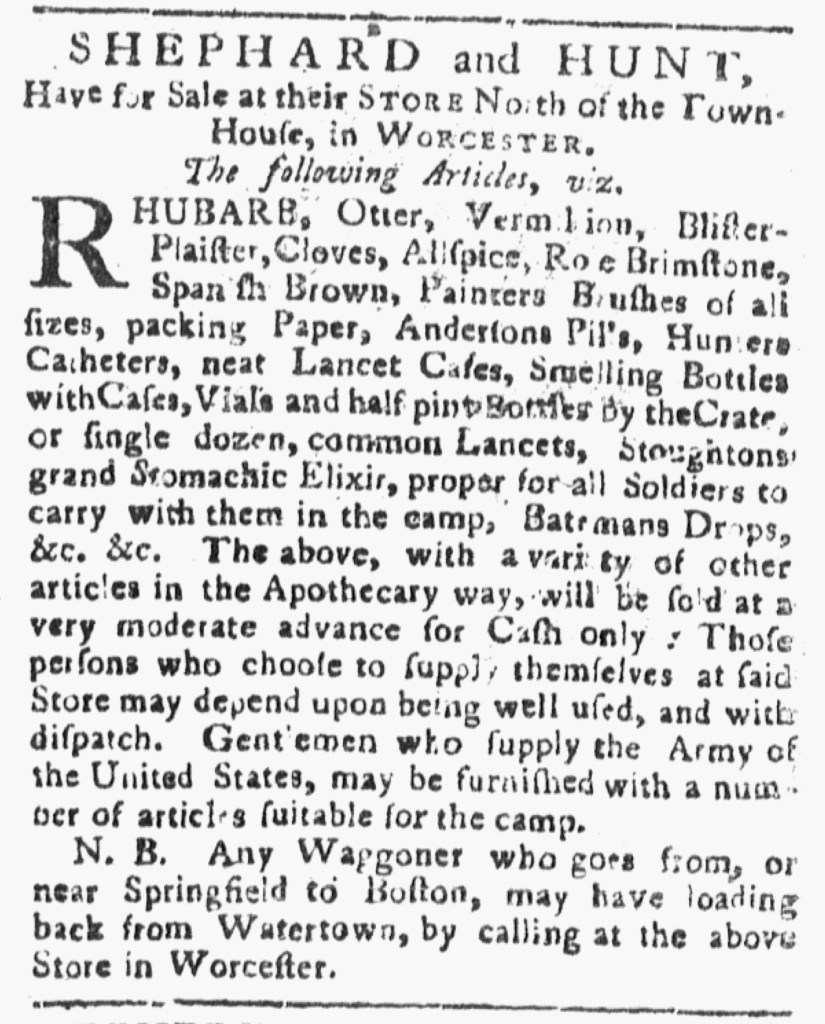
“Stoughtons grand Stomachic Elixir, proper for all Soldiers to carry with them in the camp.”
During the Revolutionary War, Shephard and Hunt adapted their newspaper advertisements to the times. The partners operated a store that sold medicines and a “variety of other articles in the Apothecary way” at a store in Worcester in the summer of 1776. In a notice in the August 21 edition of the Massachusetts Spy, they listed an assortment of patent medicines and medical supplies that commonly appeared in similar advertisements, including “Anderson’s Pills, Hunters Catheters, neat Lancet Cases, Smelling Bottles with Cases, Vials and half pint Bottles by the Crate, or single dozen, [and] Batemans Drops.”
Under other circumstances, apothecaries and other retailers usually listed patent medicines without commentary or explanation. Those remedies were so familiar to consumers that advertisers did not consider it necessary to elaborate on them. In this instance, however, Shephard and Hunt did not merely list Stoughton’s Elixir as one among several patent medicines. Instead, they named it “Stoughtons grand Stomachic Elixir” and stated that the potion was “proper for all Soldiers to carry with them in the camp.” The apothecaries identified an ailment that commonly afflicted soldiers and made a pitch to them to purchase a medicine that would provide relief. They provided a small comfort “at a very moderate advance for Cash” to soldiers fighting a war for independence.
That was not the only service that Shephard and Hunt undertook for the war effort. They informed all customers that they “may depend upon being well used, and with dispatch,” while extending a special invitation to “Gentlemen who supply the Army of the United States.” In addition to quick and efficient customer service, those “Gentlemen … may be furnished with a number of articles suitable for the camp.” Apothecaries sometimes prepared boxes of medicines and supplies for ships or homes. Shephard and Hunt may have done the same for doctors and others in military camps. Even if they did not, they stocked medical supplies “suitable for the camp” and sought to attract customers affiliated with the American army who would purchase in volume. As they continued to serve civilian customers, Shephard and Hunt also marketed their wares to soldiers and the army.