

What was advertised in a revolutionary American newspaper 250 years ago today?

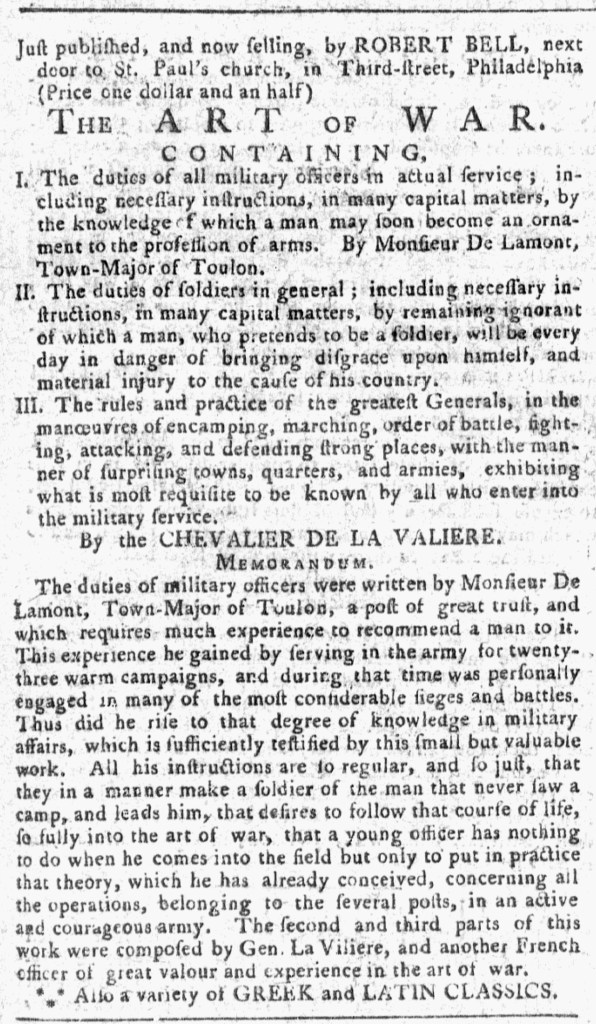
“THE ART OF WAR.”
The September 14, 1776, edition of the Pennsylvania Evening Post carried updates about British maneuvers since the Continental Army’s retreat from Long Island. The enemy invaded and occupied New York. In the same issue, the newspaper carried an advertisement for a military manual – yet another one – published by a printer in Philadelphia. Such notices for an array of military manuals had been appearing in the Pennsylvania Evening Post and other newspapers for the past two years. This time, Robert Bell announced that he “Just published … THE ART OF WAR … By Monsieur De Lamont, Town-Major of Toulon [and] By the CHEVALIER DE LA VALIERE.” Despite the significance of the news from New York, Bell’s advertisement ran as the first item in the first column on the first page.
As was common in many advertisements for books, much of the copy merely replicated the extensive subtitle that doubled as a table of contents. Readers learned that the book consisted of three parts, “I. The duties of all military officers in actual service; … II. The duties of soldiers in general; … [and] III. The rules and practice of the greatest Generals.” Bell added a “MEMORANDUM” to give more detail, noting that De Lamont wrote the first section and La Valiere penned the other two. De Lamont, he further explained, held “a post of great trust, and which requires much experience to recommend a man to it.” He gained that experience “by serving in the army for twenty-three warm campaigns, and during that time was personally engaged in many of the most considerable sieges and battles.” Once Bell established the Town-Major of Toulon’s credentials, he explained what readers could expect to get out of the first section of The Art of War. “All his instructions are so regular, and so just, that they in a manner make a soldier of the man that never saw a camp, and leads him, that desires to follow that course of life, so fully into the art of war, that a young officer has nothing to do when he comes into the field but only to put in practice that theory, which he has already conceived, concerning all the operations, belonging to the several posts, in an active and courageous army.” That may have offered some reassurance to men taking on responsibilities as military officers for the first time. Even those with more experience may have found it worthwhile to read De Lamont’s “necessary instructions” to brush up on what they needed to know.
Bell did not devote the same attention to the “second and third parts of this work … composed by Gen. La Viliere,” though he noted that the general was “another French officer of great valour and experience.” The contents already outlined that the “duties of soldiers” included “necessary instructions, in many capital matters, by remaining ignorant of which a man, who pretends to be a soldier, will be every day in danger of brining disgrace upon himself, and material injury to the cause of his country.” In addition, the “rules and practice of the greatest Generals” described “manœuvres of encamping, marching, order of battle, fighting, attacking, and defending strong places, with the manner of surprising towns, quarters, and armies.”
Even with so many military manuals recently published in Philadelphia, many of them by Bell, the printer believed a market existed for another one. Current events, especially news from New York, demonstrated that American officers and soldiers needed to learn and apply as much knowledge about military operations as they could.