September 27

What was advertised in a revolutionary American newspaper 250 years ago today?
Essex Journal (September 27, 1776).

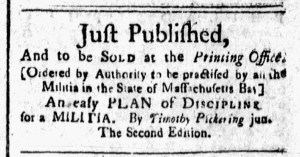
“Just Published … An easy PLAN of DISCIPLINE for a MILITIA … The Second Edition.”

John Mycall, the printer of the Essex Journal and New-Hampshire Packet, hawked copies of the second edition of Timothy Pickering’s “easy PLAN of DISCIPLINE for a MILITIA” in the fall of 1776.  As was common in many early American newspapers, the first page of the Essex Journal carried both news and advertisements.  In the September 27 edition, an update from London filled the first two columns and overflowed into the third on the first page. Advertisements completed that final column … and Mycall placed his advertisement for Pickering’s popular military manual first among those advertisements, increasing the chances that readers would take note of it.  His advertisement also reminded prospective customers that Pickering’s Easy Plan of Discipline had been “Ordered by Authority to be practised by all the Militia in the State of Massachusetts Bay,” simultaneously an endorsement and an edict to be followed.

Mycall announced that the second edition was “Just Published, And to be SOLD at the Printing Office.”  That did not mean, however, that he printed a Newburyport edition.  Eighteenth-century readers knew to separate the phrases “Just published” and “to be SOLD.”  The former merely meant that a book or pamphlet was available for sale (as opposed to being in the press) but did not necessarily refer to the advertiser.  Printers and booksellers frequently sold items “Just Published” by others.  In this instance, Mycall sold copies of a second edition of Pickering’s Easy Plan of Discipline published by Samuel Hall in Boston.  In June, Hall informed readers of the Continental Journal that the “second Edition … is now in the Press.”  On September 19, he ran a new advertisement in the Continental Journal, this time announcing that the military manual was now available at his printing office in School Street.  Hall apparently sent copies to Mycall to stock at his printing office in Newburyport.  The advertisement in the Essex Journal appeared just a week later.  The second edition that Mycall sold in Newburyport was hot off Hall’s presses in Boston.
September 23

What was advertised in a revolutionary American newspaper 250 years ago today?

Norwich Packet (September 23, 1776).

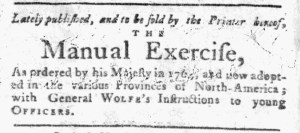
“Lately published … THE Manual Exercise.”

As fall arrived in 1776, John Trumbull inserted an advertisement for “THE Manual Exercise, As ordered by his Majesty in 1764, and now adopted in the various Provinces of North-America” in his newspaper, the Norwich Packet.  He described the military manual as “Lately published, and to be sold by the Printer hereof.”  Eighteenth-century readers understood that “Lately published” did not mean that it just came off the press.  Instead, it meant that the book had been published and was available rather than being in the proposal or preparation stage.  After all, advertisements proposing to publish many books ran in early American newspapers, but not all of them garnered enough demand that printers moved beyond merely gauging interest in them.

Local editions of this military manual, The Manual Exercise as Ordered by His Majesty in 1764: Together with Plans and Explanations of the Method Generally Practised at Reviews and Field-Days, had been published in at least ten towns from Massachusetts to Virginia in 1774 and 1775.  It did so well that some printers issued second editions.  Such had been the case with John Trumbull and his former partners, Alexander Robertson and James Roberston.  They published their first Norwich edition in 1774 and a second Norwich edition in 1775.  When Trumbull advertised the book in the fall of 1776, he did not promote a new edition but instead sought to sell remaining copies of the 1775 that he published with his former partners, Loyalists who had since moved to New York.  His latest advertisement indicated that the manual included “General WOLFE’s Instructions to young OFFICERS.”  The Robertsons and Trumbull previously added that content to the second Norwich edition, further evidence that Trumbull now hawked that book rather than a new edition.  In asserting that it was “Lately published,” the printer did not claim that the military manual just hit the market but rather that production was complete and copies were available for sale immediately.

September 19

What was advertised in a revolutionary American newspaper 250 years ago today?

Continental Journal (September 19, 1776).

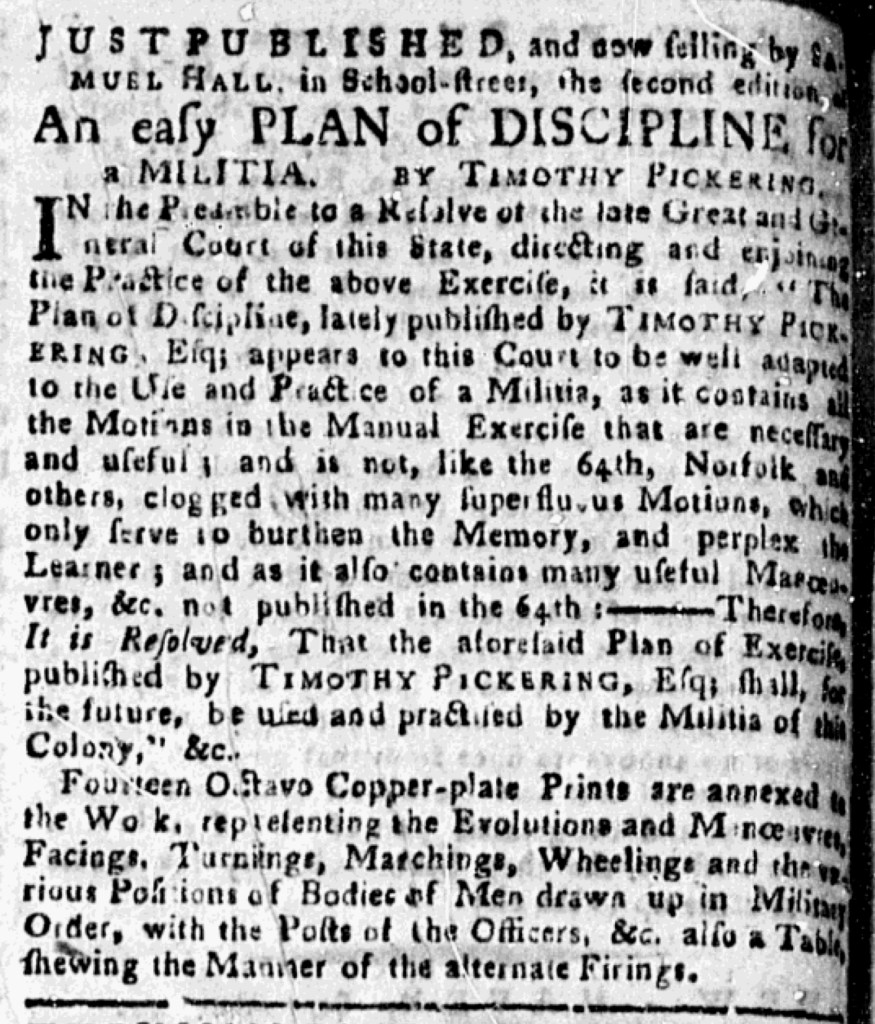
“The second edition of An easy PLAN of DISCIPLE for a MILITIA.”

In June 1776, Samuel Hall advertised that the “second Edition of Col. Pickering’s PLAN of DISCIPLINE,” a popular military manual by Timothy Pickering first published in the summer of 1775, “is now in the Press” and would be published soon.  In his initial advertisement for the second edition, Hall noted that “by Order of the General Assembly, all the Militia of this Colony are directed and enjoined to practise” Pickering’s Easy Plan of Discipline for a Militia.  The companies from towns throughout Massachusetts would benefit from the directions in the manual and the uniformity of consulting a common source for their instruction.

When Hall advertised that he “JUST PUBLISHED” the second edition in September 1776, he included a blurb from the “Preamble to a Resolve of the late Great and General Court of this State, directing and enjoining the Practice of [Pickering’s] Exercise,” deploying it as an endorsement for the manual he now sold at his printing office on School Street in Boston.  “The Plan of Discipline,” the preamble stated, “appears to this Court to be well adapted to the Use and Practice of a Militia, as it contains all the Motions in the Motions in the Manual Exercise that are necessary and useful.”  Unlike other manuals, Pickering’s Easy Plan of Discipline for a Militia was not “clogged with many superfluous Motions, which only serve to burthen the Memory, and perplex the Learner.”  Furthermore, Pickering’s manual “contains many useful Manœuvres … not published” in other manuals.”  The General Court made clear its determination that Pickering’s manual was superior to others.  George Washington, commander-in-chief of the Continental Army, apparently agreed.  Pickering’s Easy Plan of Discipline for a Militia was one of his preferred manuals before Baron von Stueben’s Regulations for the Order and Discipline of the Troops of the United States became first official manual of the Continental Army in 1779.  Hall also included the resolution itself in his advertisement for the second edition: “It is Resolved, That the aforesaid Plan of Exercise, published by TIMOTHY PICKERING, Esq; shall, for the future, be used and practised by the Militia of this Colony.”

In case such an endorsement was not enough to make a sale, Hall highlighted the “Fourteen Octavo Copper-plate Prints … annexed to the Work.”  They depicted “the Evolutions and Manœuvres, Facings, Turnings, Marchings, Wheelings and the various Positions of Bodies of Men drawn up in Military Order.”  The manual also featured “a Table, shewing the Manner of the alternate Firings.”  The Continental Army’s siege of Boston dislodged British forces in March 1776, but the war continued.  Hall presented a new edition of Pickering’s manual to officers and soldiers to aid them in continuing to fight for the American cause and defend their families, homes, and communities.

September 14

What was advertised in a revolutionary American newspaper 250 years ago today?

Pennsylvania Evening Post (September 14, 1776).

“THE ART OF WAR.”

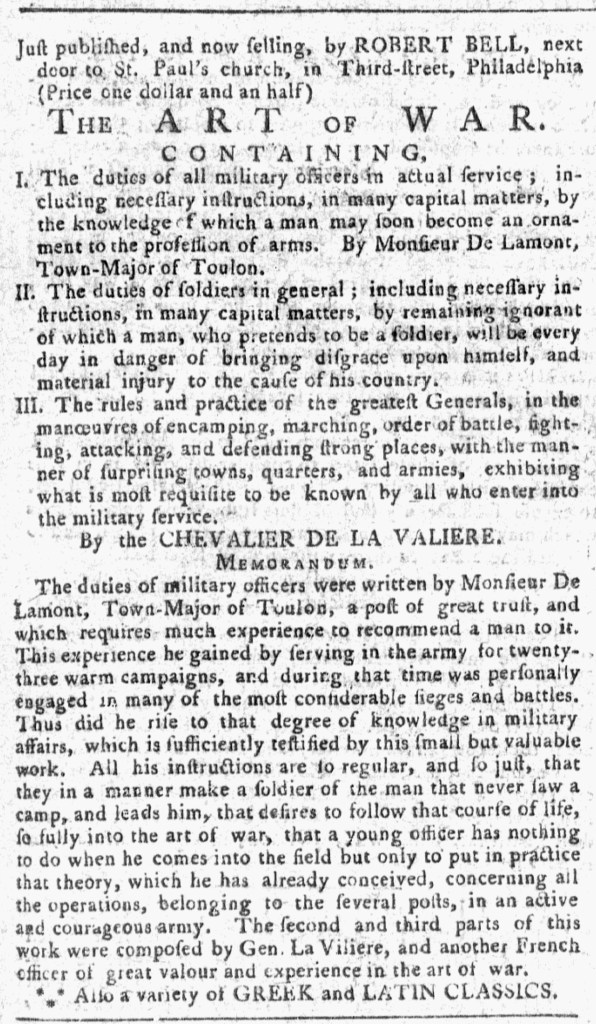
The September 14, 1776, edition of the Pennsylvania Evening Post carried updates about British maneuvers since the Continental Army’s retreat from Long Island.  The enemy invaded and occupied New York.  In the same issue, the newspaper carried an advertisement for a military manual – yet another one – published by a printer in Philadelphia.  Such notices for an array of military manuals had been appearing in the Pennsylvania Evening Post and other newspapers for the past two years.  This time, Robert Bell announced that he “Just published … THE ART OF WAR … By Monsieur De Lamont, Town-Major of Toulon [and] By the CHEVALIER DE LA VALIERE.”  Despite the significance of the news from New York, Bell’s advertisement ran as the first item in the first column on the first page.

As was common in many advertisements for books, much of the copy merely replicated the extensive subtitle that doubled as a table of contents.  Readers learned that the book consisted of three parts, “I. The duties of all military officers in actual service; … II. The duties of soldiers in general; … [and] III. The rules and practice of the greatest Generals.”  Bell added a “MEMORANDUM” to give more detail, noting that De Lamont wrote the first section and La Valiere penned the other two.  De Lamont, he further explained, held “a post of great trust, and which requires much experience to recommend a man to it.”  He gained that experience “by serving in the army for twenty-three warm campaigns, and during that time was personally engaged in many of the most considerable sieges and battles.”  Once Bell established the Town-Major of Toulon’s credentials, he explained what readers could expect to get out of the first section of The Art of War.  “All his instructions are so regular, and so just, that they in a manner make a soldier of the man that never saw a camp, and leads him, that desires to follow that course of life, so fully into the art of war, that a young officer has nothing to do when he comes into the field but only to put in practice that theory, which he has already conceived, concerning all the operations, belonging to the several posts, in an active and courageous army.”  That may have offered some reassurance to men taking on responsibilities as military officers for the first time.  Even those with more experience may have found it worthwhile to read De Lamont’s “necessary instructions” to brush up on what they needed to know.

Bell did not devote the same attention to the “second and third parts of this work … composed by Gen. La Viliere,” though he noted that the general was “another French officer of great valour and experience.”  The contents already outlined that the “duties of soldiers” included “necessary instructions, in many capital matters, by remaining ignorant of which a man, who pretends to be a soldier, will be every day in danger of brining disgrace upon himself, and material injury to the cause of his country.”  In addition, the “rules and practice of the greatest Generals” described “manœuvres of encamping, marching, order of battle, fighting, attacking, and defending strong places, with the manner of surprising towns, quarters, and armies.”

Even with so many military manuals recently published in Philadelphia, many of them by Bell, the printer believed a market existed for another one.  Current events, especially news from New York, demonstrated that American officers and soldiers needed to learn and apply as much knowledge about military operations as they could.

September 7

What was advertised in a revolutionary American newspaper 250 years ago today?

Pennsylvania Evening Post (September 7, 1776).

“I beg leave … to recommend it to our military gentlemen as a book of public utility.”

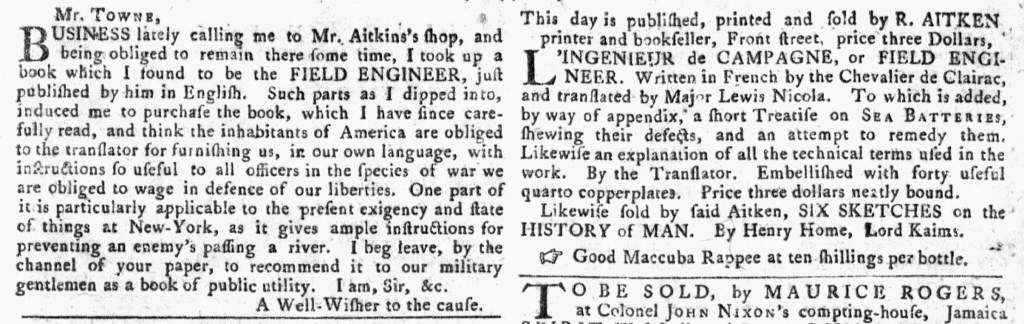
In an advertisement in the September 7, 1776, edition of the Pennsylvania Evening Post, Robert Aitken, a printer and bookseller, promoted “L’INGENIEUR de CAMPAGNE, or FIELD ENGINEER.  Written in French by the Chevalier de Clairac, and translated by Major Lewis Nicola.”  To make the work more enticing to prospective customers, Aitken supplemented it with “a short Treatise on SEA BATTERIES, shewing their defects, and an attempt to remedy them,” and “an explanation of all the technical terms used in the work.  By the Translator.”  The manual also included helpful illustrations, “forty useful quarto copperplates.”  It was one of many military manuals published and marketed in Philadelphia and other cities during the era of the American Revolution.

Quite conveniently, a letter to Benjamin Towne, the printer of the Pennsylvania Evening Post, signed by “A Well-Wisher to the cause” just happened to appear immediately to the left of Aitken’s advertisement.  The anonymous correspondent explained that during a recent visit to Aitken’s printing office for other business he “took up a book which I found to be the FIELD ENGINEER, just published by him in English.”  Enthralled by those parts that he “dipped into,” the “Well-Wisher to the cause” purchased the book and carefully read it.  Now he felt compelled to declare that “the inhabitants of America are obliged to the translator for furnishing us, in our own language, with instructions so useful to all officers in the species of war we are obliged to wage in defence of our liberties.”  The “Well-wisher to the cause” highlighted the part of the book he considered “particularly applicable to the present exigency and state of things at New-York, as it gives ample instructions for preventing an enemy’s passing a river.”  Following its defeat at the Battle of Long Island near the end of August, the Continental Army retreated from Brooklyn to Manhattan.  Many residents of the city had already fled to the countryside to escape the British invasion and occupation.  Patriots feared what would happen if General George Washington and the Continental Army could not prevent the British from crossing the Hudson River.  The “Well-Wisher to the cause” may have also worried about the prospects of British forces crossing the Delaware River to capture Philadelphia if they could not be stopped in New York.  “I beg leave, by the channel of your paper,” he wrote, “to recommend it,” The Field Engineer, “to our military gentlemen as a book of public utility.”  Whether or not Aitken coordinated with the “Well-Wisher to the cause” (or wrote the recommendation himself), the proximity of the letter to his advertisement reinforced his efforts to sell the book.

August 27

What was advertised in a revolutionary American newspaper 250 years ago today?

Dunlap’s Pennsylvania Packet (August 27, 1776).

“EXTRACTS … relative to the … fitting out PRIVATEERS; together with the Rules and Regulations of the NAVY.”

During the imperial crisis and the Revolutionary War, printers regularly published news from the Continental Congress and local assemblies in their newspapers.  Sometimes they compiled the proceedings into books that they marketed and sold to consumers who wanted convenient access to that sort of overview of current events.  Printers in many towns, for instance, published local editions of “EXTRACTS FROM THE VOTES AND PROCEEEDINGS OF THE AMERICAN CONTINENTAL CONGRESS” in the fall of 1774.

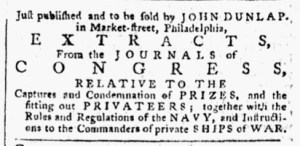
Nearly two years later, John Dunlap, the printer of Dunlap’s Pennsylvania Packet, saw an opportunity to publish a collation of rules and regulations about naval regulations for both privateers and the Continental Navy.  In an advertisement that appeared at the top of the final column on the first page of the August 27, 1776, edition of his newspaper, Dunlap informed the public that he “Just published … EXTRACTS, From the JOURNALS of CONGRESS, RELATIVE TO THE Captures and Condemnation of PRIZES, and the fitting out PRIVATEERS; together with the Rules and Regulations of the NAVY and Instructions to the Commanders of private SHIPS of WAR.”  As was common in many advertisements for books and pamphlets, the lengthy title doubled as advertising copy.  Dunlap did not generate original appeals to market the volume because the title already contained so much information.

The printer apparently believed that a market for this item existed in the largest city in the new nation.  Philadelphia was, after all, a busy port and many owners of vessels who pursued maritime commerce during times of peace contemplated how they could aid the war effort while simultaneously getting their share of prize money when they outfitted their ships for privateering.  Dunlap made this handy manual available alongside an array of military manuals published in Philadelphia and other cities.  Rather than hundreds of pages, like some of volumes containing the proceedings of the Continental Congress, this octavo pamphlet consisted of only forty-eight pages.  That made it a convenient size for officers on both privateers and naval vessels to stow among their possessions when they went to sea and then consult as necessary.  Dunlap printed this practical guide as a service, yet he also generated revenue from its sale.

July 21

What was advertised in a revolutionary American newspaper 250 years ago this week?

Pennsylvania Ledger (July 20, 1776).

“Simes’s Military Guide for officers, 2 vol.”

After the Continental Congress voted to declare independence on July 2, 1776, and approved the Declaration of Independence two days later, the war that began with the skirmishes at Concord and Lexington in Massachusetts had a new purpose.  Colonizers and subjects of George III no longer fought for redress of grievances within the British imperial system; instead, settlers and citizens of a new nation fought for independence from that empire.  The military manuals that American printers had been printing, advertising, and selling for the past two years and longer were as important as ever.  Printers and booksellers continued promoting them in newspaper advertisements.

In an advertisement in the first column on the first page of the July 20 edition of the Pennsylvania Ledger, for instance, James Humphreys, Jr., the printer of that newspaper, declared that “A few Copies of the Military Guide FOR YOUNG OFFICERS, By THOMAS SIMES … embellished with a Number of Copperplates … May be had of the PRINTER hereof.”  Humphreys jointly published Simes’s military manual with Robert Aitken and Robert Bell.  For several months he had been hawking the book.  Bell also continued advertising and selling it.  In his own advertisement on the last page of that issue of the Pennsylvania Ledger, he listed it among the “following MILITARY WORKS, some of them very valuable, and seldom to be met with, [that] may be had at R. BELL’s.”  He also stocked “New System of Military Discipline, founded on Principle, by a General Officer,” a manual that Aitken printed and previously advertised, and “Hoste and Webster’s Mechanics, Fortification, Artillery, or Gunnery, adapted to the use of the Gentlemen of the Army and Navy.”  Bell did not mention the copperplate engravings that illustrated Simes’s military manual, but he did note that “LE Blond’s Military Engineer, containing the attack and defence of all kinds of fortified places” came with “numerous and excellent copperplates.”  He also carried copies of “ARCHITECTURE HYDRAULIQUE,” a manual on hydraulic architecture and “usage du cours des eaux dans les operations de la Guerre des Sieges & de Campaign” [utilizing watercourses in siege and field warfare operations], for readers who understood French.  Not surprisingly, printers and booksellers highlighted military manuals in their newspaper advertisements during the Revolutionary War.

June 20

What was advertised in a revolutionary American newspaper 250 years ago today?

Continental Journal (June 20, 1776).

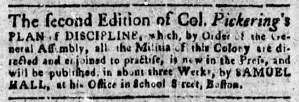
“Col. Pickering’s PLAN of DISCIPLINE, which … all the Militia of this Colony are directed and enjoined to practise.”

When he transferred the New-England Chronicle to Edward E. Powars and Nathaniel Willis in June 1776, Samuel Hall informed the public that “PRINTING in general will be continued at the Subscriber’s Office in School-street [in Boston], and performed with accuracy and dispatch.”  Although he would no longer publish a newspaper, Hall continued to earn his livelihood through job printing and other projects.  One of those projects was a second edition of Timothy Pickering’s Easy Plan of Discipline for a Militia.  Hall and his brother, Ebenezer, published and advertised the first edition nearly a year earlier.  As the war continued, the American army needed more copies military manuals, including Pickering’s manual.

On June 20, Hall inserted advertisements in both the Continental Journal and the New-England Chronicle, the only newspapers published in Boston at the time.  “The second Edition of Col. Pickering’s PLAN of DISCIPLINE, which by Order of the General Assembly, all the Militia of this Colony are directed and enjoined to practise,” Hall announced, “is not in the Press, and will be published, in about three Weeks.”  The advance notice gave interested parties an opportunity to reserve copies.  That, in turn, helped Hall determine how many copies to print.  After all, he did not publish the manual solely as a service.  He aimed to generate revenue with the venture.  He did not want an excessive number of surplus copies to eat into profits.

That an “Order of the General Assembly” directed the colony’s militia to consult Pickering’s military manual no doubt helped sales.  Yet Pickering received yet another important endorsement for his Easy Plan of Discipline for a Militia.  He sent a copy to George Washington following his appointment as commander-in-chief of the Continental Army by the Second Continental Congress.  In turn, according to the American Revolution Institute, “Washington promoted the use of several published works, including Timothy Pickering’s An Easy Plan of Discipline for a Militia and Thomas Hanson’s The Prussian Evolutions” in the years before the Baron von Stueben’s Regulations for the Order and Discipline of the Troops of the United States became the first official manual of the Continental Army in 1779.  With such support, Hall could feel confident that a second edition of Pickering’s military manual would meet with success.

April 7

What was advertised in a revolutionary American newspaper 250 years ago this week?

Pennsylvania Ledger (April 6, 1776).

“A few Copies of the Military Guide, FOR YOUNG OFFICERS.”

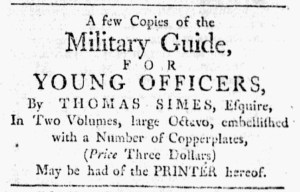
James Humphreys, Jr., the printer of the Pennsylvania Ledger, was so eager to sell surplus copies of Thomas Simes’s “Military Guide FOR YOUNG OFFICERS” that he inserted two advertisements in the April 6, 1776, edition of his newspaper.  A shorter notice appeared on the third page and a longer one on the fourth page.

Humphreys previously collaborated with Robert Aitken and Robert Bell in circulating subscription proposals for a local edition of the military manual originally published in London.  In an advertisement in the December 2, 1775, edition of the Pennsylvania Ledger, the printers declared that they took on the project “By Desire of some [of] the Members of the Honourable the American Continental CONGRESS, and some of the Military Officers of the Association.”  A few months later, they repeated that assertion in the longer advertisement that listed all three of their names and locations. That notice also featured other details from the subscription proposals, noting that the work was “a large and valuable Compilation from the most celebrated Military Writers” that included “an excellent Military, Historical and Explanatory DICTIONARY.”  The proposals had not, however, mentioned illustrations, but the advertisement that announced the two-volume set was “Printed and Published” informed readers that the “whole is illustrated with Eleven Copperplates.”  It concluded with a nota bene that instructed subscribers who had reserved copies in advance “to call or send for their Books.”  Aitken, Bell, and Humphreys had been running that advertisement in the Pennsylvania Evening Post and the Pennsylvania Ledger since late February.

Once the subscribers collected their books, Humphreys apparently had extra copies that he hoped to sell.  As long as they remained at his printing office they cut into any profits he earned on the venture.  In a streamlined advertisement, he announced that “A few Copies of the Military Guide, FOR YOUNG OFFICERS, By THOMAS SIMES, Esquire, In Two Volumes, large Octavo, embellished with a Number of Copperplates, (Price Three Dollars) May be had of the PRINTER hereof.”  Between the advertisement on the following page and the notices that already circulated widely, Humphreys assumed that prospective customers were already familiar with the local edition of Simes’s military manual.  It was one of many such works among “a flood of printings” in Philadelphia “to meet the demand for military texts,” according to the American Revolution Institute of the Society of the Cincinnati, yet that demand did not necessarily mean that copies sold themselves.  Aitken, Bell, and Humphreys carefully crafted a marketing campaign to enlist subscribers and then Humphreys still had “A few Copies” he hoped to sell.  He may have hoped that news that British troops evacuated Boston on March 17 would incite new demand for Simes’s manual.

March 20

What was advertised in a revolutionary American newspaper 250 years ago today?

Pennsylvania Journal (March 20, 1776).

“A TREATISE of MILITARY DISCIPLINE; CALCULATED FOR THE USE OF THE AMERICANS.”

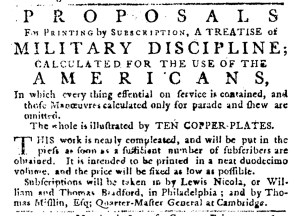
Eleven months after the Revolutionary War began at the Battles of Lexington and Concord, Lewis Nicola distributed subscription proposals for a “TREATISE of MILITARY DISCIPLINE … illustrated by TEN COPPER-PLATES.”  He indicated that the work was “nearly completed, and will be put in the press as soon as a sufficient number of subscribers are obtained.”  Authors and printers often used subscription proposals as a rudimentary form of market research, assessing whether interest merited publishing a book and determining how many copies to print while simultaneously increasing visibility for the project and augmenting demand.  Nicola envisioned a “neat duodecimo volume,” a portable size, but did not affix a price except to say that it “will be fixed as low as possible.”  He expected that other aspects of the manual would convince prospective subscribers to reserve their copies.

For instance, he proclaimed that his manual was “CALCULATED FOR THE USE OF THE AMERICANS.”  Over the past couple of years, especially since the war started, American printers published local editions of a variety of British military manuals, but Nicola’s book, as Douglas R. Cubbison explains, “was one of only two such treatises specifically prepared for the Continental Army at the time.”  Nicola emphasized that he focused on practical matters, including “every thing essential on service” while omitted “those Manoeuvres only for parade and shew.”  Militia training had often been an occasion for socializing and entertainment before the war, but officers and soldiers and the communities they served needed more than fancy formations now that they engaged an enemy rather than gathering on the town common.  Cubbison also notes that Nicola outlined “a unified system of military maneuvers” and stressed that “officers must display forbearance, understanding, and respect for their soldiers.”  In so doing, his manual “anticipated many of the core components of the Baron de Steuben’s more famous and considerably more influential Regulations for the Order and Discipline of the Troops of the United States.”

Nicola accepted subscriptions in Philadelphia, as did William Bradford and Thomas Bradford, the printers of the Pennsylvania Journal.  In addition, “Thomas Mifflin, Esq; Quarter-Master General at Cambridge,” also collected subscriptions.  When the subscription proposal appeared in the Pennsylvania Journal on March 20, residents of Philadelphia did not yet know that the British evacuated Boston three days earlier, ending the siege of the city.  The most recent news, printed in both the Pennsylvania Evening Post on March 19 and the Pennsylvania Gazette on March 20, came Watertown on March 11, a description of the “bombardment of Boston” following the arrival of cannon that Henry Knox transported from Fort Ticonderoga in New York.  “‘Tis reported the Regulars are embarking,” the missive from Watertown stated, but the printers had not yet received word that the British had indeed left Boston.  Whatever came next, the war was not coming to an end.  Nicola likely hoped that news from Watertown would entice readers to subscribe for a military manual “CALCULATED FOR THE USE OF THE AMERICANS.”