

What was advertised in a revolutionary American newspaper 250 years ago today?

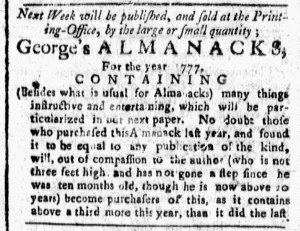
“George’s ALMANACKS … equal to to any publication of the kind.”
An advertisement in the November 20, 1776, edition of the Essex Journal announced that “Next Week will be published, and sold at the Printing-Office” in Newburyport, Massachusetts, “George’s ALMANACKS, For the year 1777.” That notice promoted An Almanack, for the Year of Our Lord and Saviour, 1777 … Calculated for the Meridian of Boston New-England … Containing All Things Necessary, Useful, and Fit for Such a Work by Daniel George. The imprint on the title page indicated that John Mycall, the printer of the Essex Journal, was not the only retailer who sold the almanac. In addition, “DRAPER and PHILLIPS, at the new Printing-Office, next Door but one to the Sign of the Lamb-Tavern, in Newbury-Street, Boston,” and “most Booksellers and Shopkeepers in the neighbouring Towns” also sold it. The advertisement stated that customers could purchase a “large or small quantity,” while the title page clarified that it cost six pence for a single issue or four shillings for a dozen. With a discount for buying in volume, retailers could acquire a quantity to sell in their shops and still set competitive prices.
The advertisement explained that the contents included “many things instructive and entertaining,” pledging that “they will be particularized in our next paper.” For the moment, however, promoting the almanac primarily focused on the author, Daniel George, and circumstances that might prompt consumers to select his almanac instead of (or in addition to) other almanacs. “No doubt those who purchased this Almanack last year, and found it to be equal to any publication of the kind,” the advertisement declared, “will, out of compassion to the author (who is not three feet high and has not gone a step since he was ten months old, though he is now above 20 years) become purchasers” of the new almanac for the coming year.
Meg Roberts examines George and the production and marketing of the almanacs he wrote at Public Disability History, noting that the young man, who was eighteen years old in 1776, “studied mathematics and astronomy extensively.” Late in the summer of 1775, David George, Daniel’s father, took his son to meet Reverend Samuel Williams, a noted astronomer himself, and presented the calculations he had undertaken for an almanac for 1776. In turn, Williams wrote to printer Ezekiel Russell that the young mathematician and astronomer “appears to be a singular object of pity and compassion. But with all the disorders of body under which he labors, his mind does not seem to have been affected.”[1] Williams had “inspected” the almanac and, finding it “equal to other compositions of that kind,” recommended that Russell print it if “it would be consistent with your business and interest.” The minister stated that he wrote “from motives of compassion to the unhappy Cripple, and because I really think his talents may be of use to mankind if encouraged.” Printing the almanac, Williams asserted, would be “an act of kindness to the distressed, and a great encouragement to a rising Genius, in early years, laboring under uncommon disadvantages.”
Russell apparently agreed with Williams’s assessment. He published George’s Cambridge Almanack or, the Essex Calendar, for the Year of Our Redemption, 1776, listing the author as “Daniel George, a student in astronomy at Haverhill, in the county of Essex, who is now in the seventeenth year of his age, and has been a cripple from his infancy.” Historian J.L. Bell suggests that George may have had cerebral palsy. Roberts states that Russell’s description of George and Williams’s letter, “which included further details of George’s impairment, … places George’s achievement firmly in the context of his impairment, portraying his ‘genius’ as particularly impressive considering his ‘uncommon disadvantages.’” Although that “framing of the almanac as the unlikely but remarkable feat of a young man with a physical impairment reads suspiciously like what we would now call ‘inspiration porn,’” Roberts cautions that we must consider such marketing within its eighteenth-century context. In particular, “the clear distinction between ‘ability’ and ‘disability’ that inspiration porn rests upon had not yet solidified.”
Roberts also notes that Williams used “a fairly standard tone for a patron advocating for a protégé in need of financial support.” In addition, the “flexibility of the household economy and interdependency of local communities, especially in rural areas, often allowed early Americans with impairments to participate in various forms of labour adapted to their needs. … George’s almanac was not impressive to Williams because it was ‘inspiring,’ but because the young man was clearly conscious of his physical limitations and embracing an alternative avenue by which he could contribute to his community.”
In addition, “perhaps most importantly,” Roberts argues, “the almanac diverges from the contemporary standards of inspiration porn because Daniel George himself is not voiceless. Inspiration porn relies on the silence of the disabled object of inspiration.” Russell printed Williams’s letter introducing George in the almanac. It amounted to nearly half a page. An address by “The AUTHOR to the PUBLIC” that extended an entire page immediately followed, signed by “their most humble servant, DANIEL GEORGE.”[2] The young astronomer and mathematician briefly expressed appreciation to Williams. He also, again briefly, acknowledged that readers may have purchased his almanac out of a sense of “helping one who is not able, or perhaps ever will have it in his power to help himself,” yet he then added that “other excitements may strike the attention of every Freeman, in New-England.” In addition to producing the astronomical calculations, George selected other content that included “concise and authentic narratives of the Concord and Bunker-hill Battles.” To make room for that material to honor American officers and soldiers, he “omitted inserting the roads and public houses of entertainment,” a standard feature in many almanacs. George made his own choices about which items to include, down to poetry he collected over the previous year. Not insignificantly, the astronomical calculations that filled most pages were all his own.
George’s almanac for 1776 met with such success that Russell printed a second edition. In the fall of 1776, printers in Boston and Newburyport collaborated in publishing and advertising his almanac for 1777. George continued supplying the calculations for almanacs for twenty years. “His physical impairment,” according to Roberts, “never seems to have been mentioned beyond the first issue. George eventually moved to Maine and became a printer himself, as well as a schoolteacher and the owner of a small bookstore.” The title page for George’s almanac for 1777 did not mention his disability, but the advertisement in the Essex Journal did. Mycall, the printer of that newspaper, may have been familiar with George, though the mistake in the young astronomer’s age suggests that other details may not have been correct or may have been exaggerated. The title page of the almanac for 1777 simply stated “BY DANIEL GEORGE” without further elaboration on the author’s circumstances, as Roberts notes; however, the advertisement in the Essex Journal did highlight his disability even as it described his previous almanac as “equal to any publication of the kind” and noted that it “contains about a third more this year, than it did the last.” Prospective customers were still encouraged to purchase it “out of compassion to the author.” While that may have fallen short of what would be considered inspiration porn today, sympathy certainly played a role in marketing George’s almanac in the Essex Journal.
**********
[1] Samuel Williams, “To the Printer of George’s Cambridge Almanack,” in David George, George’s Cambridge Almanack or, the Essex Calendar, for the Year of Our Redemption, 1776 (Salem: Ezekiel Russell, 1775), 2.
[2] David George, “The Author to the Public,” in Davis George, George’s Cambridge Almanack or, the Essex Calendar, for the Year of Our Redemption, 1776 (Salem: Ezekiel Russell, 1775), 2-3.