January 19

What was advertised in a revolutionary American newspaper 250 years ago today?
Essex Journal (January 19, 1776).

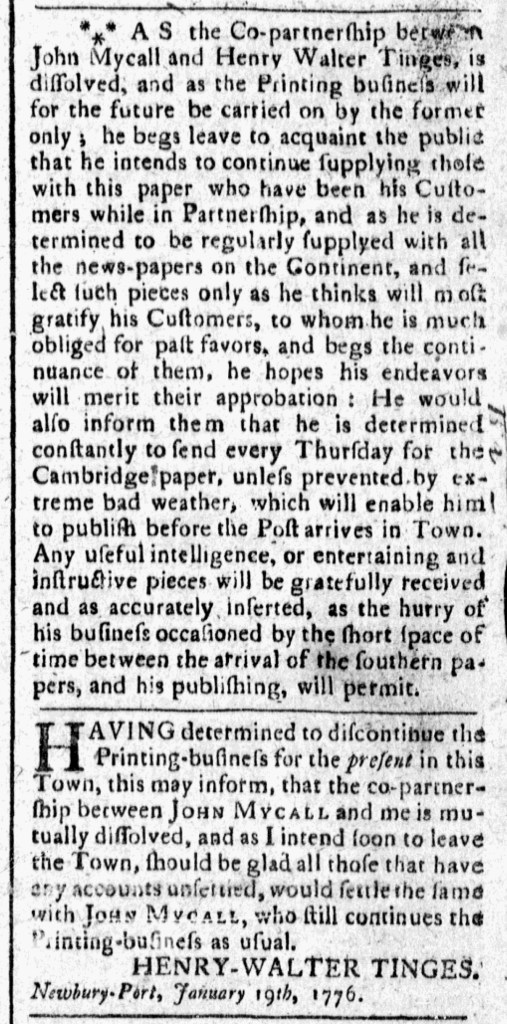
“He is determined to be regularly supplyed with all the news-papers on the Continent.”

On January 19, 1776, John Mycall and Henry-Walter Tinges, the printers of the Essex Journal, announced the end of their partnership.  Tinges had been a founding partner, commencing publication of the newspaper in Newburyport, Massachusetts, in collaboration with Isaiah Thomas, the printer of the Massachusetts Spy, in December 1773.  As the junior partner, Tinges oversaw the printing office, including publication of the Essex Journal, in Newburyport, while Thomas tended to his printing office in Boston.  That initial partnership lasted only eight months before Thomas withdrew and Tinges began a new partnership with Ezra Lunt in August 1774.  That partnership also lasted less than a year.  In July 1775, Lunt exited and Mycall joined as Tinges’s new partner.  Seven months later, Tinges announced that he “determined to discontinue the Printing-business for the present in this Town” and the “co-partnership between JOHN MYCALL and me is mutually dissolved,” though Mycall “still continues the Printing-business as usual.”  Mycall published the Essex Journal on his own for just over a year.  It folded in February 1777, one of several newspapers that ceased publication during the Revolutionary War.

For his part, Mycall inserted his own advertisement stating that the partnership ended and that he “intends to continue supplying those with this paper who have been his Customers while in partnership.”  He outlined his plan for supplying subscribers with news, declaring that he “is determined to be regularly supplyed with all the news-papers on the Continent, and select such pieces only as he thinks will most gratify his Customers.”  That was the common practice for generating content in printing offices throughout the colonies.  Printers participated in extensive exchange networks, liberally reprinting, word for word, items that appeared in the newspapers they received.  Thus an item originally published in a newspaper in Charleston, for instance, could be reprinted from newspaper to newspaper in Williamsburg, Baltimore, Philadelphia, New York, Hartford, and Boston before appearing in the Essex Journal in Newburyport.  Mycall made a point that he would “send every Thursday for the Cambridge paper, unless prevented by extreme bad weather, which will enable him to publish before the Post arrives in Town.”  He referred to the New-England Chronicle, published Samuel Hall and Ebenezer Hall in Cambridge, Massachusetts.  During the siege of Boston, most of the newspapers previously printed in that city ceased or suspended publication or moved to other towns.  The Halls relocated the Essex Gazette, published in Salem, to Cambridge and renamed it the New-England Chronicle when it became the new paper of record for the latest news about the Massachusetts government and the Continental Army under the command of George Washington.  Mycall underscored that he quickly received the latest edition of the New-England Chronicle, printed on Thursdays, and incorporated “useful intelligence” into the Essex Journal, published on Fridays, ahead of the schedule for post riders to arrive in Newburyport.  In the eighteenth century, Mycall delivered breaking news to readers of the Essex Journal.

October 20

What was advertised in a revolutionary American newspaper 250 years ago today?

Essex Journal (October 20, 1775).

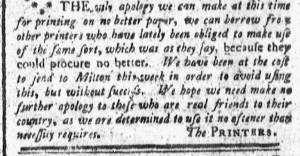
We hope we need make no further apology to those who are real friends to their country.”

John Mycall and Henry-Walter Tinges, the printers of the Essex Journal, found themselves in a situation similar to the one that Daniel Fowle, the printer of the New-Hampshire Gazette, experienced in the fall of 1775.  A disruption in Fowle’s supply of paper in Portsmouth had forced him to print his newspaper on smaller sheets on a few occasions, including the October 17 edition.  Three days later, Mycall and Tinges did the same in Newburyport.  Instead of four pages of three columns each, that issue had four pages of two columns each.  The masthead featured plain type for the title rather than presenting “Essex Journal” in the usual scrolling script.  The woodcuts that usually flanked the title, an Indigenous man with a bow and arrow on the left and a packet ship at sea on the right, did not appear at all.

Immediately above the advertisements, the printers inserted their own notice to explain what happened.  “THE only apology we can make at this time for printing on no better paper,” Mycall and Tinges stated, “we can borrow from other printers who have lately been obliged to make use of the same sort, which was as they say, because they could procure no better.”  They closely paraphrased portions of Fowle’s notice to his readers a couple of weeks earlier: “The only Apology the Publisher can make for this Day’s Paper, is that he could not procure any other.”  Mycall and Tinges printed their newspaper on different paper only as a last resort.  “We have been at the cost to send [an order for more paper] to Milton this week in order to avoid using this,” they informed readers, “but without success.”  With the disruptions and displacements that occurred in the six months since the battles at Lexington and Concord, securing paper became difficult.  The printers tried to get more from the paper mill on the Neponset River in Milton, but to no avail.  They expected their readers to understand, especially those who held the right sort of political principles.  “We hope we need make no further apology to those who are real friends to their country,” Mycall and Tinges proclaimed, “as we are determined to us [the substitute paper] no oftener than necessity requires.”  They hoped that readers would see the smaller newspaper as a minor inconvenience given the stakes of the contest between the colonies and Great Britain.  They did their best with the resources available to continue to disseminate news and advertising to their subscribers and other readers.

July 28

What was advertised in a revolutionary American newspaper 250 years ago today?

Essex Journal (July 28, 1775).

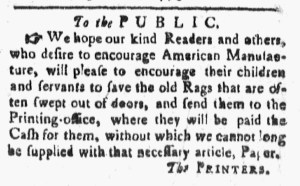
“Encourage their children and servants to save the old Rags … and send them to the Printing-office.”

John Mycall and Henry-Walter Tinges, the printers of the Essex Journal in Newburyport, Massachusetts, concluded the July 28, 1775, edition of their newspaper with an advertisement that presented colonizers an opportunity to aid the American cause.  “We hope our kind Readers and others, who desire to encourage American Manufacture,” Mycall and Tinges declared, “will please to encourage their children and servants to save the old Rags that are often swept out of doors, and send them to the Printing-office.”  The printers offered cash for the rags, explaining that without them “we cannot long be supplied with that necessary article, Paper.”  Mycall and Tinges oversaw a recycling venture imperative in producing an essential article for continuing to publish their newspaper and anything else.  They were not the only printers in the region who experienced a disruption in acquiring paper in the months after the battles at Lexington and Concord.  Daniel Fowle, the printer of the New-Hampshire Gazette, had a similar experience.

Throughout the imperial crisis, collecting rags to recycle into paper had been imbued with political significance.  Producing paper in the colonies meant that printers did not need to import as much paper from England.  As nonimportation agreements went into effect in 1768, Christopher Leffingwell of Norwich, Connecticut, described collecting rags as “an entire Saving to the COUNTRY” and encouraged “every Friend and lover thereof [to] save every Scrap” of discarded linen.  For years, John Keating regularly promoted his “Paper Manufactory” in New York’s newspapers, arguing that economic resistance during the “present alarming situation of the colonies” was the “safest and most efficacious method of convincing the Ministry of Great-Britain of their error.”  He suggested that each household designate a “certain place” for collecting rags and cultivate a habit that would “establish this valuable manufactory upon a permanent foundation.”  Who undertook such work?  John Dunlap, the printer of the Pennsylvania Packet, hoped “to prevail upon our LADIES to grant us a little of their industry and assistance,” believing that “the welfare of their country will influence them” to do their part in collecting rags to recycle into paper.  Mycall and Tinges extended the call to include “children and servants.”  As men mustered to defend their liberties, women, children, and servants had their own role to play.  They could contribute to the American cause by supporting “American Manufacture,” including collecting rags to transform into the newspapers and pamphlets that disseminated the rhetoric of the Revolution.

July 22

What was advertised in a revolutionary American newspaper 250 years ago today?

Essex Journal (July 22, 1775).

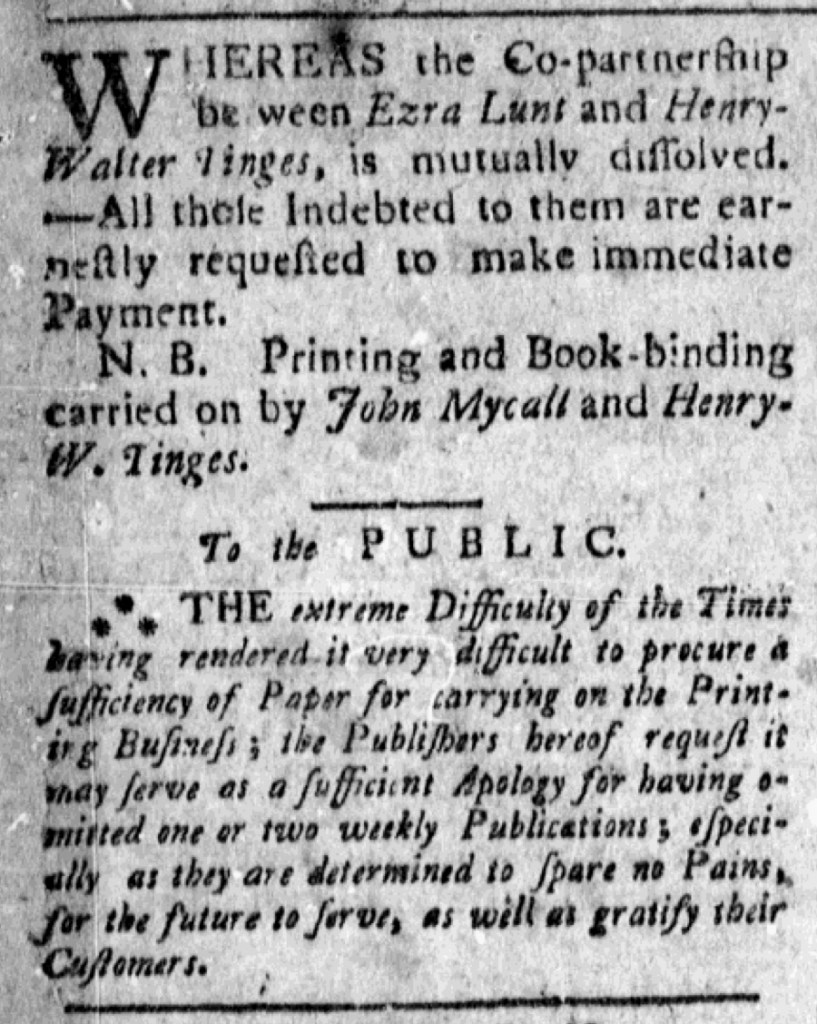
THE extreme Difficulty of the Times having rendered it very difficult to procure a sufficiency of Paper.”

A notice on the first page of the July 22, 1775, edition of the Essex Journal, Or, the Massachusetts and New-Hampshire General Advertiser informed readers that the “Co-partnership between Ezra Lunt and Henry-Walter Tinges,” the publishers of the newspaper, “is mutually dissolved” and called on “those Indebted to them” to settle accounts.  Yet the printing office in Newburyport was not being shuttered.  Instead, a nota bene declared, “Printing and Book-binding carried on by John Mycall and Henry-W. Tinges.”  Mycall became Tinges’s third partner in less than three years.  The young printer first went into business with Isaiah Thomas, the printer of the Massachusetts Spy in the late fall of 1773.  The more experienced printer remained in Boston while his junior partner oversaw the printing office and their new newspaper.  The partnership lasted less than a year.  On August 17, 1774, they notified the public that they “mutually dissolved” their partnership, but the “Printing Business is carried on as usual, by Ezra Lunt and Henry W. Tinges.”

Nearly a year later, Lunt departed and Mycall took his place.  As their first order of business, the new partners addressed some of the challenges the newspaper faced since the battles at Lexington and Concord three months earlier.  “THE extreme Difficulty of the Times having rendered it very difficult to procure a sufficiency of Paper for carrying on the Printing Business,” they lamented, “the Publishers hereof request it may serve as a sufficient Apology for having immitted one or two weekly Publications.”  Indeed, publication had been sporadic during May, immediately after the outbreak of hostilities, returned to a regular schedule in June, and then missed a week in July before announcing the departure of Lunt and arrival of Mycall.  The Essex Journal had missed only two issues, but the publishers did not consistently distribute the newspapers on the same day each week.  That likely added to the impression that they had not supplied all the newspapers that their customers expected.  In addition, the two most recent issues, June 30 and July, and the one that carried the notice about the new partnership consisted of only two pages rather than the usual four.  Mycall and Tinges vowed that “they are determined to spare no Pains, for the future to serve, as well as gratify their Customers.”  Mycall and Tinges kept that promise.  Publication returned to a regular schedule with only minor disruptions.