

What was advertised in a revolutionary American newspaper 250 years ago today?

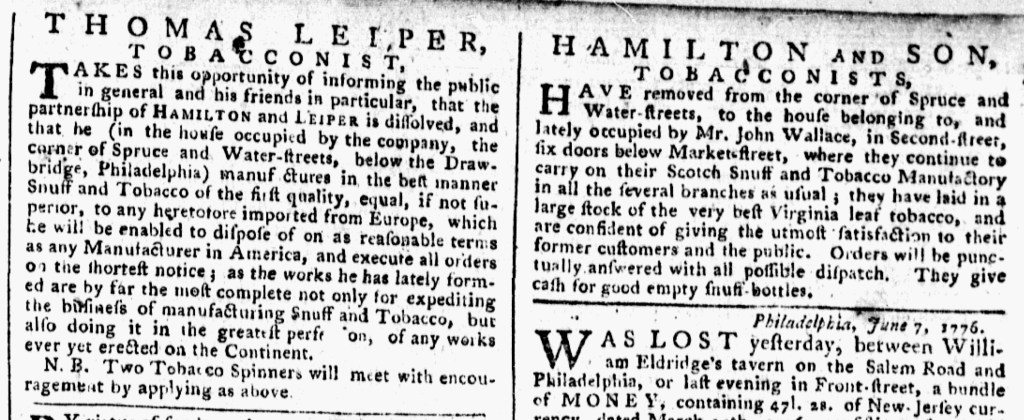
“THOMAS LEIPER … manufactures in the best manner Snuff and Tobacco of the first quality.”
Two days after tobacconists Hamilton and Leiper announced that they dissolved their partnership with an advertisement in the Pennsylvania Ledger, an advertisement with identical copy ran at the top of the middle column on the front page of Dunlap’s Pennsylvania Packet. An editorial submitted by a readers filled the rest of the column, whereas an advertisement for the new partnership of Hamilton and Son ran immediately below the same notice in the Pennsylvania Ledger. Hamilton and Son did insert their advertisement in the June 10, 1776, edition of Dunlap’s Pennsylvania Packet, though it ran in the upper right corner on the third page, separated from the advertisement about the end of the partnership.
In this instance, Hamilton and Son’s advertisement appeared immediately to the right of a new advertisement from “THOMAS LEIPER, TOBACCONIST,” who made his own announcement to “the public in general and his friends in particular, that the partnership of HAMILTON and LEIPER is dissolved, and that he … manufacturers in the best manner Snuff and Tobacco of the first quality, equal, if not superior, to any heretofore imported from Europe.” Now in competition with his former partner, Leiper proclaimed that he could sell his products “on as reasonable terms as any Manufacturer in America” and he could “execute all orders on the shortest notice.” To make that possible, “the works he has lately formed are by far the most complete not only for expediting the business of manufacturing Snuff and Tobacco, but also doing it in the greatest perfection, of any works ever yet erected on the Continent.” Leiper gave good reasons why the clientele that he and Hamilton had cultivated while in business together for several years should stick with him rather than take their business to Hamilton and Sons. He also had the advantage of remaining “in the house occupied by the company,” a familiar location to both former customers and the public.
Hamilton and Son may have initially had a leg up on Leiper by publishing their advertisement with the notice about the dissolution of the partnership. In response, Leiper disseminated a more elaborate advertisement that made even bolder claims. He may even have made arrangements for the compositor of Dunlap’s Pennsylvania Packet to separate the notices that appeared together in the Pennsylvania Ledger. That the advertisements for the two new ventures appeared next to each other put them on equal footing. Two days later, all three advertisements ran in the Pennsylvania Gazette. The compositor placed them one after the other after the other on the third page, staring with the announcement about dissolving the company, then Hamilton and Son’s advertisements, and Leiper’s notice at the end. Readers could peruse all the news about these tobacconists in one convenient place.