June 10

What was advertised in a revolutionary American newspaper 250 years ago today?
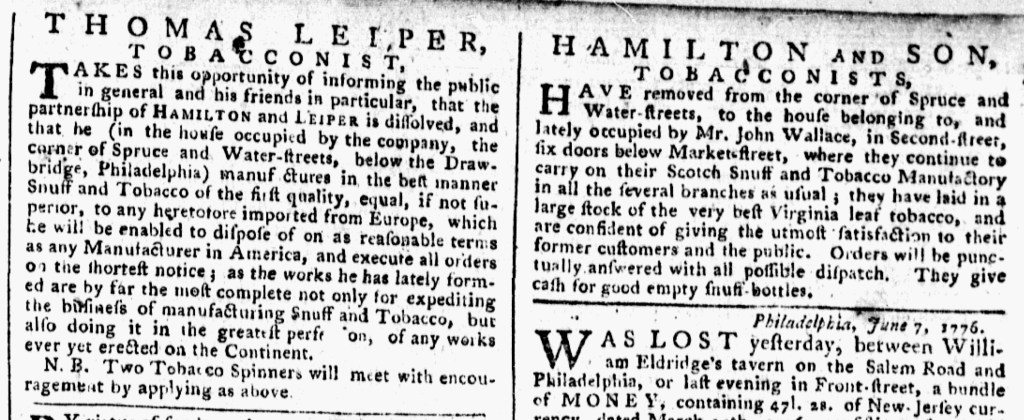
Dunlap’s Pennsylvania Packet (June 10, 1776).

“THOMAS LEIPER … manufactures in the best manner Snuff and Tobacco of the first quality.”

Two days after tobacconists Hamilton and Leiper announced that they dissolved their partnership with an advertisement in the Pennsylvania Ledger, an advertisement with identical copy ran at the top of the middle column on the front page of Dunlap’s Pennsylvania Packet.  An editorial submitted by a readers filled the rest of the column, whereas an advertisement for the new partnership of Hamilton and Son ran immediately below the same notice in the Pennsylvania Ledger.  Hamilton and Son did insert their advertisement in the June 10, 1776, edition of Dunlap’s Pennsylvania Packet, though it ran in the upper right corner on the third page, separated from the advertisement about the end of the partnership.

In this instance, Hamilton and Son’s advertisement appeared immediately to the right of a new advertisement from “THOMAS LEIPER, TOBACCONIST,” who made his own announcement to “the public in general and his friends in particular, that the partnership of HAMILTON and LEIPER is dissolved, and that he … manufacturers in the best manner Snuff and Tobacco of the first quality, equal, if not superior, to any heretofore imported from Europe.”  Now in competition with his former partner, Leiper proclaimed that he could sell his products “on as reasonable terms as any Manufacturer in America” and he could “execute all orders on the shortest notice.”  To make that possible, “the works he has lately formed are by far the most complete not only for expediting the business of manufacturing Snuff and Tobacco, but also doing it in the greatest perfection, of any works ever yet erected on the Continent.”  Leiper gave good reasons why the clientele that he and Hamilton had cultivated while in business together for several years should stick with him rather than take their business to Hamilton and Sons.  He also had the advantage of remaining “in the house occupied by the company,” a familiar location to both former customers and the public.

Hamilton and Son may have initially had a leg up on Leiper by publishing their advertisement with the notice about the dissolution of the partnership.  In response, Leiper disseminated a more elaborate advertisement that made even bolder claims.  He may even have made arrangements for the compositor of Dunlap’s Pennsylvania Packet to separate the notices that appeared together in the Pennsylvania Ledger.  That the advertisements for the two new ventures appeared next to each other put them on equal footing.  Two days later, all three advertisements ran in the Pennsylvania Gazette.  The compositor placed them one after the other after the other on the third page, staring with the announcement about dissolving the company, then Hamilton and Son’s advertisements, and Leiper’s notice at the end.  Readers could peruse all the news about these tobacconists in one convenient place.

June 9

What was advertised in a revolutionary American newspaper 250 years ago this week?

Pennsylvania Ledger (June 8, 1776).

“THE Copartnership of HAMILTON and LEIPER, Tobacconists, is dissolved.”

The “Copartnership of HAMILTON and LEIPER, Tobacconists,” provided their products to consumers for more than half a decade in the early 1770s.  In May 1772, they placed an advertisement in the Pennsylvania Gazette to advise the public that they “established a MANUFACTORY in Market-street, Baltimore,” and they continued “to manufacture and sell as usual at Frederick-Town,” Maryland.  (At the time, Baltimore did not yet have its own newspapers, so the partners resorted to the Pennsylvania Gazette as a regional newspaper for their advertisement.)  Less than a year and a half later, they opened a new location in Philadelphia. In an advertisement in the Pennsylvania Journal in September 1772, they promoted “KITE-FOOT TOBACCO … manufactured and sold … In Second-street,” Philadelphia.  To entice prospective customers who might not believe that their tobacco was “Of an excellent quality, equal to any imported from Europe,” Hamilton and Leiper made samples available “at the Bar of the London Coffee-House.”

As summer arrived in 1776, however, Hamilton and Leiper ran a new advertisement in the Pennsylvania Ledger, this time announcing that they dissolved their partnership and calling on associates who “have any demand against that concern … to bring in their accounts as soon as possible.”  They could present any such accounts to Leiper “in the house lately occupied by the Company, at the corner of Spruce and Water-streets,” or to Hamilton and Son “in Second-street.”  That notice implied that Hamilton and Son commenced their own partnership.  An advertisement that conveniently appeared immediately below that notice made clear that “HAMILTON and SON, Tobacconists[,] … continue to carry on their Scotch snuff and to bacco Manufactory in all the several branches as usual.”  To that end, they “have laid in a large stock of the very best Virginia leaf tobacco.”  The news partners declared that they “are confident of giving the utmost satisfaction to their former customers and the publick” and pledged that orders “will be punctually answer’d with all possible dispatch.”  In running one advertisement after the other, they aimed to maintain the clientele that Hamilton and Leiper had cultivated over several years in business together.

September 16

What was advertised in a colonial American newspaper 250 years ago today?

Pennsylvania Journal (September 16, 1772).

“A sample of the TOBACCO may be seen at the Bar of the London Coffee-House.”

In a series of newspaper advertisements, Hamilton and Leiper informed readers that they sold “the various kinds of manufactured TOBACCO and SNUFF (of the best quality)” at their store on Second Street in Philadelphia.  In addition, they “established a MANUFACTORY” in Baltimore “for the conveniency of their customers in Maryland.”  Over time, the partners became the most successful tobacconists in the region.  Their advertisements and other marketing efforts likely played a role in their success.

As fall approached in 1772, the partners promoted their “KITE-FOOT TOBACCO” in an advertisement in the September 16 edition of the Pennsylvania Gazette.  As usual, they lauded their tobacco’s “excellent quality.”  Like other entrepreneurs who hawked “domestic manufactures,” goods produced in the colonies, Hamilton and Leiper proclaimed their product “equal to any imported from Europe.”  Consumers were familiar with tobacco exported to England and Scotland as raw materials, processed in those places, and then imported into the colonies.  Hamilton and Leiper, however, asserted that quality tobacco did not need to cross the Atlantic twice.

Prospective customers could decide for themselves.  In addition to visiting Hamilton and Leiper’s shop, consumers had the option of examining a sample “at the Bar of the London Coffee-House.”  That almost certainly enhanced the visibility of Hamilton and Leiper’s product, exposing patrons of an establishment already popular with merchants and other colonizers to their brand of tobacco.  Patrons did not need to enter the London Coffee House with the intention of scrutinizing Hamilton and Leiper’s “KITE-FOOT TOBACCO” to determine if they wished to make a purchase.  Instead, they could be incidentally exposed to the product as others examined and discussed it.  Making samples available had the potential to incite interest and enthusiasm among multiple prospective customers engaging with each other and the product simultaneously.  That marketing strategy had the potential to create a very different kind of experience among consumers than reading newspaper notices.

May 5

What was advertised in a colonial American newspaper 250 years ago this week?

Pennsylvania Gazette (May 2, 1771).

“They manufacture and sell as usual at Frederick-Town.”

According to their advertisement in the Pennsylvania Gazette, Hamilton and Leiper sold tobacco and snuff at several locations.  For consumers in Philadelphia, they listed their location as “Second-street, between Market and Arch-streets.”  The primary purpose of their advertisement in the May 2, 1771, edition of the Pennsylvania Gazette, however, was to inform customers in Maryland that they had “established a MANUFACTORY in Market-street, Baltimore.”  At that location, they sold “the various kinds of manufactured TOBACCO and SNUFF (of the best quality) on the most reasonable terms.”  In addition, the tobacconists declared that they “manufacture and sell as usual at Frederick-Town” in western Maryland.  Altogether, Hamilton and Leiper sold tobacco and snuff in three towns in two colonies, their multiple locations providing for “the conveniency of their customers.”

Their advertisement in the Pennsylvania Gazette also testified to the reach of that newspaper in the early 1770s.  Baltimore would not have its own newspaper until August 1773.  Fredericktown (now Frederick) did not have a newspaper until after the American Revolution.  For half a century, the Pennsylvania Gazette served as a regional newspaper for readers in Pennsylvania, Delaware, Maryland, and New Jersey.  Although most of the advertisers who promoted consumers goods and services in its pages were located in Philadelphia, the Pennsylvania Gazette also carried notices from Lancaster, Pennsylvania; Wilmington, Delaware; Baltimore and Frederick, Maryland; Burlington and Trenton, New Jersey; and several other towns in those colonies.  Similarly, the Pennsylvania Gazette carried legal notices and advertisements about runaway apprentices and indentured servants and enslaved people who liberated themselves submitted by colonists throughout the region.  In the same column as Hamilton and Leiper’s advertisement, Henry Wells, a jailer, described a runaway servant who made his escape from William Anders or Andrews in Joppa, Maryland, but had been taken into custody and confined in Dover, Delaware.

Several colonies constituted a single media market for the Pennsylvania Gazette and other newspapers published in Philadelphia before the revolution.  Enterprising entrepreneurs like Hamilton and Leiper also recognized the potential to create larger markets for their wares rather than serve only a single town and its hinterlands.  In the early 1770s, they branched out from locations in Philadelphia and Frederick to a third location in Baltimore.  Advertisements in the Pennsylvania Gazette alerted consumers in and near all three places about the tobacco and snuff that Hamilton and Leiper sold at their several convenient locations.