

What was advertised in a revolutionary American newspaper 250 years ago today?

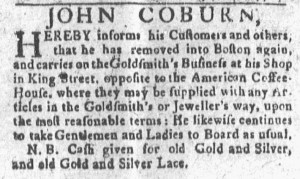
“JOHN COBURN … has removed into Boston again.”
In the summer of 1776, John Coburn, a goldsmith, returned to Boston to resume business there. He ran advertisements in the Boston-Gazette and the New-England Chronicle in July. Although he discontinued his notice in the New-England Chronicle after three insertions, he continued running it in the Boston-Gazette through the end of September. During that time, he made a significant investment in “inform[ing] his Customers and others, that he has removed into Boston again, and carries on the Goldsmith’s Business at his Shop in King Street, opposite to the American Coffee-House.”
That Coburn stated that he was in Boston “again” indicated that he previously lived and worked there. Although he did not previously advertise his services, real estate advertisements in several of Boston’s newspapers, including one in the August 19, 1773, edition of the Boston News-Letter, gave his address as “King-street, near opposite to the British Coffee-House.” Things had certainly changed in the three years since that advertisement appeared. In December 1773, men disguised as Indigenous Americans destroyed shipments of tea. In the spring, Parliament responded by passing the Coercive Acts, including the Boston Port Bill that closed the harbor in June 1774. The city experienced “Distresses,” as Isaiah Thomas described the situation, for many months before hostilities commenced at Lexington and Concord. British forces occupied the city for several more months during the siege of Boston before evacuating in March 1776.
During that time, many residents of the city departed for other towns, many of them as refugees who left at the beginning of the siege. Neither news updates nor advertisements reveal when Coburn moved out of Boston, but only when he returned to the shop on King Street that he had formerly occupied. Among the changes of the past three years, the establishment across the street had a new name, the American Coffee House rather than the British Coffee House. It had that new name as early as May 1776, at least two months before the Continental Congress declared independence. As Coburn sought to revive his business in Boston during the Revolutionary War, the location he gave in his advertisements reflected and reinforced the new identity that many readers embraced.