September 16

What was advertised in a revolutionary American newspaper 250 years ago today?
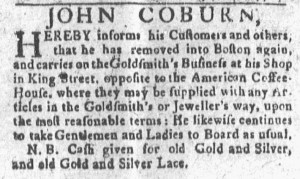
Boston-Gazette (September 16, 1776).

“JOHN COBURN … has removed into Boston again.”

In the summer of 1776, John Coburn, a goldsmith, returned to Boston to resume business there.  He ran advertisements in the Boston-Gazette and the New-England Chronicle in July.  Although he discontinued his notice in the New-England Chronicle after three insertions, he continued running it in the Boston-Gazette through the end of September.  During that time, he made a significant investment in “inform[ing] his Customers and others, that he has removed into Boston again, and carries on the Goldsmith’s Business at his Shop in King Street, opposite to the American Coffee-House.”

That Coburn stated that he was in Boston “again” indicated that he previously lived and worked there.  Although he did not previously advertise his services, real estate advertisements in several of Boston’s newspapers, including one in the August 19, 1773, edition of the Boston News-Letter, gave his address as “King-street, near opposite to the British Coffee-House.”  Things had certainly changed in the three years since that advertisement appeared.  In December 1773, men disguised as Indigenous Americans destroyed shipments of tea.  In the spring, Parliament responded by passing the Coercive Acts, including the Boston Port Bill that closed the harbor in June 1774.  The city experienced “Distresses,” as Isaiah Thomas described the situation, for many months before hostilities commenced at Lexington and Concord.  British forces occupied the city for several more months during the siege of Boston before evacuating in March 1776.

During that time, many residents of the city departed for other towns, many of them as refugees who left at the beginning of the siege.  Neither news updates nor advertisements reveal when Coburn moved out of Boston, but only when he returned to the shop on King Street that he had formerly occupied.  Among the changes of the past three years, the establishment across the street had a new name, the American Coffee House rather than the British Coffee House.  It had that new name as early as May 1776, at least two months before the Continental Congress declared independence.  As Coburn sought to revive his business in Boston during the Revolutionary War, the location he gave in his advertisements reflected and reinforced the new identity that many readers embraced.
May 2

What was advertised in a revolutionary American newspaper 250 years ago today?

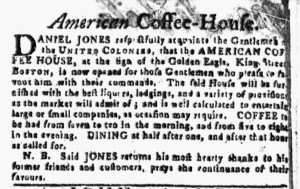
New-England Chronicle (May 2, 1776).

“American Coffee-House.”

Not long after British forces departed from Boston on March 17, 1776, and the siege of the city ended, Daniel Jones opened the “American Coffee-House.”  At about the same time, Samuel Hall, the printer of the New-England Chronicle, moved his printing office from “Stoughton-Hall, HARVARD-COLLEGE,” in Cambridge into Boston “next to the OLIVER CROMWELL TAVERN, in SCHOOL-STREET.”  He printed the first issue in the formerly occupied city on April 25.  A week later, Jones ran a notice in which he “respectfully acquaints the Gentlemen of the UNITED COLONIES, that the AMERICAN COFFEE HOUSE, at the sign of the Golden Eagle, King Street, BOSTON, is now opened for those Gentlemen who please to favour him with their commands.”

As much as Jones hoped to offer a place of respite for patrons who joined him for coffee and dining, that opening sentence testified to the uncertainty of the times.  The war had entered its second year.  When it began, most colonizers sought a redress of their grievances within the imperial system, but over time more and more of them advocated for declaring independence, especially following the publication of Thomas Paine’s Common Sense in Philadelphia in January 1776 and the widespread dissemination of local editions in the following months.  In the past, establishments like the one that Jones advertised were often known as the London Coffee House, a nod to the largest and most cosmopolitan city in the empire and, especially, to the transatlantic and even global networks of commerce that converged there.  Yet Jones named his establishment the “American Coffee-House” and addressed the “Gentlemen of the UNITED COLONIES,” privileging their American identity and acknowledging that the diverse colonies had banded together.  A Continental Congress organized resistance.  A Continental Army defended American liberties.  Even though Jones associated his new establishment with the American cause, it happened to be located on King Street (which would be renamed State Street shortly after the Treaty of Paris officially ended the Revolutionary War).  The “sign of the Golden Eagle,” a familiar device in several towns, one that did not have revolutionary significance, marked the coffeehouse’s location.  That the “Gentlemen of the UNITED COLONIES” gathered at the “AMERICAN COFFEE HOUSE” on King Street exemplified the transition taking place as colonizers moved from engaging in resistance to embracing revolution in 1776.