September 16

What was advertised in a revolutionary American newspaper 250 years ago today?
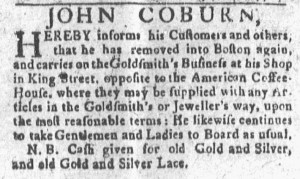
Boston-Gazette (September 16, 1776).

“JOHN COBURN … has removed into Boston again.”

In the summer of 1776, John Coburn, a goldsmith, returned to Boston to resume business there.  He ran advertisements in the Boston-Gazette and the New-England Chronicle in July.  Although he discontinued his notice in the New-England Chronicle after three insertions, he continued running it in the Boston-Gazette through the end of September.  During that time, he made a significant investment in “inform[ing] his Customers and others, that he has removed into Boston again, and carries on the Goldsmith’s Business at his Shop in King Street, opposite to the American Coffee-House.”

That Coburn stated that he was in Boston “again” indicated that he previously lived and worked there.  Although he did not previously advertise his services, real estate advertisements in several of Boston’s newspapers, including one in the August 19, 1773, edition of the Boston News-Letter, gave his address as “King-street, near opposite to the British Coffee-House.”  Things had certainly changed in the three years since that advertisement appeared.  In December 1773, men disguised as Indigenous Americans destroyed shipments of tea.  In the spring, Parliament responded by passing the Coercive Acts, including the Boston Port Bill that closed the harbor in June 1774.  The city experienced “Distresses,” as Isaiah Thomas described the situation, for many months before hostilities commenced at Lexington and Concord.  British forces occupied the city for several more months during the siege of Boston before evacuating in March 1776.

During that time, many residents of the city departed for other towns, many of them as refugees who left at the beginning of the siege.  Neither news updates nor advertisements reveal when Coburn moved out of Boston, but only when he returned to the shop on King Street that he had formerly occupied.  Among the changes of the past three years, the establishment across the street had a new name, the American Coffee House rather than the British Coffee House.  It had that new name as early as May 1776, at least two months before the Continental Congress declared independence.  As Coburn sought to revive his business in Boston during the Revolutionary War, the location he gave in his advertisements reflected and reinforced the new identity that many readers embraced.

May 11

What was advertised in a colonial American newspaper 250 years ago today?

May 11 - 5:11:1767 New-York Gazette
New-York Gazette (May 11, 1767).

“None but the best of Medicines.”

The mononymous Steuart, “DRUGGIST and APOTHECARY, At the GOLDEN HEAD” on Queen Street in New York, crafted an advertising campaign intended to maximize market penetration. Most advertisers inserted paid notices in only one newspaper, though enterprising entrepreneurs sometimes promoted their goods and services in multiple publications. Rarely did advertisers in New York, however, invest the effort or expense in placing advertisements in all four of the city’s newspapers in a single week in 1767. Steuart, however, advertised in the New-York Gazette and the New-York Mercury on May 11, as well as in the New-York Journal and the New-York Gazette: Or, Weekly Post-Boy on May 7. In all except that final publication, he was fortunate that his notice appeared on the front page.

It might be tempting to conclude that a recent relocation made such advertising imperative. The advertisements indicated that he had “removed from between Burling’s and Beekman’s-Slip, to the House lately occupied by Messrs. Walter and Thomas Buchannen, in Queen-Street, (between Hanover-Square and the Fly-Market:).” The move certainly provided one motive for advertising in as many newspapers as possible, but Steuart also competed with McLean and Treat, prolific advertisers who inserted their own notices for their “Medicinal Store, in Hanover-square” in three out of four of New-York’s newspapers that same week. McLean and Treat had also been advertising in multiple newspapers for several weeks before Steuart’s notices appeared. In addition, other apothecaries and shopkeepers who sold medicines took to the public prints to promote their ware that week, including Edward Agar in the New-York Journal and the New-York Mercury; Thomas Bridgen Attwood in the New-York Journal and the New-York Gazette; and Gerardus Duyckinck in the New-York Gazette: Or, Weekly Post-Boy, the New-York Journal, and the New-York Mercury.

Steuart stated that he “hopes his Friends in Town and Country will still continue to Favour him with their Custom.” He had established a clientele and wanted them to follow him to his new location on Queen Street. While that may have been reason enough to post an advertisement in each of the city’s newspapers, Steuart also realized that he faced competition from several other druggists who advertised aggressively. Getting his share of the market required advertising. Had his notices been intended solely to inform readers of his new location, it would not have been necessary to make appeals to quality – “none but the best of Medicines” – or price – “on as low Terms as possible” – or variety recently arrived from London – “just imported … a fresh and general Assortment.”