

What was advertised in a revolutionary American newspaper 250 years ago today?

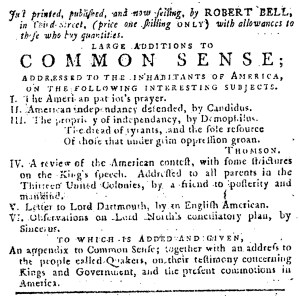
“Printed, published, and now selling, by ROBERT BELL … LARGE ADDITIONS TO COMMON SENSE.”
It was an interesting turn of events in the feud over publishing Thomas Paine’s Common Sense that unfolded in Philadelphia. On January 9, 1776, Robert Bell announced the publication of what would become the most popular political pamphlet of the era of the American Revolution. At first, he was the only printer willing to publish such Paine’s radical arguments in favor of independence. It did not take long for Paine and Bell to part ways over publishing a second edition, reportedly because Bell’s ledgers showed that he did not earn a profit on the first edition. Paine, who claimed that he wished to donate his share of the proceeds to buy mittens for American soldiers involved in the invasion of Canada, instructed Bell not to publish a second edition. Instead, he worked with William Bradford and Thomas Bradford, the printers of the Pennsylvania Journal, on a new edition with bonus material. Bell went ahead with his second edition anyway, pirated the additions that Paine made to the new edition, and released a companion pamphlet, “LARGE ADDITIONS TO COMMON SENSE,” that consisted of essays drawn from newspapers, none of them by Paine.
All of that and even more drama appeared in advertisements in several newspapers published in Philadelphia and even a couple in New York. Initially, Bell and Paine addressed each other in open letters. After the author had his say, Bell and the Bradfords exchanged barbs. Bell ran advertisements for his second edition of Common Sense and related pamphlets in most of the Philadelphia’s newspapers, but not the Pennsylvania Journal. Either he refused to give the Bradfords the advertising revenue or they refused to accept his advertisements. Curiously, the Pennsylvania Journal did carry Bell’s advertisement for “LARGE ADDITIONS TO COMMON SENSE” on February 21, but it appeared alongside an advertisement for the Bradfords’ “NEW EDITION OF COMMON SENSE” that concluded with a warning: “The Pamphlet advertised by Robert Bell, entitled Additions to Common Sense, or by any other name he may hereafter call it, consists of pieces taken out of the News-papers, and not written by the author of Common Sense.” No advertisement for any variations of Common Sense or related material published by Bell ran in the Pennsylvania Journal for seven weeks. Then, on April 10, the advertisement from February 21 appeared once again, the type apparently still set. For whatever reason, the Bradfords had not broken it down, suggesting that they thought it possible Bell’s notice might run again. Richard Gimbel asserts that the “acrimonious quarrel … doubtless helped to make Paine’s Common Sense the most discussed and most widely circulated pamphlet in America.”[1] Did the Bradfords have that in mind when they made decisions about whether and when to publish Bell’s advertisements for Common Sense and related material in the Pennsylvania Journal?
**********
[1] Richard Gimbel, Thomas Paine: A Bibliographical Check List of Common Sense with an Account of Its Publication (New Haven: Yale University Press, 1956), 49.