April 10

What was advertised in a revolutionary American newspaper 250 years ago today?
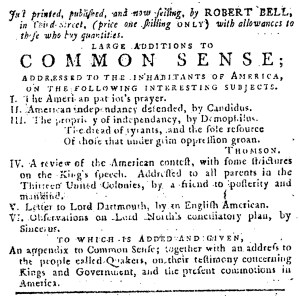
Pennsylvania Journal (April 10, 1776).

Printed, published, and now selling, by ROBERT BELL … LARGE ADDITIONS TO COMMON SENSE.”

It was an interesting turn of events in the feud over publishing Thomas Paine’s Common Sense that unfolded in Philadelphia.  On January 9, 1776, Robert Bell announced the publication of what would become the most popular political pamphlet of the era of the American Revolution.  At first, he was the only printer willing to publish such Paine’s radical arguments in favor of independence.  It did not take long for Paine and Bell to part ways over publishing a second edition, reportedly because Bell’s ledgers showed that he did not earn a profit on the first edition.  Paine, who claimed that he wished to donate his share of the proceeds to buy mittens for American soldiers involved in the invasion of Canada, instructed Bell not to publish a second edition.  Instead, he worked with William Bradford and Thomas Bradford, the printers of the Pennsylvania Journal, on a new edition with bonus material.  Bell went ahead with his second edition anyway, pirated the additions that Paine made to the new edition, and released a companion pamphlet, “LARGE ADDITIONS TO COMMON SENSE,” that consisted of essays drawn from newspapers, none of them by Paine.

All of that and even more drama appeared in advertisements in several newspapers published in Philadelphia and even a couple in New York.  Initially, Bell and Paine addressed each other in open letters.  After the author had his say, Bell and the Bradfords exchanged barbs.  Bell ran advertisements for his second edition of Common Sense and related pamphlets in most of the Philadelphia’s newspapers, but not the Pennsylvania Journal.  Either he refused to give the Bradfords the advertising revenue or they refused to accept his advertisements.  Curiously, the Pennsylvania Journal did carry Bell’s advertisement for “LARGE ADDITIONS TO COMMON SENSE” on February 21, but it appeared alongside an advertisement for the Bradfords’ “NEW EDITION OF COMMON SENSE” that concluded with a warning: “The Pamphlet advertised by Robert Bell, entitled Additions to Common Sense, or by any other name he may hereafter call it, consists of pieces taken out of the News-papers, and not written by the author of Common Sense.”  No advertisement for any variations of Common Sense or related material published by Bell ran in the Pennsylvania Journal for seven weeks.  Then, on April 10, the advertisement from February 21 appeared once again, the type apparently still set.  For whatever reason, the Bradfords had not broken it down, suggesting that they thought it possible Bell’s notice might run again.  Richard Gimbel asserts that the “acrimonious quarrel … doubtless helped to make Paine’s Common Sense the most discussed and most widely circulated pamphlet in America.”[1]  Did the Bradfords have that in mind when they made decisions about whether and when to publish Bell’s advertisements for Common Sense and related material in the Pennsylvania Journal?

**********

[1] Richard Gimbel, Thomas Paine: A Bibliographical Check List of Common Sense with an Account of Its Publication (New Haven: Yale University Press, 1956), 49.

March 7

What was advertised in a revolutionary American newspaper 250 years ago today?

New-York Journal (March 7, 1776).

“THE NEW EDITION OF COMMON SENSE.”

“LARGE ADDITIONS TO COMMON SENSE.”

The March 7, 1776, edition of the New-York Journal included competing advertisements for Thomas Paine’s Common Sense and “LARGE ADDITIONS TO COMMON SENSE.”  Although John Anderson, the printer of the Constitutional Gazette, recently published a New York edition of Paine’s pamphlet, neither of these advertisements promoted pamphlets printed in that city.  Instead, both advertisements hawked pamphlets printed in Philadelphia and sent to New York.

New-York Journal (March 7, 1776).

Garrat Noel and Ebenezer Hazard stocked the “NEW EDITION OF COMMON SENSE; With Additions and Improvements in the Body of the WORK” published by William Bradford and Thomas Bradford, printers of the Pennsylvania Journal.  When Paine and Robert Bell, the publisher of the first edition of Common Sense, had a falling out, the author collaborated with the Bradfords on a “NEW EDITION” that featured new material, including “AN APPENDIX, And an ADDRESS to the People, called, QUAKERS.”  As the Bradfords prepared that edition for press, Bell published an unauthorized second edition and then supplemented it with yet another pamphlet of “LARGE ADDITIONS” that included “The American Patriot’s Prayer” and “American Independency defended, by Candidus.”  In their advertisements, the Bradfords warned that the pamphlet “consists of pieces taken out of News-Papers, and NOT written by the AUTHOR of Common Sense.”  To spite Paine and the Bradfords, Bell then pirated “An Appendix to Common Sense; together with an Address to the People called Quakers, on their Testimony concerning Kings and Government, and the present Commotions in America” and packaged it with the “LARGE ADDITIONS.”

The advertisements in the New-York Journal reveal that Noel and Hazard stocked the Bradfords’ edition of Common Sense at the Constitutional Post Office and that William Green, a bookseller and bookbinder in Maiden Lane, carried Bell’s “LARGE ADDITIONS.”  Noel and Hazard’s advertisement included the warning about items from newspapers passed off as Paine’s work.  Green previously placed the first advertisement for Common Sense that appeared in any newspaper beyond Philadelphia, identifying himself as Bell’s local agent for distributing the pamphlet.  That he now advertised the “LARGE ADDITIONS” demonstrated that Bell continued supplying him with pamphlets to peddle in New York.  Even as printers in New York and other towns produced local editions of Common Sense, printers in Philadelphia tried to expand their share of the market for the popular pamphlet by sending copies to local agents to advertise and sell.

February 20

What was advertised in a revolutionary American newspaper 250 years ago today?

Pennsylvania Evening Post (February 20, 1776).

“Pieces taken out of News papers, and not written by the Author of COMMON SENSE.”

The final page of the Pennsylvania Evening Post was once again ground zero for the dispute between Robert Bell, the publisher of the first edition of Thomas Paine’s Common Sense and subsequent unauthorized editions, and William Bradford and Thomas Bradford, the printers of the Pennsylvania Journal entrusted by Paine to publish a “NEW EDITION … With ADDITIONS and IMPROVEMENTS in the BODY of the WORK.”  Paine previously participated in the dispute, but he seemingly withdrew in favor of letting the printers duke it out in the public prints.

The Bradfords’ expanded edition had been in the press for a few weeks, but on February 14, 1776, they announced in their own newspaper that “THIS DAY WILL BE PUBLISHED AND SOLD … THE NEW EDITION OF COMMON SENSE.”  The following day, they ran a new advertisement in the Pennsylvania Evening Post and then updated it on February 20.  To make that edition more appealing than any of the editions published by Bell, the Bradfords proclaimed, “The Additions which are here given, amount to upwards of one Third of any former Edition.”  They also acknowledged that Bell had been advertising “ADDITION to COMMON SENSE,” but they alerted readers that Bell was trying to pull a fast one.  The “ADDITIONS” that Bell marketed “consist of Pieces taken out of News Papers, and not written by the Author of COMMON SENSE.”  Paine had worked exclusively with the Bradfords on the “ADDITIONS and IMPROVEMENTS.”  The Bradfords also listed several booksellers who stocked their new edition.  Benjamin Towne, the printer of the Pennsylvania Evening Post, was not among them, but he certainly generated revenue from publishing the advertisements that the Bradfords and Bell submitted to his printing office.

Right next to the Bradfords’ advertisement, as had been the case on other occasions, appeared Bell’s advertisement for “Large ADDITIONS to COMMON SENSE.”  Those “ADDITIONS” included “the following interesting subjects,” “American Independency defended by Candidus,” and “The Propriety of Independancy, by Demophilus,” and “Observations on Lord North’s Conciliatory Plan, by Sincerus.”  This version of the advertisement added “The American Patriot’s Prayer,” left out of Bell’s previous notice, to entice prospective customers.  Bell also pirated “AN APPENDIX TO COMMON SENSE, together with an ADDRESS to the people called QUAKERS, on their Testimony concerning Kings and Government.”  Like the Bradfords, he charged “one shilling ONLY” and made “allowance to those who buy quantities.”  In other words, the printers of Common Sense and related materials offered discounts to retailers who purchased in volume to sell the pamphlet in their own shops and others who bought multiple copies to distribute to friends, relatives, and associates.  The contents of Paine’s political pamphlet made it popular, yet the advertisements in the Pennsylvania Evening Post and other newspapers also helped raise awareness of Common Sense.