April 10

What was advertised in a revolutionary American newspaper 250 years ago today?
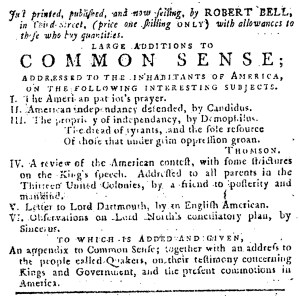
Pennsylvania Journal (April 10, 1776).

Printed, published, and now selling, by ROBERT BELL … LARGE ADDITIONS TO COMMON SENSE.”

It was an interesting turn of events in the feud over publishing Thomas Paine’s Common Sense that unfolded in Philadelphia.  On January 9, 1776, Robert Bell announced the publication of what would become the most popular political pamphlet of the era of the American Revolution.  At first, he was the only printer willing to publish such Paine’s radical arguments in favor of independence.  It did not take long for Paine and Bell to part ways over publishing a second edition, reportedly because Bell’s ledgers showed that he did not earn a profit on the first edition.  Paine, who claimed that he wished to donate his share of the proceeds to buy mittens for American soldiers involved in the invasion of Canada, instructed Bell not to publish a second edition.  Instead, he worked with William Bradford and Thomas Bradford, the printers of the Pennsylvania Journal, on a new edition with bonus material.  Bell went ahead with his second edition anyway, pirated the additions that Paine made to the new edition, and released a companion pamphlet, “LARGE ADDITIONS TO COMMON SENSE,” that consisted of essays drawn from newspapers, none of them by Paine.

All of that and even more drama appeared in advertisements in several newspapers published in Philadelphia and even a couple in New York.  Initially, Bell and Paine addressed each other in open letters.  After the author had his say, Bell and the Bradfords exchanged barbs.  Bell ran advertisements for his second edition of Common Sense and related pamphlets in most of the Philadelphia’s newspapers, but not the Pennsylvania Journal.  Either he refused to give the Bradfords the advertising revenue or they refused to accept his advertisements.  Curiously, the Pennsylvania Journal did carry Bell’s advertisement for “LARGE ADDITIONS TO COMMON SENSE” on February 21, but it appeared alongside an advertisement for the Bradfords’ “NEW EDITION OF COMMON SENSE” that concluded with a warning: “The Pamphlet advertised by Robert Bell, entitled Additions to Common Sense, or by any other name he may hereafter call it, consists of pieces taken out of the News-papers, and not written by the author of Common Sense.”  No advertisement for any variations of Common Sense or related material published by Bell ran in the Pennsylvania Journal for seven weeks.  Then, on April 10, the advertisement from February 21 appeared once again, the type apparently still set.  For whatever reason, the Bradfords had not broken it down, suggesting that they thought it possible Bell’s notice might run again.  Richard Gimbel asserts that the “acrimonious quarrel … doubtless helped to make Paine’s Common Sense the most discussed and most widely circulated pamphlet in America.”[1]  Did the Bradfords have that in mind when they made decisions about whether and when to publish Bell’s advertisements for Common Sense and related material in the Pennsylvania Journal?

**********

[1] Richard Gimbel, Thomas Paine: A Bibliographical Check List of Common Sense with an Account of Its Publication (New Haven: Yale University Press, 1956), 49.

March 2

What was advertised in a colonial American newspaper 250 years ago today?

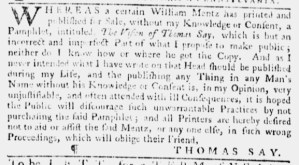
Pennsylvania Gazette (March 2, 1774).

“It is hoped the Public will discourage such unwarrantable Practices by not purchasing the said Pamphlet.”

In the winter of 1774, William Mentz published The Visions of a Certain Tho. Say, of the City of Philadelphia, Which He Saw in a Trance.  That pamphlet did not receive attention in the public prints because Mentz advertised it but instead because Thomas Say ran notices repudiating the work.  On March 2, Say inserted advertisements in the Pennsylvania Gazette and the Pennsylvania Journal.  Five days later, he ran the same notice in Dunlap’s Pennsylvania Packet.  He was so intent on disseminating his message as widely as possible that he invested in advertisements in all three of the English-language newspapers published in Philadelphia at the time.

Mentz did not advertise the pamphlet, so Say’s notices may have generated more attention than anything else.  Did they have the intended effect?  Did colonizers refrain from purchasing the pamphlet because Say reacted so strongly to its publication?  Or did the controversy whet their appetites to see what was contained within its pages?  Say denounced “a certain Mentz [who] has printed and published for Sale, without my Knowledge or Consent, a Pamphlet … which is but an incorrect and imperfect Part of what I propose to make public.”  Furthermore, Say did not know “how or where he got the Copy.”  He excoriated Mentz: “publishing any Thing in any Man’s Name without his Knowledge or Consent is, in my Opinion, very unjustifiable, and often attended with ill Consequences.”  Addressing the public, Say made a plea that they “will discourage such unwarrantable Practices by not purchasing said Pamphlet.”  He also requested that printers neither aid nor assist Mentz “in such wrong Proceedings.”

Did that incite instead of quell demand for the pamphlet?  Mentz issued a second version, The Visions of a Certain Thomas Say, of the City of Philadelphia, Which He Saw in a Trance: To Which Is Added, Another Vision. By the Late Reverend Isaac Watts, D.D.  Perhaps he did so because Say’s unintended marketing of the pamphlet yielded interest in it.  On the other hand, Say may have managed to inhibit sales, prompting Mentz to package the pamphlet with a similar item by a popular author in hopes of rescuing the endeavor from financial failure.  Either way, the visibility that the pamphlet received in Philadelphia’s newspapers came solely from Say’s efforts to constrain sales rather than marketing undertaken by the publisher.

October 10

What was advertised in a colonial American newspapwer 250 years ago today?

Oct 10 - 10:10:1767 Providence Gazette.jpg
Providence Gazette (October 10, 1767).

“The said Joseph is not, by me, any Ways authorized or impowered to settle any of my Affairs.”

According to his advertisement, a notice that originally appeared in the September 26, 1767, edition of the Providence Gazette must have surprised John Whipple. It stated that “ALL Persons having any Demands on the Estate of Captain JOHN WHIPPLE, of Providence; and likewise all those who are any ways indebted to said Estate” should contact the executor, Joseph Whipple. At a glance, it appeared to be a standard estate notice; it replicated the language deployed in similar notices published in newspapers throughout the colonies.

However, John Whipple, the deceased, saw the advertisement and then disputed his death and stated in no uncertain terms that he had not “authorized or impowered” Joseph Whipple “to settle any of my Affairs.” In the very next issue, published on October 3, he inserted his own advertisement, but it was not until the following week that the compositor positioned the two contradictory advertisements next to each other. Was that the result of those working in the “PRINTING-OFFICE, [at] the Sign of Shakespear’s Head” attempting to impose order within the pages of the Providence Gazette? Did they seek to assist readers in navigating the two advertisements? Did they place them one after another as a service to the aggrieved John Whipple? Or did the supposedly deceased captain examine the October 3 issue, notice that his advertisement was not even on the same page as the second insertion of Joseph Whipple’s original notice, and then make a subsequent visit to the printing office to demand that his advertisement would be most effective if it appeared immediately after the fraudulent one?

Colonists engaged in extensive and active reading of newspapers, yet the decision to place the advertisements by the feuding Whipples one after the other (which continued in subsequent issues) suggests that someone – printer, compositor, or advertiser – saw a need for greater organization than the system of unclassified advertisements usually provided. This also had the effect of telling a better and more complete story, potentially ramping up interest among readers interested in local gossip. On the rare occasions that runaway wives responded to advertisements placed by their abandoned husbands, printers or others sometimes positioned their notices next to each other, giving each their say while also accentuating the drama for readers.

Sarah Goddard and John Carter and their employees in the printing office did not further differentiate or organize other advertisements in the Providence Gazette according to their purposes, but in the case of the Whipples and an early modern case of identity theft they did print the related advertisements next to each other throughout most of their runs.