

What was advertised in a revolutionary American newspaper 250 years ago today?

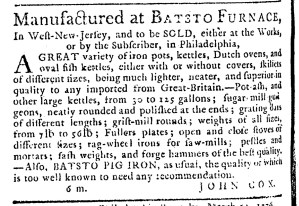
“Manufactured at BATSTO FURNACE.”
For months, an advertisement for goods “Manufactured at BATSTO FURNACE, In West-New-Jersey,” ran in the Pennsylvania Journal. The notice advised prospective customers that they could select from among a “GREAT variety of iron pots, kettles, Dutch ovens, and oval fish kettles, either with or without covers, [and] skillets of different sizes” as well as “open and close stoves of different sizes, … pestles and mortars; sash weights, and forge hammers of the best quality.”
According to the public historians at Batsto Village in Hammonton, New Jersey, “Charles Read of Burlington constructed the Iron Furnace at Batsto in 1766. The furnace produced cannons, munitions and other items to aid the patriots during their struggle with the British. … Following the Revolutionary War, the Batsto furnace produc[ed] a variety of items such as pots, kettles, stoves, and fireplace backing.” Unfortunately, the furnace no longer stands today, though visitors may view an ore pile and a nineteenth-century ore boat.
The advertisements in the Pennsylvania Journal demonstrate that the Batsto Furnace produced an array of consumer goods during the first year of the Revolutionary War. Read likely responded to calls for “domestic manufactures,” goods produced in the colonies as alternatives to items imported from England, that accompanied nonimportation agreements adopted in response to the Stamp Act in 1765 and 1766, the Townshend Acts in the late 1760s, and the Intolerable Acts in 1774. The eight article of the Continental Association, a nonimportation, nonconsumption, and nonexportation pact devised by the Second Continental Congress in October 1774 and adopted throughout the colonies, stated, “That we will, in our several Stations, encourage Frugality, Economy, and Industry; and promote Agriculture, Arts, and the Manufactures of this Country.” The thirteen article address prices: “That all Manufactures of this country to be sold at reasonable Prices, so that no undue Advantage be taken of a future scarcity of Goods.” Given those provisions, the advertisement for the goods produced at the Batsto Furnace likely resonated with readers. John Cox, the local agent who sold the pots, kettles, skillets, and other kitchenware in Philadelphia, described them as “much lighter, neater, and superior in quality to any imported from Great-Britain.” He attempted to assure consumers that they did not need to sacrifice quality when they observed their political principles through buying goods made in the colonies.