April 17

What was advertised in a revolutionary American newspaper 250 years ago today?
Pennsylvania Journal (April 17, 1776).

“Manufactured at BATSTO FURNACE.”

For months, an advertisement for goods “Manufactured at BATSTO FURNACE, In West-New-Jersey,” ran in the Pennsylvania Journal.  The notice advised prospective customers that they could select from among a “GREAT variety of iron pots, kettles, Dutch ovens, and oval fish kettles, either with or without covers, [and] skillets of different sizes” as well as “open and close stoves of different sizes, … pestles and mortars; sash weights, and forge hammers of the best quality.”

According to the public historians at Batsto Village in Hammonton, New Jersey, “Charles Read of Burlington constructed the Iron Furnace at Batsto in 1766.  The furnace produced cannons, munitions and other items to aid the patriots during their struggle with the British.  …  Following the Revolutionary War, the Batsto furnace produc[ed] a variety of items such as pots, kettles, stoves, and fireplace backing.”  Unfortunately, the furnace no longer stands today, though visitors may view an ore pile and a nineteenth-century ore boat.

The advertisements in the Pennsylvania Journal demonstrate that the Batsto Furnace produced an array of consumer goods during the first year of the Revolutionary War.  Read likely responded to calls for “domestic manufactures,” goods produced in the colonies as alternatives to items imported from England, that accompanied nonimportation agreements adopted in response to the Stamp Act in 1765 and 1766, the Townshend Acts in the late 1760s, and the Intolerable Acts in 1774.  The eight article of the Continental Association, a nonimportation, nonconsumption, and nonexportation pact devised by the Second Continental Congress in October 1774 and adopted throughout the colonies, stated, “That we will, in our several Stations, encourage Frugality, Economy, and Industry; and promote Agriculture, Arts, and the Manufactures of this Country.”  The thirteen article address prices: “That all Manufactures of this country to be sold at reasonable Prices, so that no undue Advantage be taken of a future scarcity of Goods.”  Given those provisions, the advertisement for the goods produced at the Batsto Furnace likely resonated with readers.  John Cox, the local agent who sold the pots, kettles, skillets, and other kitchenware in Philadelphia, described them as “much lighter, neater, and superior in quality to any imported from Great-Britain.”  He attempted to assure consumers that they did not need to sacrifice quality when they observed their political principles through buying goods made in the colonies.
March 27

What was advertised in a revolutionary American newspaper 250 years ago today?

Pennsylvania Journal (March 27, 1776).

“The above goods are now offered … as low as goods of the same quality have been sold … for two years past.”

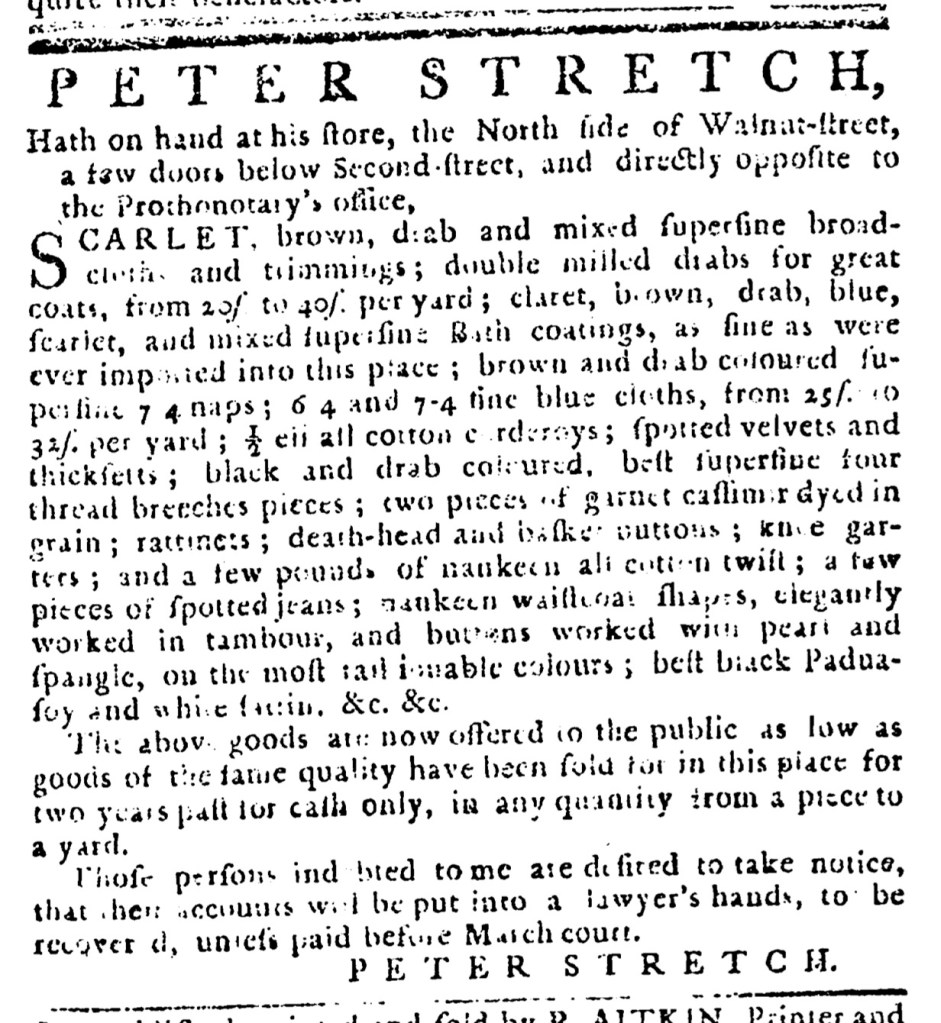
As spring arrived in 1776, Peter Stretch advertised an assortment of textiles and accessories available at his store on Walnut Street in Philadelphia.  In a notice in the March 27 edition of the Pennsylvania Journal, he listed many kinds of fabrics, including “SCARLET, brown, drab and mixed superfine broadcloaths and trimmings,” “spotted velvets and thicksetts,” and “best black Paduasoy and white sattin.”  Among the accessories, he stocked “death-head and basket buttons,” “knee garters,” and “buttons worked with pearl and spangle, on the most fashionable colours.”  Stretch’s inventory also included “claret, brown, drab, blue, scarlet, and mixed superfine Bath coatings, as fine as were ever imported into this place.”  He conveniently did not mention when he had received shipment of any of his wares, sidestepping whether they arrived before the Continental Association went into effect on December 1, 1774, though he had on another occasion detailed his compliance with that pact.

In this instance, Stretch did assert that his goods “are now offered to the public as low as goods of the same quality have been sold for in this place for two years past.”  In that regard, he did acknowledge the nonimportation agreement devised by the Second Continental Congress in response to the Coercive Acts that Parliament passed to punish Boston for destroying tea by throwing it into the harbor in December 1773.  The ninth article required that “Venders of Goods or Merchandise will not take Advantage of the Scarcity of Goods that may be occasioned by this Associacion, but will sell the same at the Rates we have been respectively accustomed to do for twelve Months past.”  It also specified that merchants and shopkeepers who did engage in price gouging then “no Person ought, nor will any of us deal with any such Person … at any Time thereafter, for any Commodity whatever.”  Stretch certainly wanted to avoid such consequences!  In stating that his prices matched those charged two years earlier, he assured prospective customers that they were in line with prices from before the Continental Association went into effect.  He did not promise great bargains, but at least his customers did not have to worry that he took advantage of the disruptions to trade caused by the imperial crisis and a war that started the previous April.

March 23

What was advertised in a revolutionary American newspaper 250 years ago today?

Providence Gazette (March 23, 1776).

No advantage is meant to be taken.”

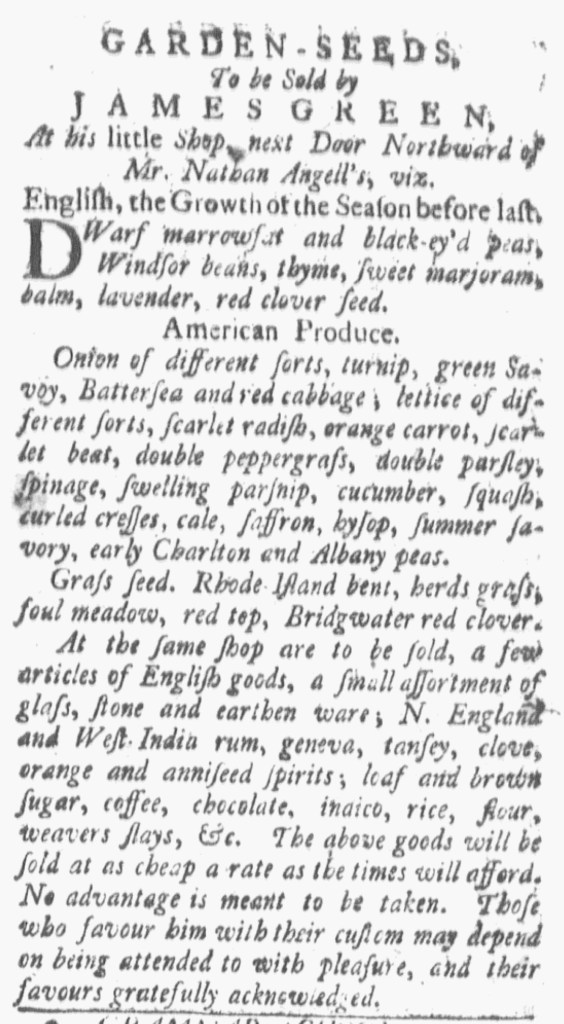
As spring approached in 1776, James Green took to the pages of the Providence Gazette to advertise “GARDEN-SEEDS” that he sold “At his little Shop.”  He had done so in recent years, though the Continental Association, a nonimportation agreement devised by the Second Continental Congress that went into effect on December 1, 1774, and the outbreak of hostilities at Lexington and Concord on April 19, 1775, seemingly had an impact on his business.  He previously promoted a “Fresh Assortment of Garden Seed, just imported in the last Ships from London,” in the spring of 1773 and a “Fresh Assortment of Garden Seeds, imported from London …, warranted to be all of the last Year’s Produce,” in the spring of 1774.  In 1776, on the other hand, he stocked some seeds that he described as “English, the Growth of the Season before last,” meaning that they arrived before the Continental Association went into effect.  This time around he also had seeds for a variety of “American Produce,” adapting his business to the changing times.

As was often the case, Green took the opportunity to hawk other merchandise, including “a few articles of English goods,” presumably imported more than a year earlier, “a small assortment of glass, stone and earthen ware,” and “loaf and brown sugar, coffee, chocolate, indico, rice, [and] flour.”  Tea was conspicuously missing from the list of groceries that Green stocked.  The shopkeeper did not merely list his wares.  He also assured prospective customers his merchandise “will be sold at as cheap a rate as the times will afford.”  In other words, he set reasonable prices, yet he acknowledged that the nonimportation agreement and the war resulted in higher prices.  Still, he sought to avoid suspicion that he engaged in price gouging: “No advantage is meant to be taken.”  In making that statement, he echoed the ninth article of the Continental Association.  It dictated that “such as are Venders of Goods or Merchandise will not take Advantage of the Scarcity of Goods that may be occasioned” by this agreement.  Green wanted the entire community to know that he dealt fairly with his customers.

December 5

What was advertised in a revolutionary American newspaper 250 years ago today?

New-Hampshire Gazette (December 5, 1775).

“Shopkeepers are cautioned, not to advance on their Goods, which is contrary to the Resolves of the Continental Congress.”

The December 5, 1775, edition of the New-Hampshire Gazette consisted of only two pages rather than the usual four.  That limited the amount of news and advertising that the printer, Daniel Fowle, could disseminate to readers, yet that issue carried good news that the “Printing Press is now again removed from Greenland to Portsmouth.”  Fowle had moved his press to Greenland, about six miles from Portsmouth, to protect it from an anticipated British attack on New Hampshire’s most important port.  In early December, he moved his press back to Portsmouth, “into an old Building adjoining the late Printing-Office … where it is hop’d the Types will remain undisturb’d, as this Harbour is so well fortified that any Enemy must pass thro’ a Hell of Fire, intermix’d with Brimstone, Pitch Tar, Turpentine, and almost every Sort of Combustible Matter to make the Passage dreadful.”

Yet enemies to the American cause did not approach Portsmouth solely by sea.  Some enemies resided in the port and nearby towns, undermining efforts to resist British tyranny through their actions in the marketplace rather than on the battlefield.  At the bottom of the last column on the last page, Fowle concluded that issue of the New-Hampshire Gazettewith a warning published “By desire” of a correspondent that “Shopkeepers are cautioned, not to advance on their Goods, which is contrary to the Resolves of the Continental Congress.”  The correspondent invoked the ninth article of the Continental Association, a nonimportant agreement devised by the First Continental Congress that went into effect on December 1, 1774.  That article stated that “such as are Venders of Goods or Merchandise will not take Advantage of the Scarcity of Goods that may be occasioned by this Association, but will sell the same at the Rates we have been respectively accustomed to do for twelve months past.”  Some shopkeepers in and near Portsmouth apparently considered charging an “Advance” (or markup) on their wares, prompting the patriotic correspondent to remind them of the Continental Association and the consequences they faced.  That would be their only warning because “if they do [raise prices], their Names will be return’d to the Congress ad publish’d, without further Notice.”  Once that happened, the ninth article specified that “if any Venders of Goods or Merchandise shall sell any such Goods on higher Terms … no Person ought, nor will any of us deal with any such Person … at any Time thereafter, for any Commodity whatever.”  That issue carried only two advertisements from local retailers, yet the address applied to all the shopkeepers in the vicinity.

November 28

What was advertised in a revolutionary American newspaper 250 years ago today?

Dunlap’s Maryland Gazette (November 28, 1775).

“He will engage to make Looms for the weaving of Linen an[d] Woollen.”

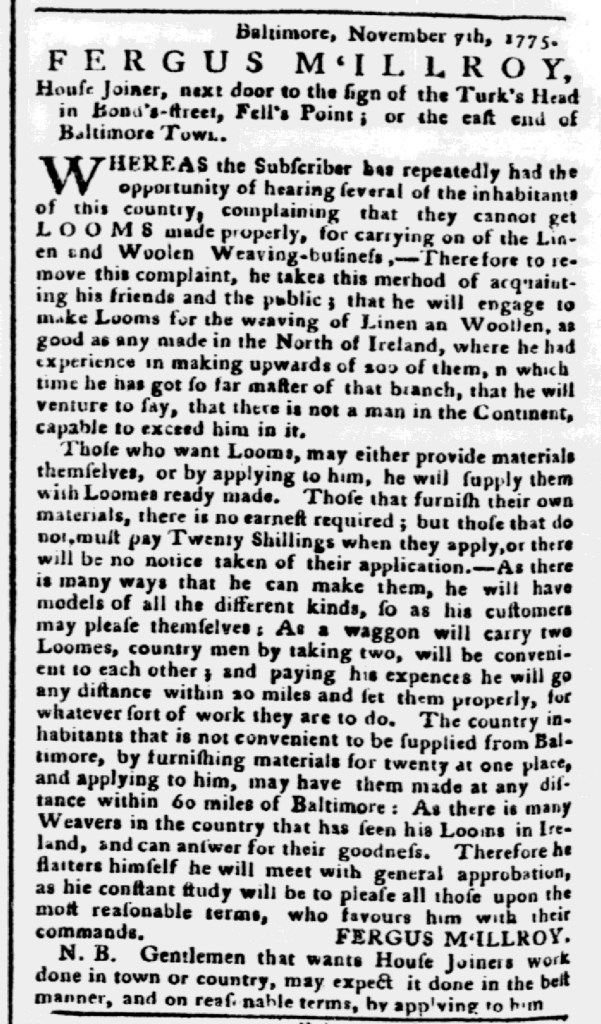
At the same time that David Poe advertised that he “set up … the business of SPINNING WHEEL Making” in Baltimore in November 1775, Fergus McIllroy took to the pages of Dunlap’s Maryland Gazette to inform the public that he “will engage to make Looms for the weaving of Linen an[d] Woolen.”  Both artisans responded to demand for equipment for making textiles that arose in response to the Continental Association, a nonimportation and nonconsumption agreement devised by the First Continental Congress to leverage commerce as a means of achieving political goals.  The text of the pact stated that it would remain in place until Parliament repealed duties on tea and the Coercive Acts that punished Boston for the destruction of tea in what has become known as the Boston Tea Party.  It also issued a call to “encourage Frugality, Economy, and Industry; and promote Agriculture, Arts, and the Manufactures of this Country, especially that of Wool.”

Many colonizers, both men and women, wanted to do their part in producing domestic manufactures as alternatives to imported textiles and other goods, but they needed materials and equipment.  McIllroy reported that he “repeatedly had the opportunity of hearing several of the inhabitants of this country, complaining that they cannot get LOOMS made properly, for carrying on of the Linen and Woolen Weaving-business.”  Although he currently worked as a “House Joiner,” he claimed that he “has experience of making upwards of 200” looms before he migrated to Baltimore.  That being the case, he pledged that his looms were “as good as any made in the North of Ireland.”  Yet prospective customers did not have to take his word for it: “there is many Weavers in the country that has seen his Looms in Ireland, and can answer for their goodness.”  For good measure, he added that he was a “master” when it came to making looms and “there is not a man in the Continent capable to exceed him.”

In addition, McIllroy noted the “many ways that he can make them,” so he had “models of all the different kinds, so as his customers may please themselves.”  Furthermore, they could supply the materials for constructing their looms or leave it to McIllroy to provide the materials.  In the latter instance, customers had to pay a deposit of twenty shillings before McIllroy would make their loom.  He also outlined the conditions for visiting homes to “set them up properly.”  If a town within sixty miles of Baltimore wished to order twenty or more looms, he offered to do the work there to avoid transporting the new looms over long distances.  McIllroy stood ready to contribute to the American cause with his “Industry” that in turn “promote[d] … the Manufactures of this Country,” joining with other artisans who vowed to do the same.

September 10

What was advertised in a revolutionary American newspaper 250 years ago this week?

New-York Journal (September 7, 1775).

“Several packages of their Spring goods, are yet unopened.”

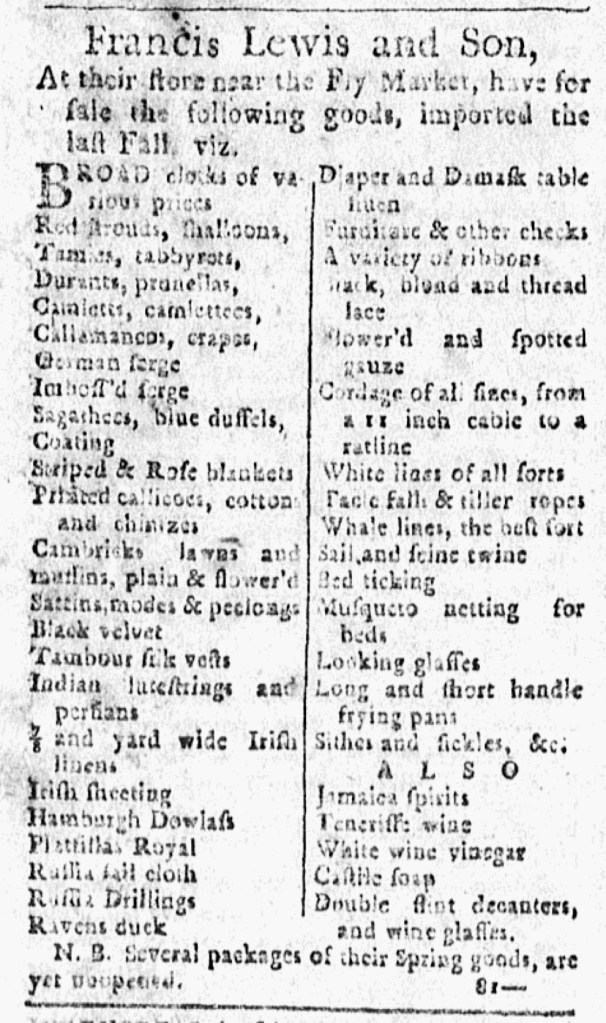
As fall arrived in 1775, Francis Lewis and Son took to the pages of the New-York Journal to advertise an array of imported goods that they stocked and sold at their store.  As many merchants and shopkeepers did, they demonstrated the choices they made available to consumers with a list of their inventory.  Their catalog featured two columns with one or two items per line, enumerating “Red strouds, shalloons,” “Printed callicoes, cotton and chintzes,” “A variety of ribbons,” “Musqueto netting for beds,” “Looking glasses,” and “Long and short handle frying pans.”  That popular format for newspaper advertisements did not appear with the same frequency once the Continental Association went into effect on December 1, 1774.  Recognizing that the nonimportation pact devised by the First Continental Congress in response to the Coercive Acts remained in place, Lewis and Son signaled that they abided by it.

The savvy entrepreneurs specified that their wares had been “imported last Fall.”  Under other circumstances, retailers did not boast that their merchandise had been on the shelves for nearly a year.  Instead, they emphasized how recently they received shipments from London and other English ports, sometimes even naming which vessels had transported the goods so readers who followed the shipping news could confirm that sold new items.  In this instance, however, Lewis and Son needed to assure the public, especially prospective customers, that they did not deviate from the Continental Association.  Patriots could not fault shopkeepers and consumers for selling and buying goods “imported the last Fall.” To underscore that they made a deliberate choice, Lewis and Son added a nota bene: “Several Packages of their Spring goods, are yet unopened.”  That note had even greater in significance in September 1775, following the outbreak of hostilities at Lexington and Concord, than it did when the advertisement first appeared in the March 23, 1775, edition of the New-York Journal.  Lewis and Son highlighted their own restraint in placing goods in the marketplace even as they suggested to prospective customers that they barely had to restrain themselves in their purchases because the shopkeepers offered so many choices.

August 10

What was advertised in a revolutionary American newspaper 250 years ago today?

New-York Journal (August 10, 1775).

“Stockings made in the best manner, for those that bring their own stuff.”

In an advertisement that first ran in the August 10, 1775, edition of the New-York Journal, James Wallace informed the “Ladies and Gentry” of the city that he “makes and sells, black and white silk patent lace for ladies aprons, handkerchiefs, &c.” and “hoods, aprons and tippets, and several other things in that way.”  In addition, he made and sold “silk and thread gloves and mitts, the silk of which is American produce.”  On that point, Wallace made an additional pitch: “He therefore hopes to be honoured with the commands of those who wish to encourage their own manufacture.”  It was not clear whether the silk for his lace to adorn aprons, handkerchiefs and other items was produced in the colonies or just the lace for his gloves and mitts.

Either way, Wallace expected his marketing would resonate with prospective customers who certainly knew about the provisions of the Continental Association without him explicitly invoking it.  That nonimportation agreement also called on American producers to supply alternatives and American consumers to support their endeavors.  The eighth article stated, “That we will, in our several Stations, encourage Frugality, Economy, and Industry; and promote Agriculture, Arts, and the Manufactures of this Country.”  Wallace made it easy for the “Ladies and Gentry” of New York to do so.

Wallace also noted that he made stockings “in the best manner, for those that bring their own stuff.”  In other words, customers could reduce the prices they paid for stocking by supplying their own materials, paying only for the labor.  Once again, consumers had an opportunity to put their political principles into practice in the choices they made in the marketplace.  In supplying their “own stuff,” the “Ladies and Gentry” could opt for thread spun in their own homes, either by themselves or by servants, or for thread that they knew for certain had been produced in the colonies.  Wallace did not merely offer a chance to save money for customers who provided their own materials; he also signaled that they could support the American cause through their own industry in producing those materials.

July 31

What was advertised in a revolutionary American newspaper 250 years ago today?

Dunlap’s Pennsylvania Packet (July 31, 1775).

“… that we may not now, nor hereafter, have any occasion to import from our ministerial enemies in Great-Britain.”

Charles Maise, a “MUSTARD and CHOCOLATE MAKER” in Philadelphia, took to the pages of Dunlap’s Pennsylvania Packet to promote his business at the end of July 1775.  First, he needed supplies, offering “Forty shillings per bushel for any quantity of good clean Mustard-seed.”  Yet Maise wanted readers to think bigger about his business and their role as both suppliers and consumers given the imperial crisis experienced in the colonies over the last decade.  He expressed his hope that “farmers and others will use their best endeavours to encourage this valuable manufactory, by cultivating and improving the growth of so valuable an article, that we may not now, nor hereafter, have any occasion to import from our ministerial enemies in Great-Britain.”  Such sentiments certainly resonated with the Continental Association, a nonimportant agreement devised by the First Continental Congress in the fall of 1774 in response to the Coercive Acts. The eight article called on colonizers “in our several Stations,” including mustard and chocolate makers, to “encourage Frugality, Economy, and Industry; and promote Agriculture, Arts, and the Manufactures of this Country.”

Producers had a part to play in making available alternatives to imported goods, but the Continental Association did not depend on their efforts alone.  Consumers also had to make choices aligned with their political principles.  That meant purchasing “domestic manufactures,” goods produced in the colonies.  Maise stood ready to partner with consumers in pursuing their common cause.  In a nota bene, he announced that he “stands in the market on market days, opposite the London Coffee-house.”  Customers could find him there.  He extended “thanks to his former customers,” stating that he “hopes for a continuance of their favours, and doubts not but to merit their esteem.”  Of course, Maise also intended for his advertisement to reach new customers and wanted them to join existing customers in supporting both his business and the American cause by purchasing mustard produced locally from mustard seeds grown in the colonies.  Mustard gained political significance when taking into consideration “our ministerial enemies in Great-Britain,” especially in the wake of recent news of hostilities commencing at Lexington and Concord, the siege of Boston, and the Battle of Bunker Hill.

July 18

What was advertised in a revolutionary American newspaper 250 years ago today?

Pennsylvania Evening Post (July 18, 1775).

“JACKET PATTERNS … printed near this city, quite superior to those imported from England.”

Public discourse about the American Revolution resonated not only in the news and editorials that appeared in newspapers but also in the advertisements that ran in them.  In the July 18, 1775, edition of the Pennsylvania Journal, for instance, John Dean, a bookbinder, once again advertised the Philadelphia edition of A Self Defensive War Lawful, a sermon recently “preached at Lancaster, before Captain Ross’s company of militia” by John Carmichael.  The updated version of this advertisement indicated that four local printers and booksellers now stocked the sermon.  It also listed prices for single copies, a dozen, or a hundred, suggesting that Dean anticipated that retailers would purchase copies to sell or other customers would buy the sermon to distribute in their communities.

The advertisement immediately above the one for the sermon was also tied to the events of the American Revolution.  Moses Young announced that he sold “JACKET PATTERNS.”  He had an “elegant assortment of the new fashioned JACKET PATTERNS, fit for summer wear, and printed near this city.”  Young did not have to invoke the Continental Association, a nonimportation agreement devised by the First Continental Congress in response to the Coercive Acts, for readers to understand the implications of his assertion that the patterns were produced near Philadelphia.  In addition to prohibiting imported goods, the Continental Association called on colonizers to “encourage Frugality, Economy, and Industry; and promote Agriculture, Arts, and the Manufactures of this Country.”  Moses Young did just that … and he gave consumers a chance to do their part.  They could keep up with current trends and they could do so without sacrificing quality.  After all, Young described the patterns as both “new fashioned” and “quite superior to those imported from England.”  In addition, he sold them for a “reasonable” price.  As the siege of Boston continued in Massachusetts and the Second Continental Congress continued meeting in Philadelphia, Young’s marketing presented an opportunity for consumers to offer their support for the American cause through one of the decisions they made in the marketplace.

June 2

What was advertised in a revolutionary American newspaper 250 years ago today?

Story and Humphreys’s Pennsylvania Mercury (June 2 1775).

“Imported last summer and fall from London [and] Bristol … A VERY large and general assortment of Ironmongery [and] Cutlery.”

James Bringhurst advertised a variety of items available at “his Ware-house on the Bank, below Walnut-street,” in Philadelphia in the summer of 1775.  He stocked a “VERY large and general assortment of Ironmongery [and] Cutlery” that included “knives and forks with or without cases, roasting jacks, bake ovens, preserving pans with covers, sauce pans with ditto, teakettles, skillets, pots, kettles, [and] frying pans.”  He also carried “most sorts of tradesmens tools” along with “compleat Furniture both for house and ship building.”  In addition, his inventory included “sundry other articles too numerous to insert” in a newspaper advertisement.  Bringhurst’s “Ware-house” was an eighteenth-century precursor of a superstore that sold housewares to consumers and equipment and supplies to builders.

Before he gave or his location or presented his list of merchandise, Bringhurst noted when and where he received the goods he sold.  Many merchants and shopkeepers did so in the 1760s and 1770s yet doing so had a new kind of significance once the Continental Association went into effect on December 1, 1774.  The First Continental Congress devised the Continental Association, a nonimportation agreement, in response to the Coercive Acts, hoping to leverage the commercial boycott into political reform.  Colonizers who signed the Continental Association vowed to abide by it until Parliament repealed the Coercive Acts and other legislation that infringed on their rights that had been passed since the end of the Seven Years War.

Bringhurst sent an important signal to prospective customers and the entire community when he specified that his wares had been “Imported last summer and fall from London, Bristol,” and other English ports.  Under other circumstances, wholesalers and retailers would have been unlikely to acknowledge that they sold items that had been on the shelves or in the warehouse for so long; instead, they usually emphasized that they had just the received the newest goods and the newest fashions.  In this case, however, peddling merchandise that had been around for the better part of a year was a virtue.  Bringhurst abided by the Continental Association … and his customers could shop in good conscience knowing that they did so as well.