March 3

What was advertised in a colonial American newspaper 250 years ago today?

South-Carolina Gazette and Country Journal (March 3, 1772).

“CHOCOLATE MAKERS.”

When Richard Dickinson and William Turpin, chocolate makers, marketed their product in the South-Carolina Gazette and Country Journal in March 1772, they adorned their advertisement with a woodcut depicting two men conversing while holding cups that presumably held the beverage they sold.  Compared to most other images incorporated into newspaper advertisements in the 1770s, their woodcut likely seemed clumsy to readers.  On the other hand, including an image in their advertisement at all distinguished it from other notices.

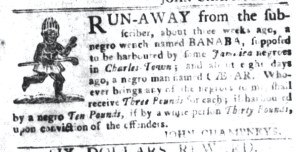
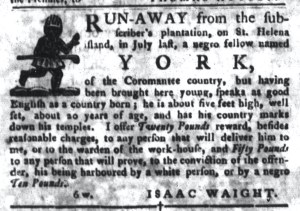
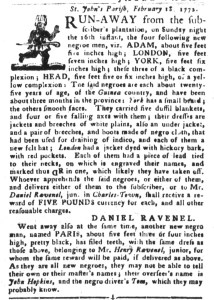
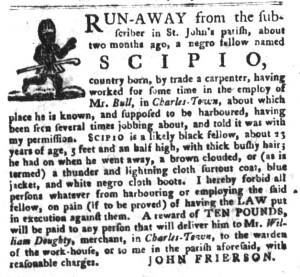
Advertisements filled eleven of the twelve columns in the standard issue published on March 3.  The printer, Charles Crouch, also distributed a half sheet supplement comprised entirely of advertising.  In total, the standard issue and the supplement carried 126 advertisements, but only nineteen of them featured any sort of visual image.  Eleven real estate advertisements included images of houses.  Another had a more elaborate scene of two houses, trees, and a fence dividing fields.  Six advertisements offering rewards for enslaved people who liberated themselves included woodcuts depicting a dark-skinned figure running.  An image of a vessel at sea accompanied a notice about a ship departing for Bristol.  All of those woodcuts belonged to the printer.  Almost every printer who published a newspaper in the colonies had stock images of houses, ships, horses, and enslaved people to insert into advertisements.

The image of two figures conversing while drinking cups of chocolate in Dickinson and Turpin’s advertisement was the only woodcut commissioned by the advertisers in that edition of the South-Carolina Gazette and Country Journal and its supplement.  Dozens of other advertisers refrained from creating and including images that depicted their products, their shop signs, or anything else.  As a result, Dickinson and Turpin’s unique image likely drew even more attention since it competed only with familiar woodcuts that readers encountered in every issue as the printer recycled them from advertisement to advertisements.  In the copy for their advertisement, the chocolate makers proclaimed that consumers considered their chocolate “much superior to any other made here or imported.”  Some prospective customers likely noticed that bold claim because the image in the advertisement, different from any other in the newspaper, caught their attention.

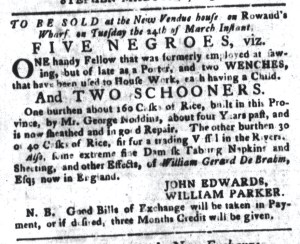
Slavery Advertisements Published March 3, 1772

GUEST CURATOR: Charlotte Hatcher

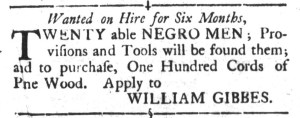
The Slavery Adverts 250 Project chronicles the role of newspaper advertising in perpetuating slavery in the era of the American Revolution. The project seeks to reveal the ubiquity of slavery in eighteenth-century life from New England to Georgia by republishing advertisements about enslaved people – for sale as individuals or in groups, wanted to purchase or for hire for short periods, runaways who liberated themselves, and those who were subsequently captured and confined in jails and workhouses – in daily digests on this site as well as in real time via the @SlaveAdverts250 Twitter feed, utilizing twenty-first-century media to stand in for the print media of the eighteenth century.

The project aims to provide modern audiences with a sense of just how often colonizers encountered these advertisements in their daily lives. Enslaved men, women, and children appeared in print somewhere in the colonies almost every single day. Those advertisements served as a constant backdrop for social, cultural, economic, and political life in colonial and revolutionary America. Colonizers who did not purport to own enslaved people were still confronted with slavery as well as invited to maintain the system by purchasing enslaved men, women, and children or assisting in the capture of so-called “runaways” who sought to free themselves from bondage. The frequency of these newspaper advertisements suggests just how embedded slavery was in colonial and revolutionary American culture in everyday interactions beyond the printed page.

These advertisements also testify to the experiences of enslaved men, women, and children, though readers must consider that those experiences have been remediated through descriptions offered by enslavers rather than enslaved people themselves. Often unnamed in the advertisements, enslaved men, women, and children were not invisible or unimportant in early America.

These advertisements appeared in colonial American newspapers 250 years ago today.

South-Carolina Gazette and Country Journal (March 3, 1772).

**********

South-Carolina Gazette and Country Journal (March 3, 1772).

**********

South-Carolina Gazette and Country Journal (March 3, 1772).

**********

South-Carolina Gazette and Country Journal (March 3, 1772).

**********

South-Carolina Gazette and Country Journal (March 3, 1772).

**********

South-Carolina Gazette and Country Journal (March 3, 1772).

**********

South-Carolina Gazette and Country Journal (March 3, 1772).

**********

South-Carolina Gazette and Country Journal (March 3, 1772).

**********

South-Carolina Gazette and Country Journal (March 3, 1772).

**********

South-Carolina Gazette and Country Journal (March 3, 1772).

**********

South-Carolina Gazette and Country Journal (March 3, 1772).

**********

South-Carolina Gazette and Country Journal (March 3, 1772).

**********

South-Carolina Gazette and Country Journal (March 3, 1772).

**********

South-Carolina Gazette and Country Journal (March 3, 1772).

**********

South-Carolina Gazette and Country Journal (March 3, 1772).

**********

Supplement to the South-Carolina Gazette and Country Journal (March 3, 1772).

**********

Supplement to the South-Carolina Gazette and Country Journal (March 3, 1772).

**********

Supplement to the South-Carolina Gazette and Country Journal (March 3, 1772).

**********

Supplement to the South-Carolina Gazette and Country Journal (March 3, 1772).

**********

Supplement to the South-Carolina Gazette and Country Journal (March 3, 1772).

**********

Supplement to the South-Carolina Gazette and Country Journal (March 3, 1772).

**********

Supplement to the South-Carolina Gazette and Country Journal (March 3, 1772).

**********

Supplement to the South-Carolina Gazette and Country Journal (March 3, 1772).

March 2

What was advertised in a colonial American newspaper 250 years ago today?

New-York Gazette and Weekly Mercury (March 2, 1772).

“NEW-YORK BEER.”

Benjamin Williams, a brewer, touted his skill and experience when he placed an advertisement in the March 2, 1772, edition of the New-York Gazette and Weekly Mercury.  He invited both “Gentlemen in Town” and “Captains of Vessels” to purchase beer at his “Store-Cellar, upon HUNTER’S-QUAY.”  To convince them to choose his beer over others, Williams informed the public that through “great Experience and Application, in Brewing, Managing, and Bottling NEW-YORK BEER” he “brought it to that Perfection, which, with Pleasure, he can boast superior to any Attempt of the Kind in this, or in any other Colony on the Continent of North-America.”  That was a bold claim!  Today, brewers continue to promote the quality of their products and, in many instances, the years of experience and tradition associated with their breweries. When they do so, they echo marketing strategies already deployed by brewers during the era of the American Revolution.

Williams encouraged local consumption of his “NEW-YORK BEER,” informing “Gentlemen in Town” that they could acquire it for ten shillings for a dozen bottles.  If they returned the bottles, consumers enjoyed a discount of three shillings.  The brewer also sought customers among “Captains of Vessels” headed to ports in other places, including the Caribbean.  He assured them that “Repeated Trials have prov’d” that his beer “will stand the West Indies” rather than go bad during transport.  Here again, Williams’s “great Experience and Application” played a role in marketing his product to prospective customers.  He also promoted another product, “Fine Cyder, of a peculiar Quality and Flavour,” for consumers interested in beverages beyond beer.  In the 1770s, he diversified his line of products in much the same way that many breweries have recently done by offering ciders and, especially, seltzers and other flavor-infused malt beverages.  Both Williams and his modern counterparts hoped that familiarity with the quality and reputation of one beverage would lead to purchasing others from the same brewer.

Slavery Advertisements Published March 2, 1772

GUEST CURATOR: Charlotte Hatcher

The Slavery Adverts 250 Project chronicles the role of newspaper advertising in perpetuating slavery in the era of the American Revolution. The project seeks to reveal the ubiquity of slavery in eighteenth-century life from New England to Georgia by republishing advertisements about enslaved people – for sale as individuals or in groups, wanted to purchase or for hire for short periods, runaways who liberated themselves, and those who were subsequently captured and confined in jails and workhouses – in daily digests on this site as well as in real time via the @SlaveAdverts250 Twitter feed, utilizing twenty-first-century media to stand in for the print media of the eighteenth century.

The project aims to provide modern audiences with a sense of just how often colonizers encountered these advertisements in their daily lives. Enslaved men, women, and children appeared in print somewhere in the colonies almost every single day. Those advertisements served as a constant backdrop for social, cultural, economic, and political life in colonial and revolutionary America. Colonizers who did not purport to own enslaved people were still confronted with slavery as well as invited to maintain the system by purchasing enslaved men, women, and children or assisting in the capture of so-called “runaways” who sought to free themselves from bondage. The frequency of these newspaper advertisements suggests just how embedded slavery was in colonial and revolutionary American culture in everyday interactions beyond the printed page.

These advertisements also testify to the experiences of enslaved men, women, and children, though readers must consider that those experiences have been remediated through descriptions offered by enslavers rather than enslaved people themselves. Often unnamed in the advertisements, enslaved men, women, and children were not invisible or unimportant in early America.

These advertisements appeared in colonial American newspapers 250 years ago today.

Boston-Gazette (March 2, 1772).

**********

Boston-Gazette (March 2, 1772).

**********

Boston-Gazette (March 2, 1772).

**********

New-York Gazette and Weekly Mercury (March 2, 1772).

**********

Supplement to the New-York Gazette and Weekly Mercury (March 2, 1772).

**********

Supplement to the New-York Gazette and Weekly Mercury (March 2, 1772).

**********

Pennsylvania Chronicle (March 2, 1772).

**********

Pennsylvania Packet (March 2, 1772).

**********

South-Carolina and American General Gazette (March 2, 1772).

**********

South-Carolina and American General Gazette (March 2, 1772).

**********

South-Carolina and American General Gazette (March 2, 1772).

**********

South-Carolina and American General Gazette (March 2, 1772).

**********

South-Carolina and American General Gazette (March 2, 1772).

**********

South-Carolina and American General Gazette (March 2, 1772).

**********

South-Carolina and American General Gazette (March 2, 1772).

**********

South-Carolina and American General Gazette (March 2, 1772).

**********

South-Carolina and American General Gazette (March 2, 1772).

**********

South-Carolina and American General Gazette (March 2, 1772).

**********

South-Carolina and American General Gazette (March 2, 1772).

**********

South-Carolina and American General Gazette (March 2, 1772).

**********

South-Carolina and American General Gazette (March 2, 1772).

**********

South-Carolina and American General Gazette (March 2, 1772).

**********

South-Carolina and American General Gazette (March 2, 1772).

**********

South-Carolina and American General Gazette (March 2, 1772).

March 1

What was advertised in a colonial American newspaper 250 years ago this week?

The Censor (February 29, 1772).

“NORTON’s American Mercantile INK-POWDER.”

Ezekiel Russell of Boston commenced publication of The Censor on November 23, 1771.  In an advertisement he inserted in the Massachusetts Gazette and Boston Post-Boy a few weeks later, he described The Censor as “a New Political Paper,” though both colonizers and historians have since questioned whether Russell published a newspaper or a magazine or something else that defied categorization.  For several months, The Censor did not carry any advertisements, distinguishing it from every newspaper published in the colonies.  Eventually, according to Isaiah Thomas, printer and publisher of the Massachusetts Spy and author of The History of Printing in America (1810), Russell “made and effort to convert” The Censor “into a newspaper; and, with this view some of its last numbers were accompanied with a separate half sheet, containing a few articles of news and some advertisements.”[1]  An infusion of revenue from advertising did not prevent The Censor from folding a couple of months later since the Tory-leaning publication did not attract a broad readership in Boston.

The first of those half sheets accompanied the February 29, 1772, edition of The Censor.  Russell printed “Vol I.” and “NUMB. 15” in the masthead of both the standard issue and the supplement.  The latter featured four columns, two on the front and two on the back.  News from London, some of it reprinted from the London Gazette, filled the first three columns, leaving the entire fourth column for advertisements.  Only two of the four advertisements appear to have been paid notices, one seeking a farm to rent and another offering a farm for sale.  Russell inserted the other two advertisements in support of other activities undertaken at his printing office in Marlborough Street.  In one, he hawked “NORTON’s American Mercantile INK-POWDER.”  The other, a subscription notice, outlined “PROPOSALS For Printing … A Collection of POEMS, wrote at several times, and upon various occasions, by PHILLIS, a Negro Girl.”  Russell sought to publish about two dozen of Phillis Wheatley’s poems in a single volume “as soon as three Hundred Copes are subscribed for,” but his notices apparently did not generate sufficient attention to produce an American edition.  The following year, Wheatley traveled to London to publish Poems on Various Subjects, Religious and Moralwith assistance from the Countess of Huntingdon.

Even when Russell introduced advertising into The Censor, his own notices accounted for the vast majority of such content.  Colonial printers often inserted advertisements into their own publications, sometimes two or three or more in a single newspaper issue.  Russell demonstrated that The Censor provided space for advertising, but the publication closed before he managed to cultivate a clientele of regular advertisers.  For only a couple of months in 1772, colonizers in Boston encountered advertising that circulated via yet another publication printed in the city.

**********

[1] Isaiah Thomas, The History of Printing in America: With a Biography of Printers and an Account of Newspapers, ed. Marcus McCorison (1810; New York: Weathervane Books, 1970), 153.