May 31

Who was the subject of an advertisement in a colonial American newspaper 250 years ago today?
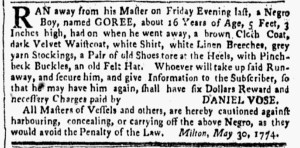
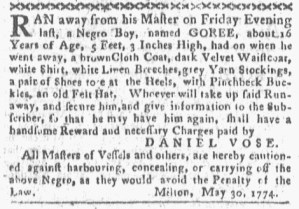
Essex Gazette (May 31, 1774).

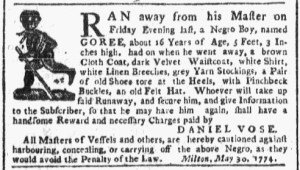
“RAN away … a Negro Boy, named GOREE.”

As the summer of 1774 approached, an enslaved youth named Goree saw his opportunity to liberate himself by running away from Daniel Vose of Milton, Massachusetts.  Vose, for his part, joined the ranks of enslavers who placed newspaper advertisement that offered rewards for the capture and return of enslaved men and women who made similar declarations of independence during the era of the American Revolution.  He provided a description of the Goree, encouraging readers to engage in surveillance of all Black people, especially young Black men, with the intention that such scrutiny would aid in identifying him.  Vose also warned “All Masters of Vessels and others … against harbouring, concealing, or carrying off” Goree or else face “the Penalty of the Law” for aiding him.

Massachusetts Gazette and Boston Post-Boy (May 30, 1774).

Vose made quite an investment in locating and securing Goree.  In addition to offering “six Dollars Reward and necessary Charges” for securing him in jail and sending word to Milford, he also ran advertisements in several newspapers.  On May 30, his notice appeared in the Boston Evening-Post, the Boston-Gazette, and the Massachusetts Gazette and Boston Post-Boy, all three newspapers published in Boston on Mondays.  His advertisement in the Massachusetts Gazette and Boston Post-Boy even included a crude woodcut depicting an enslaved man on the run as a means of drawing attention to it.  Apart from the masthead, that was the only image in that issue of the newspaper.  The following day, Vose ran the same advertisement in the Essex Gazette, published in Salem.  He did not place his advertisement in the Massachusetts Gazette and Boston Weekly News-Letter or the Massachusetts Spy, both published in Boston on Thursdays, perhaps believing that four newspapers printed in two towns provided sufficient dissemination of Goree’s description and the reward for capturing him.

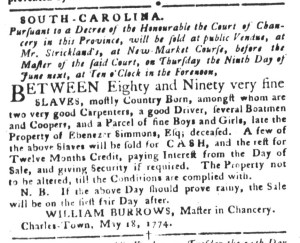
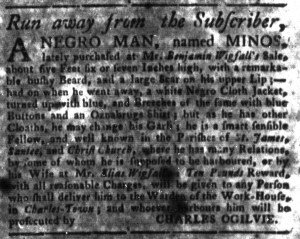
South-Carolina Gazette and Country Journal (May 31, 1774).

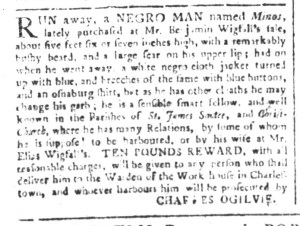
Vose was not alone in placing such advertisements in multiple newspapers.  At the same time that he sought to enlist the aid of other colonizers in securing an enslaved youth who liberated himself, Charles Ogilvie ran advertisement about “a Negro Man named MINOS” in the South-Carolina and American General Gazette on May 27, the South-Carolina Gazette on May 30, and the South-Carolina Gazette and Country Journal on May 31.  That accounted for every newspaper published in Charleston and the rest of the colony at the time.  Ogilvie had recently purchased Minos “at Mr. Benjamin Wigfall’s Sale,” but Minos had other ideas.  The enslaver suspected that Minos had assistance from “his Wife at Mr. Elias Wigfall’s” or his “many Relations” in the “Parishes of St. James, Santee, and Christ Church,” believing that they “harboured” or hid him.  Although not his purpose in placing the advertisement, Ogilvie revealed one of Minos’s likely motivations for liberating himself.

In both New England and South Carolina, enslavers like Vose and Ogilvie went to great expense in running advertisements about enslaved people who liberated themselves.  Such notices were not a feature solely of the newspapers published in southern colonies during the era of the American Revolution.  Instead, they appeared in newspapers throughout the colonies, part of the everyday culture of slavery from New England to Georgia.

Slavery Advertisements Published May 31, 1774

The Slavery Adverts 250 Project chronicles the role of newspaper advertising in perpetuating slavery in the era of the American Revolution. The project seeks to reveal the ubiquity of slavery in eighteenth-century life from New England to Georgia by republishing advertisements about enslaved people – for sale as individuals or in groups, wanted to purchase or for hire for short periods, runaways who liberated themselves, and those who were subsequently captured and confined in jails and workhouses – in daily digests on this site as well as in real time via the @SlaveAdverts250 Twitter feed, utilizing twenty-first-century media to stand in for the print media of the eighteenth century.

The project aims to provide modern audiences with a sense of just how often colonizers encountered these advertisements in their daily lives. Enslaved men, women, and children appeared in print somewhere in the colonies almost every single day. Those advertisements served as a constant backdrop for social, cultural, economic, and political life in colonial and revolutionary America. Colonizers who did not purport to own enslaved people were still confronted with slavery as well as invited to maintain the system by purchasing enslaved men, women, and children or assisting in the capture of so-called “runaways” who sought to free themselves from bondage. The frequency of these newspaper advertisements suggests just how embedded slavery was in colonial and revolutionary American culture in everyday interactions beyond the printed page.
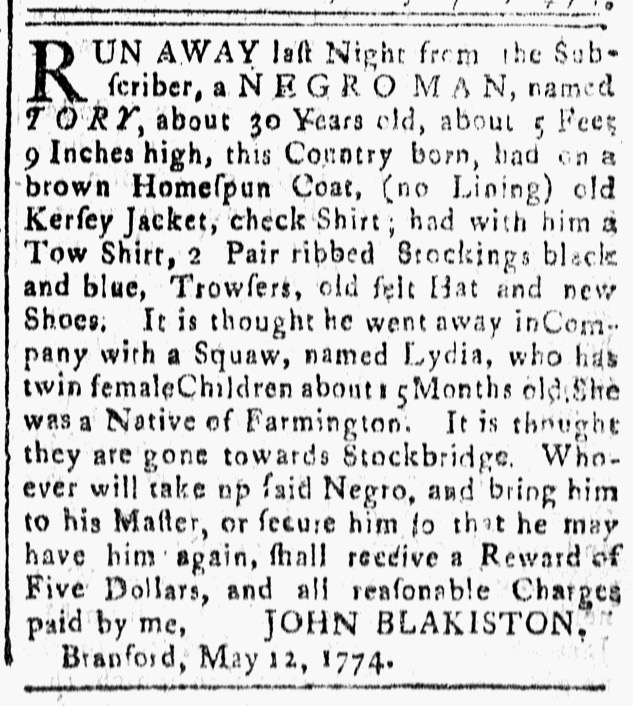
These advertisements also testify to the experiences of enslaved men, women, and children, though readers must consider that those experiences have been remediated through descriptions offered by enslavers rather than enslaved people themselves. Often unnamed in the advertisements, enslaved men, women, and children were not invisible or unimportant in early America.

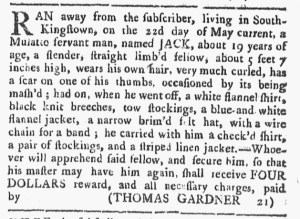
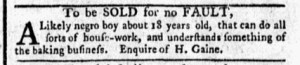
These advertisements appeared in colonial American newspapers 250 years ago today.

Connecticut Courant (May 31, 1774).

**********

Essex Gazette (May 31, 1774).

**********

Essex Gazette (May 31, 1774).

**********

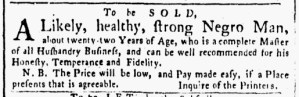
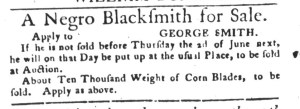
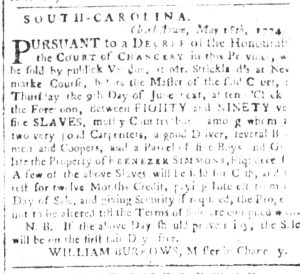
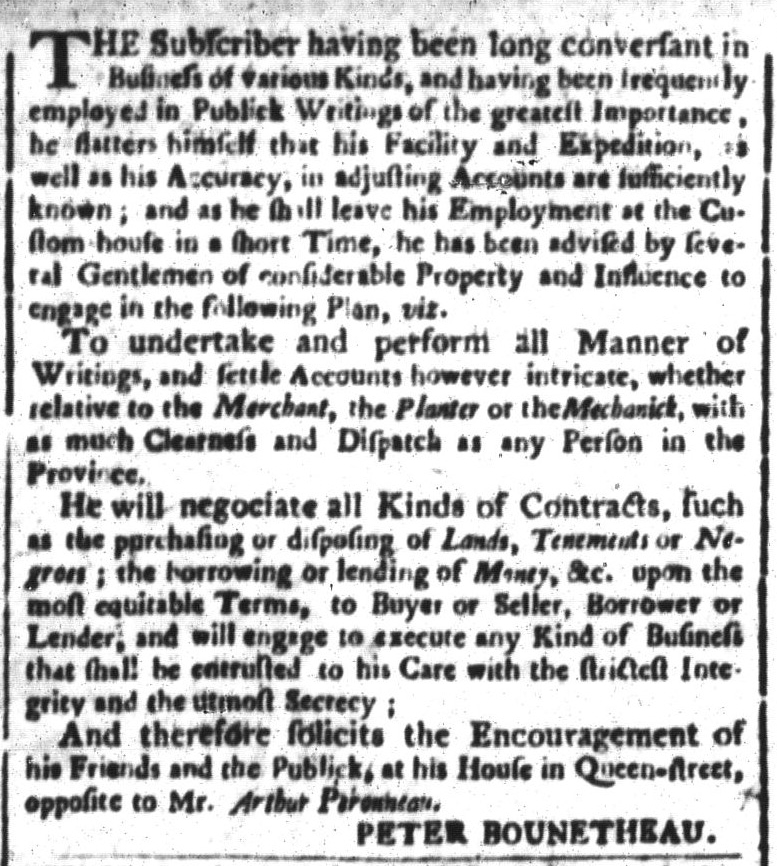
South-Carolina Gazette and Country Journal (May 31, 1774).

**********

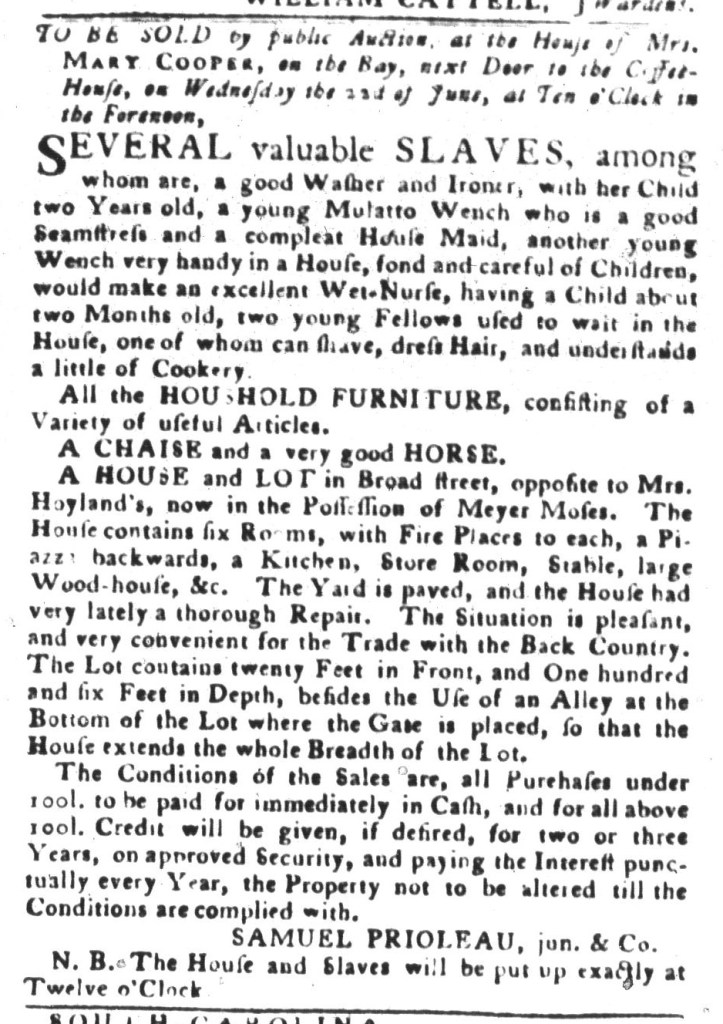
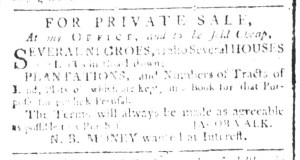
South-Carolina Gazette and Country Journal (May 31, 1774).

**********

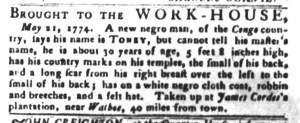
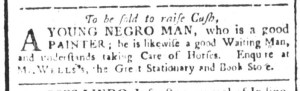
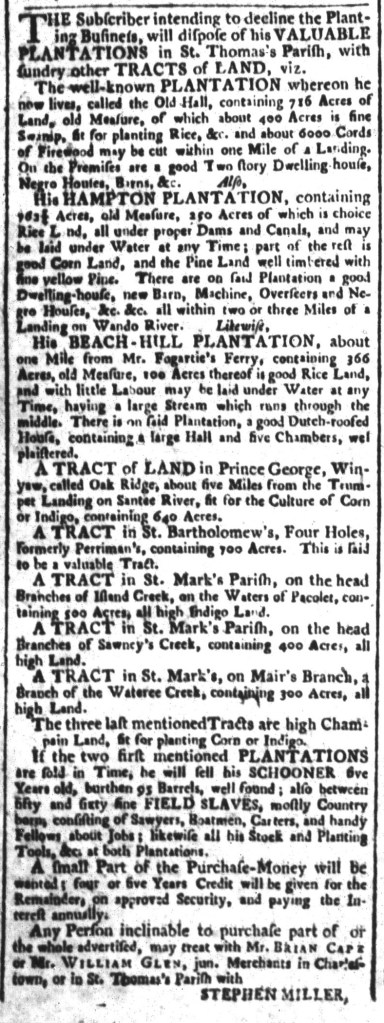
South-Carolina Gazette and Country Journal (May 31, 1774).

**********

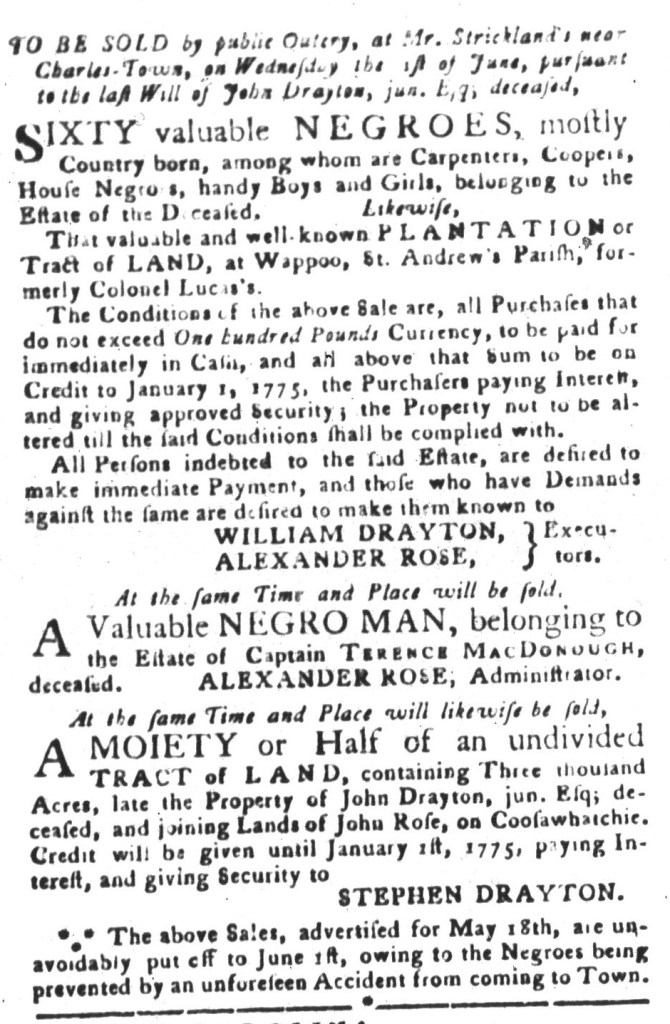
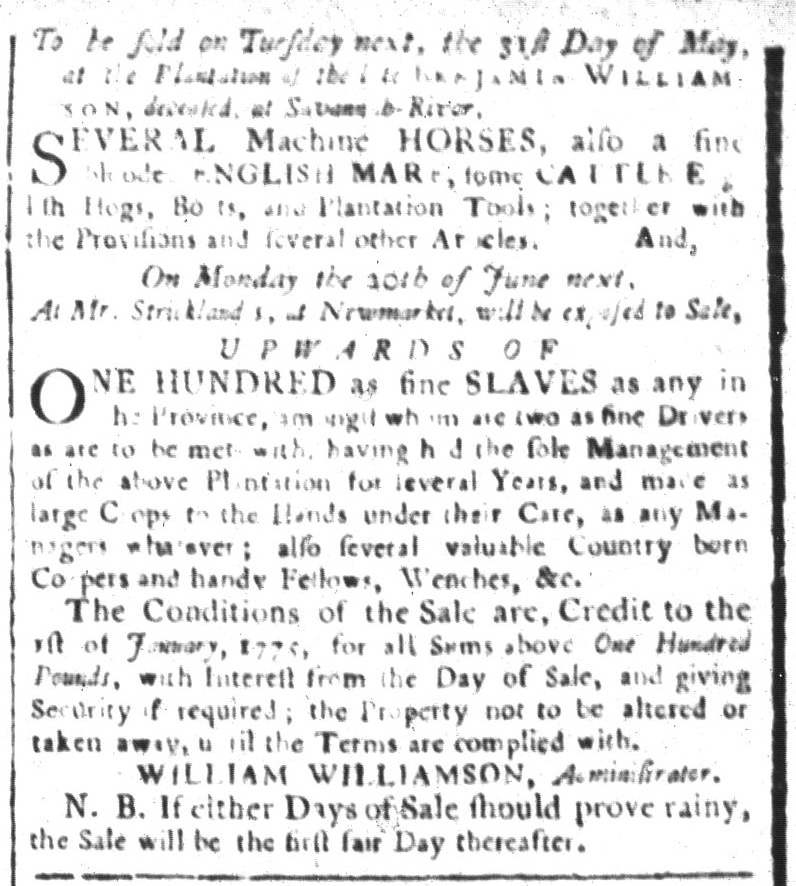
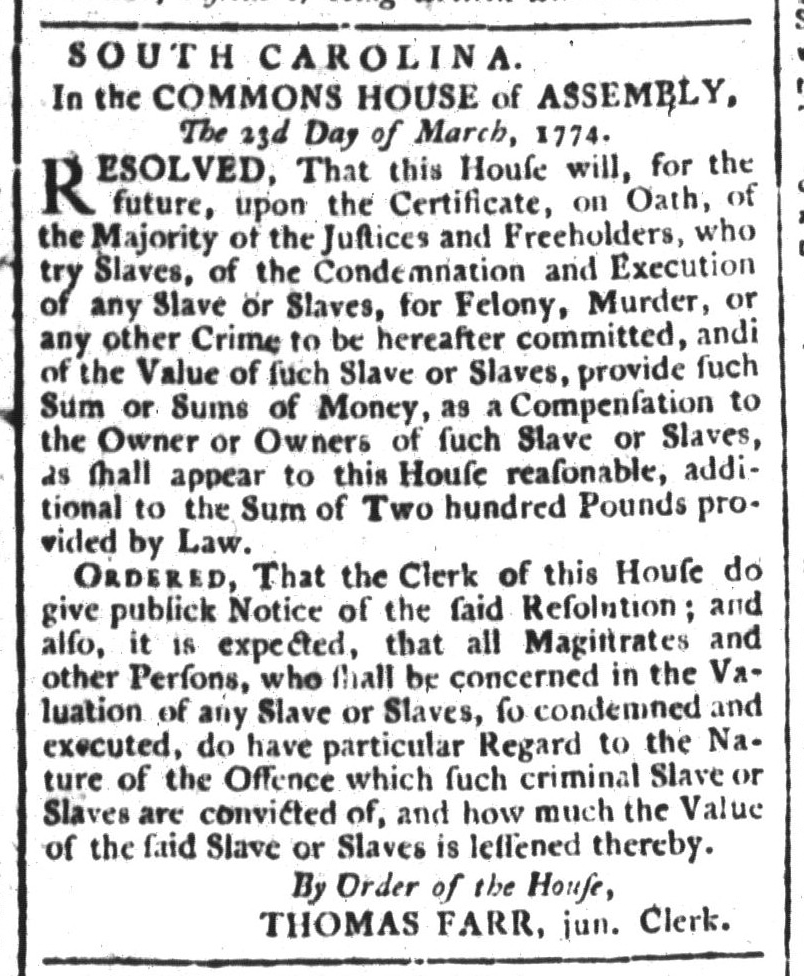
South-Carolina Gazette and Country Journal (May 31, 1774).

**********

South-Carolina Gazette and Country Journal (May 31, 1774).

**********

South-Carolina Gazette and Country Journal (May 31, 1774).

**********

South-Carolina Gazette and Country Journal (May 31, 1774).

**********

South-Carolina Gazette and Country Journal (May 31, 1774).

**********

South-Carolina Gazette and Country Journal (May 31, 1774).

**********

South-Carolina Gazette and Country Journal (May 31, 1774).

**********

South-Carolina Gazette and Country Journal (May 31, 1774).

**********

South-Carolina Gazette and Country Journal (May 31, 1774).

May 30

What was advertised in a colonial American newspaper 250 years ago today?

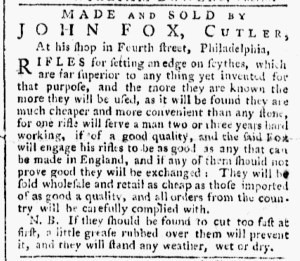
Dunlap’s Pennsylvania Packet (May 30, 1774).

“Fox will engage his rifles to be as good as any that can be made in England.”

John Fox marketed American ingenuity when he advertised scythe rifles, instruments for “setting an edge on scythes,” that he invented.  In the May 30, 1774, edition of Dunlap’s Pennsylvania Packet, the cutler proclaimed that his rifles “are far superior to any thing yet invented for that purpose.”  He was so certain of that assertion that he confidently asserted that “the more [his rifles] are known the more they will be used,” especially since “it will be found they are much cheaper and more convenient than any stone.”  Rifles were made of wood, light enough for farmers to carry with them to sharpen the edges of scythes as they worked in the fields; whetstones were much heavier and, in turn, much less convenient for such purposes.  Continuing his pitch, Fox claimed that “one rifle will serve a man two or three years hard working, if of a good quality,” and he considered “his rifles to be as good as any that can be made in England.”  Furthermore, he pledged to sell his product “wholesale and retail as cheap as those imported of as good a quality.”  If any customers were not satisfied once they gave his rifles a try, the cutler offered to exchange any that “should not prove good.”

During the imperial crisis, colonial entrepreneurs promoted “domestic manufactures” or products made in America rather than imported.  Such appeals appeared in newspaper advertisements with greater frequency when confrontations with Parliament intensified, especially when colonizers enacted nonimportation agreements in response to the Stamp Act and the Townshend Acts.  Fox marketed his scythe rifles as relations between the colonies and Parliament once again deteriorated, this time because of duties on tea, the Boston Tea Party, and the Boston Port Act that closed the harbor until residents made restitution.  Dunlap’s Pennsylvania Packet and other newspapers published in Philadelphia carried extensive coverage of the debates and passage of the Boston Port Act and the responses in other cities and towns.  Fox’s advertisement appeared immediately below resolutions passed at “a meeting of the inhabitants of the city of Annapolis” on May 25, 1774.  They agreed “to put an immediate stop to all exports to Great-Britain” and, upon a date to be determined in coordination with other town in Maryland and “the principal colonies of America,” that “there be no imports from Great-Britain till the said act be repealed.”  Perhaps it was coincidence that Fox’s advertisement happened to follow the resolutions from Annapolis.  No matter where the two items appeared in relation to each other in the newspaper, the political crisis that inspired the resolutions provided support for Fox’s encouragement to purchase the rifle scythes he “MADE AND SOLD … At his shop in Fourth street, Philadelphia,” as an alternative to imported ones.

Slavery Advertisements Published May 30, 1774

The Slavery Adverts 250 Project chronicles the role of newspaper advertising in perpetuating slavery in the era of the American Revolution. The project seeks to reveal the ubiquity of slavery in eighteenth-century life from New England to Georgia by republishing advertisements about enslaved people – for sale as individuals or in groups, wanted to purchase or for hire for short periods, runaways who liberated themselves, and those who were subsequently captured and confined in jails and workhouses – in daily digests on this site as well as in real time via the @SlaveAdverts250 Twitter feed, utilizing twenty-first-century media to stand in for the print media of the eighteenth century.

The project aims to provide modern audiences with a sense of just how often colonizers encountered these advertisements in their daily lives. Enslaved men, women, and children appeared in print somewhere in the colonies almost every single day. Those advertisements served as a constant backdrop for social, cultural, economic, and political life in colonial and revolutionary America. Colonizers who did not purport to own enslaved people were still confronted with slavery as well as invited to maintain the system by purchasing enslaved men, women, and children or assisting in the capture of so-called “runaways” who sought to free themselves from bondage. The frequency of these newspaper advertisements suggests just how embedded slavery was in colonial and revolutionary American culture in everyday interactions beyond the printed page.

These advertisements also testify to the experiences of enslaved men, women, and children, though readers must consider that those experiences have been remediated through descriptions offered by enslavers rather than enslaved people themselves. Often unnamed in the advertisements, enslaved men, women, and children were not invisible or unimportant in early America.

These advertisements appeared in colonial American newspapers 250 years ago today.

Boston Evening-Post (May 30, 1774).

**********

Boston-Gazette (May 30, 1774).

**********

Massachusetts Gazette and Boston Post-Boy (May 30, 1774).

**********

Newport Mercury (May 30, 1774).

**********

New-York Gazette and Weekly Mercury (May 30, 1774).

**********

South-Carolina Gazette (May 30, 1774).

**********

South-Carolina Gazette (May 30, 1774).

**********

Supplement to the South-Carolina Gazette (May 30, 1774).

**********

Supplement to the South-Carolina Gazette (May 30, 1774).

**********

Supplement to the South-Carolina Gazette (May 30, 1774).

**********

Supplement to the South-Carolina Gazette (May 30, 1774).

**********

Supplement to the South-Carolina Gazette (May 30, 1774).

**********

Supplement to the South-Carolina Gazette (May 30, 1774).

**********

Supplement to the South-Carolina Gazette (May 30, 1774).

**********

Supplement to the South-Carolina Gazette (May 30, 1774).

**********

Supplement to the South-Carolina Gazette (May 30, 1774).

**********

Supplement to the South-Carolina Gazette (May 30, 1774).

**********

Supplement to the South-Carolina Gazette (May 30, 1774).

May 29

What was advertised in a colonial American newspaper 250 years ago this month?

Massachusetts Spy (May 26, 1774).

“NUMBER IV. of THE ROYAL American Magazine … For APRIL, 1774.”

A year after he first announced plans to distribute subscription proposals for the Royal American Magazine, Isaiah Thomas continued advertising the only magazine published in the colonies at the time.  It took more than half a year to engage enough subscribers to make the venture viable.  Thomas intended to publish the first issue in January 1774, but the types did not arrive in time, so the inaugural edition came out in early February (though still bearing January as its date).  Once the magazine began circulating among subscribers and other readers, Thomas promoted it in the public prints, especially his own Massachusetts Spy, though not in as many newspapers as carried the subscription proposals.  The Adverts 250 Project has tracked advertisements for the Royal American Magazine that appeared in June, July, August, September, October, November, and December 1773 and JanuaryFebruary, March, and April 1774.  This entry provides an overview of Thomas’s marketing campaign in May 1774.

Two advertisements ran simultaneously in the Massachusetts Spy on May 5.  In one, Thomas announced that “Tuesday next will be published, No, IV of the Royal American Magazine … For APRIL, 1774.”  Publication continued to lag behind the date of the publication, but magazines followed a different schedule in the eighteenth century compared to today.  Modern magazines often circulate with dates that have not yet arrived, while eighteenth-century publishers tended to distribute a magazine for a particular month at the end of that month.  Such magazines featured content compiled during that month, not material intended to be read that month.  In the other advertisement in that issue of the Massachusetts Spy, Thomas called on “THOSE Gentlemen who are inclined to favour the Royal American Magazine, for MAY, with their Productions … to send them with all convenient Speed, to the Publisher.”  Thomas worked throughout May to gather the contents for that month’s issue of the magazine.  That notice appeared each week.  In contrast, he did not run announcements about the impending publication of the April edition in any newspapers except the Massachusetts Spy.

On May 12, Thomas announced publication of “NUMBER IV. of THE ROYAL American Magazine … For APRIL, 1774” in the Massachusetts Spy.  Similar to advertisements for previous editions, this one included a list of the contents to entice prospective subscribers as well as a header that highlighted the “elegant Engravings” that accompanied the magazine.  For April, those illustrations included “The Bust of Mr. Samuel Adams,” an influential leader in the dispute with Parliament over taxing tea and blockading the harbor as punishment for the Boston Tea Party, and “The Hill-Tops: A new Hunting Song, set to Music, with a Representation of the Death of the Stag.”  Paul Revere engraved the portrait of Adams, but Thomas did not consider that notable enough to mention in the advertisement.  The publisher inserted this notice in the Massachusetts Spy for three consecutive weeks.  It also appeared once in the Boston Evening-Post on May 16.

The Boston-Gazette and the Essex Journal each ran an abbreviated version of that advertisement on two occasions.  That variation included only the header about the engravings and the announcement that the magazine “was Published,” but not the list of contents.  Henry-Walter Tinges printed the Essex Journal in Salem in partnership with Thomas, helping to explain the multiple insertions in that newspaper.  The second time that the advertisement appeared in the Boston-Gazette, it was on the final page of a supplement.  Thomas may have arranged for a second insertion in that newspaper, but the printers might have opted to fill remaining space in the supplement with type already set for advertisements that ran in previous issues.  Thomas did not arrange to have an advertisement in the Massachusetts Gazette and Boston Post-Boy nor the Massachusetts Gazette and Boston Weekly News-Letter.  His advertising efforts in even Boston’s newspapers contracted in May 1774, down to only three of the five newspapers published there.

Only one advertisement for the Royal American Magazine ran in a newspaper published beyond Boston in May 1774.  On May 20, a notice announced the publication of the April issue, but did not include the header about the engravings or the list of contents.  It did advise “Subscribers in Portsmouth, York, Berwick, New-Castle, Dover, Windham, and Kittery … to apply to Mr. Isaac Williams of Portsmouth for their Books.”  Apparently local agents in other towns and colonies distributed the new issue of the magazine without resorting to newspaper advertisements.

Overall, five distinct advertisements for the Royal American Magazine appeared a total of fourteen times in American newspapers in May 1774, including eight insertions of three of those advertisements in Thomas’s own Massachusetts Spy and two more insertions of one of the other notices in the Essex Journal, the newspaper operated by Tinges in partnership in Boston.  Thomas continued to actively promote the magazine in his own newspapers, but advertising in other publications did not range as far and wide as in previous months, especially the period for attracting subscribers before taking the first issue of the magazine to press.

**********

“Tuesday next will be published”

  • May 5 – Massachusetts Spy (first insertion)

“with their Productions”

  • May 5 – Massachusetts Spy (first insertion)
  • May 12 – Massachusetts Spy (second insertion)
  • May 19 – Massachusetts Spy (third insertion)
  • May 26 – Massachusetts Spy (fourth insertion)

“This Day was published … NUMBER IV” (variation with contents and header)

  • May 12 – Massachusetts Spy (first insertion)
  • May 16 – Boston Evening-Post (first insertion)
  • May 19 – Massachusetts Spy (second insertion)
  • May 26 – Massachusetts Spy (third insertion)

“This Day Published … NUMBER IV” (variation with header and without contents)

  • May 16 – Boston-Gazette (first insertion)
  • May 18 – Supplement to the Essex Journal (first insertion)
  • May 25 – Essex Journal (second insertion)
  • May 30 – Supplement to the Boston-Gazette (second insertion)

“JUST PUBLISH’d, Number IV”

  • May 20 – New-Hampshire Gazette (first insertion)

May 28

What was advertised in a colonial American newspaper 250 years ago today?

Maryland Journal (May 28, 1774).

“Next door but one to the London coffee-house, on Fell’s-Point, Baltimore.”

Baltimore was growing in importance on the eve of the American Revolution, though the port did not yet rival or surpass Annapolis.  In August 1773, William Goddard launched the Maryland Journal, the first newspaper printed in Baltimore.  Joseph Rathell attempted to establish a circulating library in the fall of 1773, but in the end could not compete with bookseller William Aikman’s library in Annapolis.  Still, the advertisements in the Maryland Journal testified to other amenities available in Baltimore, a town that offered a style of life becoming increasingly sophisticated.

Among the advertisements in the May 28, 1774, edition, one promoted a “Stage … between the city of Philadelphia and Baltimore-Town.”  Instead of directing their attention solely toward Annapolis, residents of Baltimore also cultivated connections with Philadelphia, the largest and most cosmopolitan city in the colonies.  In addition to transporting passengers, the operators of the “stage wagon” and “stage boat” also carried goods.  Yet consumers in Baltimore did not need to rely on placing orders with merchants and shopkeepers in Philadelphia or any other city.  Retailers in their own town carried all sorts of imported goods.  Christopher Johnson and Company advertised their “neat and general assortment of goods, just imported … from LONDON,” listing an array of textiles and housewares comparable to the selection available in towns of all sizes throughout the colonies.  In his advertisement, William O’Bryan previewed a “fresh supply of Books, of the latest Publication, from London, Dublin, and Edinburgh.”

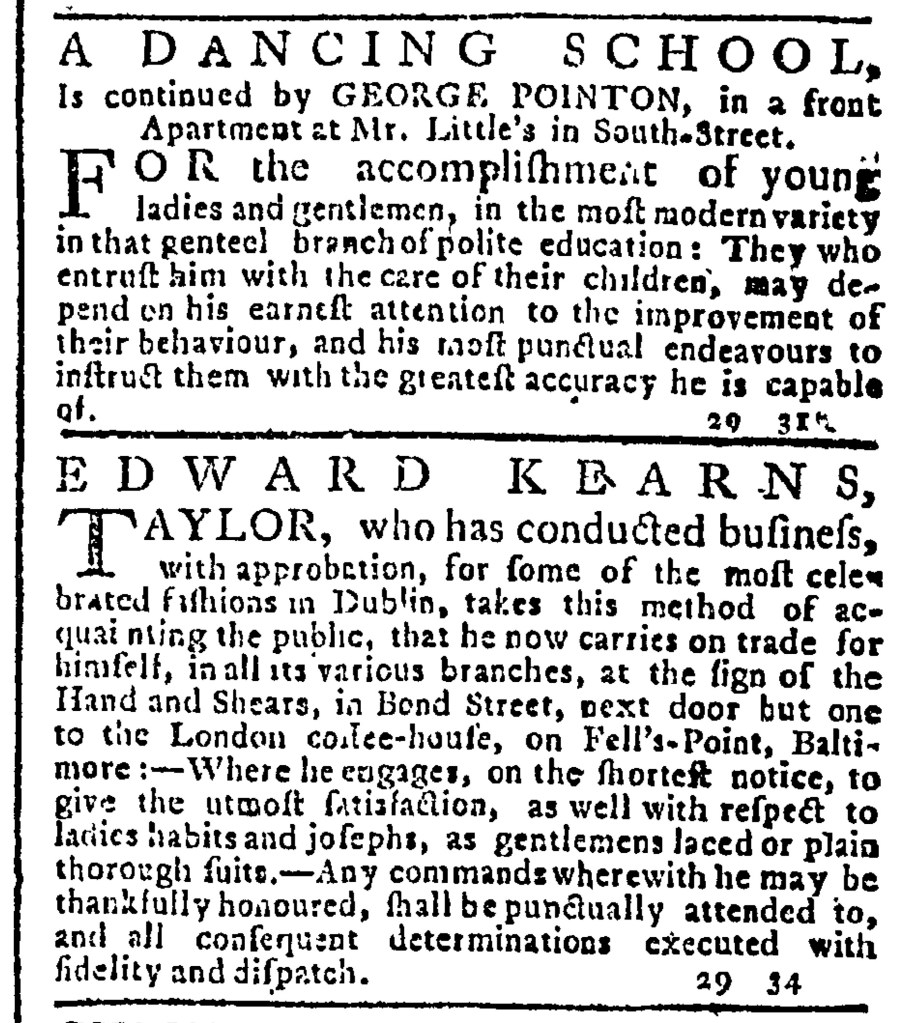
Yet it was not solely the availability of goods that marked Baltimore’s participation in the transatlantic consumer revolution.  Residents also appreciated the latest fashions, aiming to demonstrate that even at a distance they kept up with current styles.  Edward Kearns, a tailor, trumpeted that he “has conducted business, with approbation, for some of the most celebrated fashions in Dublin.”  Clients could find his shop “at the sign of the Hand and Shears, … next door but one to the London coffee-house.”  That establishment also represented connections to the metropolis that elevated Baltimore’s standing as more than a distant outpost.  In addition, George Pointon ran a “DANCING SCHOOL … FOR the accomplishment of young ladies and gentlemen, in the most modern variety in that genteel branch of polite education.”  The dancing master also tended to the comportment of his pupils, pledging “his earnest attention to the improvement of their behaviour.”  His description of his services corresponded with newspaper notices placed by dancing masters in major urban ports like Philadelphia, New York, and Charleston.  Displays of gentility mattered as much to colonizers in Baltimore as in other cities and towns.  Not only did they acquire clothing and goods that matched the latest fashions, they also developed manners that confirmed their status … or at least had opportunities to do so, according to the goods and services represented among the advertisements in the Maryland Journal.

May 27

What was advertised in a colonial American newspaper 250 years ago today?

South-Carolina and American General Gazette (May 27, 1774).

“Souchong Tea at 60s. the Pound.”

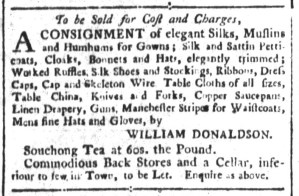
As summer approached in 1774, William Donaldson advertised a variety of goods in the South-Carolina and American General Gazette.  On May 27, he promoted “elegant Silks, Muslins and Humhums for Gowns; Silk and Sattin Petticoats, Cloaks, Bonnets and Hats, elegantly trimmed; [and] Table China,” among other merchandise.  He had a separate entry for “Souchong Tea at 60s. the Pound.”  As in other towns, decisions about buying, selling, and consuming tea were part of an unfolding showdown between the colonies and Parliament.

Residents of Charleston were well aware of the Boston Tea Party that occurred the previous December.  They also anticipated some sort of response from Parliament, but at the time that Donaldson ran his advertisement, word of the Boston Part Act had not yet arrived in South Carolina.  Indeed, four days after Donaldson’s advertisement appeared in the South-Carolina and American General Gazette, another newspaper, the South-Carolina Gazette and Country Journalcarried updates from London, dated March 15, that included an overview of the proposed act to close Boston Harbor until the town paid for the tea that had been destroyed and “made proper concession for their tumultuous behaviour.”  In addition, the report stated that a “light vessel is said to have been kept ready by some friends to the Bostonians in England, in order to carry accounts of the first determination of a Great Assembly.”  By the end of May, colonizers in New England and New York knew that the Boston Port Act had passed and would go into effect on June 1.  The news was still making its way to South Carolina.

When it arrived, Peter Timothy, the printer of the South-Carolina Gazette, considered it momentous enough to merit an extraordinary, a supplemental issue.  Timothy usually published his newspaper on Mondays, but felt that this news could not wait three more days.  He rushed the South-Carolina Gazette Extraordinary to press on Friday, June 3.  The masthead included thick black borders, traditionally a sign of mourning the death of an influential member of the community but increasingly deployed by American printers to lament the death of liberty.  Confirmation of the Boston Port Act inspired new debates about consuming tea and purchasing other imported goods, eventually leading to a boycott known as the Continental Association, but colonizers did not immediately forego buying, selling, drinking, or advertising tea following the Boston Tea Party.  That happened over time (and loyalists like Peter Oliver claimed that even those who claimed to support the boycott devised ways to cheat).  In the interim, Donaldson continued marketing tea along with other merchandise.

Slavery Advertisements Published May 27, 1774

The Slavery Adverts 250 Project chronicles the role of newspaper advertising in perpetuating slavery in the era of the American Revolution. The project seeks to reveal the ubiquity of slavery in eighteenth-century life from New England to Georgia by republishing advertisements about enslaved people – for sale as individuals or in groups, wanted to purchase or for hire for short periods, runaways who liberated themselves, and those who were subsequently captured and confined in jails and workhouses – in daily digests on this site as well as in real time via the @SlaveAdverts250 Twitter feed, utilizing twenty-first-century media to stand in for the print media of the eighteenth century.

The project aims to provide modern audiences with a sense of just how often colonizers encountered these advertisements in their daily lives. Enslaved men, women, and children appeared in print somewhere in the colonies almost every single day. Those advertisements served as a constant backdrop for social, cultural, economic, and political life in colonial and revolutionary America. Colonizers who did not purport to own enslaved people were still confronted with slavery as well as invited to maintain the system by purchasing enslaved men, women, and children or assisting in the capture of so-called “runaways” who sought to free themselves from bondage. The frequency of these newspaper advertisements suggests just how embedded slavery was in colonial and revolutionary American culture in everyday interactions beyond the printed page.

These advertisements also testify to the experiences of enslaved men, women, and children, though readers must consider that those experiences have been remediated through descriptions offered by enslavers rather than enslaved people themselves. Often unnamed in the advertisements, enslaved men, women, and children were not invisible or unimportant in early America.

These advertisements appeared in colonial American newspapers 250 years ago today.

Connecticut Gazette (May 27, 1774).

**********

Connecticut Journal (May 27, 1774).

**********

New-Hampshire Gazette (May 27, 1774).

**********

South-Carolina and American General Gazette (May 27, 1774).

**********

South-Carolina and American General Gazette (May 27, 1774).

**********

South-Carolina and American General Gazette (May 27, 1774).

**********

South-Carolina and American General Gazette (May 27, 1774).

**********

South-Carolina and American General Gazette (May 27, 1774).

**********

South-Carolina and American General Gazette (May 27, 1774).

**********

South-Carolina and American General Gazette (May 27, 1774).

**********

South-Carolina and American General Gazette (May 27, 1774).

**********

South-Carolina and American General Gazette (May 27, 1774).

**********

South-Carolina and American General Gazette (May 27, 1774).

**********

South-Carolina and American General Gazette (May 27, 1774).

**********

South-Carolina and American General Gazette (May 27, 1774).

**********

South-Carolina and American General Gazette (May 27, 1774).

**********

South-Carolina and American General Gazette (May 27, 1774).

**********

South-Carolina and American General Gazette (May 27, 1774).

**********

South-Carolina and American General Gazette (May 27, 1774).

**********

South-Carolina and American General Gazette (May 27, 1774).

**********

South-Carolina and American General Gazette (May 27, 1774).

**********

South-Carolina and American General Gazette (May 27, 1774).

**********

South-Carolina and American General Gazette (May 27, 1774).

**********

South-Carolina and American General Gazette (May 27, 1774).

**********

South-Carolina and American General Gazette (May 27, 1774).

May 26

What was advertised in a colonial American newspaper 250 years ago today?

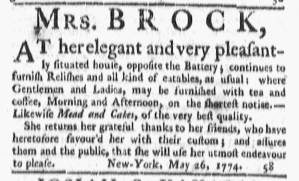
Rivington’s New-York Gazetteer (May 26, 1774).

“Gentlemen and Ladies, may be furnished with tea and coffee, Morning and Afternoon.”

Mrs. Brock invited “Gentlemen and Ladies” to gather at “her elegant and very pleasantly situated house, opposite the Battery,” in New York in the spring of 1774.  In an advertisement in the May 26 edition of Rivington’s New-York Gazetteer, she declared that she “continues to furnish Relishes and all kinds of eatables, as usual.”  She also served “Mead and Cakes, of the very best quality.”  The hostess also took the opportunity to express “her grateful thanks to her friends, who have heretofore favour’d her with their custom.”  Brock had been in business for at least five years, having previously advertised in the New-York Journal.  Given the reputation she had cultivated during that time, she assured her existing clientele and the public “that she will use her utmost endeavour to please.”

Despite such assurances, some readers may not have been pleased with Brock.  In addition to “Relishes” and “eatables,” she also served “tea and coffee, Morning and Afternoon, on the shortest notice.”  New York had recently received word of the Boston Port Act that closed that harbor of that town until residents paid for the tea destroyed the previous December.  Residents were certainly aware of efforts to turn away ships carrying tea to their own colony.  Though no prohibition on buying, selling, or drinking tea had been enacted, many colonizers looked on the commodity with suspicion.  Some merchants and shopkeepers already advertised that they stocked a variety of groceries but not tea, while others made clear that they continued business as usual.  Brock joined their ranks.  Her advertisement could not be mistaken as one merely reprinted after having run for some time, perhaps originating prior to the latest controversy; it was dated “May 26, 1774” and bore the issue number, “58,” of the current edition.  Whatever measures were coalescing around consuming tea, Brock considered it appropriate to continue serving the beverage to “Gentlemen and Ladies” and anticipated that she would meet with a ready market.  Many colonizers, she surmised, were not yet ready to dispense with tea, no matter the complicated politics swirling around it.

Slavery Advertisements Published May 26, 1774

The Slavery Adverts 250 Project chronicles the role of newspaper advertising in perpetuating slavery in the era of the American Revolution. The project seeks to reveal the ubiquity of slavery in eighteenth-century life from New England to Georgia by republishing advertisements about enslaved people – for sale as individuals or in groups, wanted to purchase or for hire for short periods, runaways who liberated themselves, and those who were subsequently captured and confined in jails and workhouses – in daily digests on this site as well as in real time via the @SlaveAdverts250 Twitter feed, utilizing twenty-first-century media to stand in for the print media of the eighteenth century.

The project aims to provide modern audiences with a sense of just how often colonizers encountered these advertisements in their daily lives. Enslaved men, women, and children appeared in print somewhere in the colonies almost every single day. Those advertisements served as a constant backdrop for social, cultural, economic, and political life in colonial and revolutionary America. Colonizers who did not purport to own enslaved people were still confronted with slavery as well as invited to maintain the system by purchasing enslaved men, women, and children or assisting in the capture of so-called “runaways” who sought to free themselves from bondage. The frequency of these newspaper advertisements suggests just how embedded slavery was in colonial and revolutionary American culture in everyday interactions beyond the printed page.

These advertisements also testify to the experiences of enslaved men, women, and children, though readers must consider that those experiences have been remediated through descriptions offered by enslavers rather than enslaved people themselves. Often unnamed in the advertisements, enslaved men, women, and children were not invisible or unimportant in early America.

These advertisements appeared in colonial American newspapers 250 years ago today.

Maryland Gazette (May 26, 1774).

**********

Maryland Gazette (May 26, 1774).

**********

Rivington’s New-York Gazetteer (May 26, 1774).

**********

Virginia Gazette [Purdie and Dixon] (May 26, 1774).

**********

Virginia Gazette [Purdie and Dixon] (May 26, 1774).

**********

Virginia Gazette [Purdie and Dixon] (May 26, 1774).

**********

Virginia Gazette [Purdie and Dixon] (May 26, 1774).

**********

Virginia Gazette [Purdie and Dixon] (May 26, 1774).

**********

Virginia Gazette [Purdie and Dixon] (May 26, 1774).

**********

Virginia Gazette [Rind] (May 26, 1774).

**********

Virginia Gazette [Rind] (May 26, 1774).

**********

Virginia Gazette [Rind] (May 26, 1774).

**********

Virginia Gazette [Rind] (May 26, 1774).