
What was advertised in a colonial American newspaper 250 years ago this week?
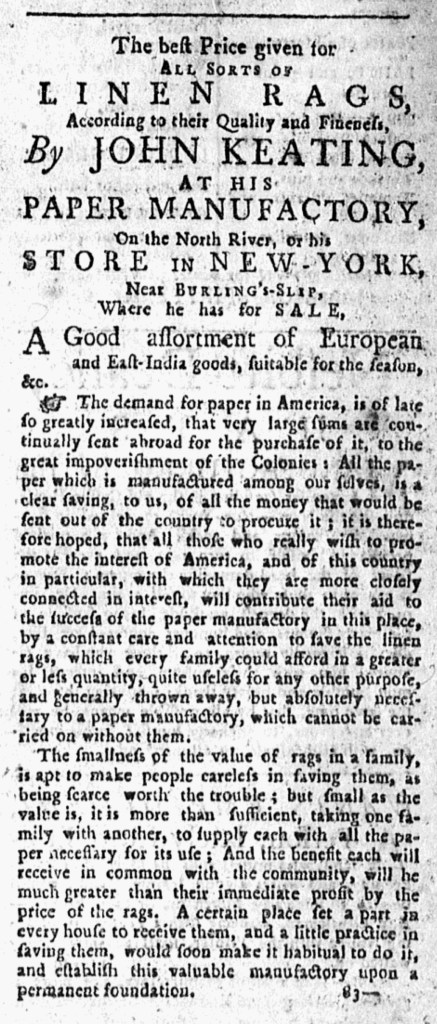
“Those who really wish to promote the interest of America … will contribute their aid to the success of the paper manufactory.”
John Keating, the proprietor of a “PAPER MANUFACTORY” near New York, had a task for every household in the colonies: collect rags to make into paper. That might seem like an insignificant act, he argued in an advertisement that appeared week after week in the New-York Journal, but it had value beyond measure. “The smallness of the value of rags in a family, is apt to make people careless in saving them, as being scarce worth the trouble,” Keating acknowledged. However, “small as the value is, it is more than sufficient, taking one family with another, to supply each with all the paper necessary for its use.” This endeavor, like so many acts of protest against the abuse of Parliament, depended on colonizers working in unison. Cooperation yielded strength. Keating elaborated on his vision: “And the benefit each will receive in common with the community, will be much greater than the immediate profit by the of the rags.” To achieve that goal, he encouraged every household to designate a spot for collecting rags, noting that “a little practice in saving them, would soon make it habitual to do it, and establish this valuable manufactory upon a permanent foundation.”
True patriots would heed this call to help meet the demand for paper in America, “of late so greatly increased, that very large sums are continually sent abroad for the purchase of it.” Importing paper instead of producing it locally resulted in “the great impoverishment of the colonies,” an assertion that Keating made in advertisement after advertisement for several years in the late 1760s and early 1770s. “All the paper which is manufactured among ourselves,” he proclaimed, “is a clear saving, to us, of all the money that would be sent out of the country to procure it.” Rather than exacerbate a trade imbalance with England, “those who really wish to promote the interest of America … will contribute their aid to the success of the paper manufactory in this place.” That meant purchasing paper from Keating, yet his advertisements usually emphasized participating in the production of paper rather than the consumption of his product. Given the demand, he likely assumed that he could sell paper as quickly as he produced it. He needed the most assistance with procuring the necessary materials, “linen rags, quite useless for any other purpose, and generally thrown away.” The strength of the local economy depended on the efforts of the members of every household. According to Keating, wives and mothers, indentured servants and enslaved people, and youths and children all had a role to play in supporting this important industry in New York during the era of the American Revolution.
[…] “Those who really wish to promote the interest of America … will contribute their aid to the success of the paper manufactory.” John Keating, the proprietor of a “PAPER MANUFACTORY” near New York, had a task for every household in the colonies: collect rags to make into paper. That might seem like an insignificant act, he argued in an advertisement that appeared week after week in the New-York Journal, but it had value beyond measure. “The smallness of the value of rags in a family, is apt to make people careless in saving them, as being scarce worth the trouble,” Keating acknowledged. However, “small as the value is, it is more than sufficient, taking one family with another, to supply each with all the paper necessary for its use.” This endeavor, like so many acts of protest against the abuse of Parliament, depended on colonizers working in unison. Cooperation yielded strength. Keating elaborated on his vision: “And the benefit each will receive in common with the community, will be much greater than the immediate profit by the of the rags.” To achieve that goal, he encouraged every household to designate a spot for collecting rags, noting that “a little practice in saving them, would soon make it habitual to do it, and establish this valuable manufactory upon a permanent foundation.” Read more… […]
[…] also made an appeal to support domestic manufactures, echoing the sentiments that John Keating so often published in advertisements for his “PAPER MANUFACTORY” in New York and others who wished to support […]