
What was advertised in a colonial American newspaper 250 years ago today?
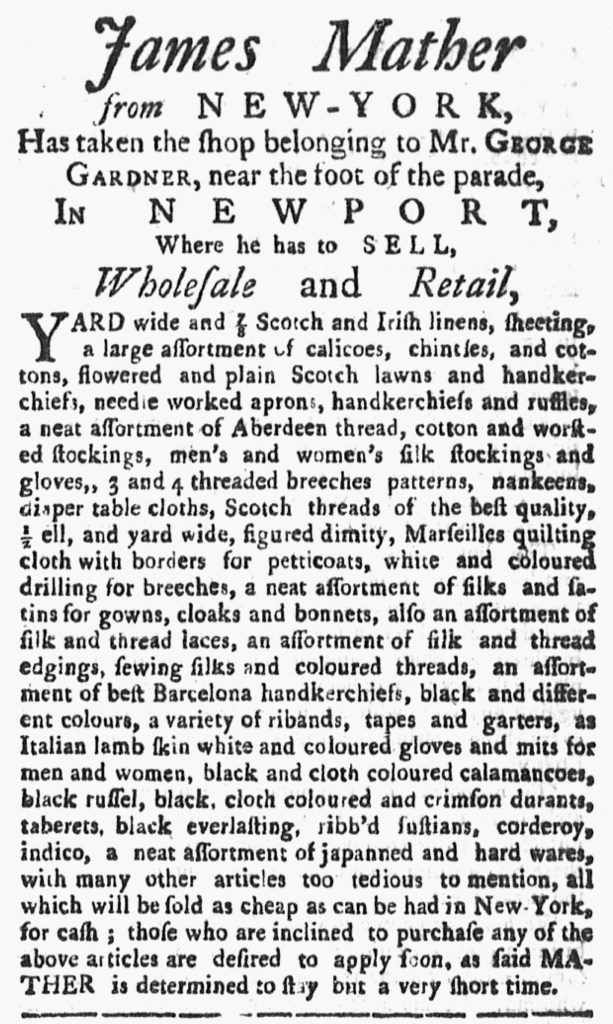
“MATHER is determined to stay but a very short time.”
A new purveyor of goods arrived in Newport in the spring of 1774, but he did not have plans to remain in Rhode Island for long, at least not according to the advertisement he placed in the May 23 edition of the Newport Mercury. James Mather “from NEW-YORK” introduced himself to the public with an announcement that he occupied “the shop belonging to Mr. GEORGE GARDNER, near the foot of the parade.” Presumably, many readers were familiar with the location and the proprietor if not the entrepreneur who now did business in that space.
Mather offered his wares “Wholesale and Retail,” giving an extensive list of items in stock at his shop. He carried “a large assortment of calicoes, chintses, and cottons,” “men’s and women’s silk stockings and gloves,” “a neat assortment of silks and satins for gowns, cloaks and bonnets,” and “a neat assortment of japanned and hard wares.” Yet his newspaper advertisement could not contain the variety of merchandise he had on hand. Mather exclaimed that he had “many other articles too tedious to mention.” Prospective customers could depend on an array of choices when they visited the shop “near the foot of the parade.”
They could also expect bargain prices. Mather declared that he set prices “as cheap as can be had in New-York,” suggesting that competition in the larger port yielded deals for consumers and retailers who bought to sell again. Being “from NEW-YORK,” Mather had firsthand knowledge of the prices there. He made them available in Newport, but for a limited time only. He recommended that “those who are inclined to purchase any of the above articles” should “apply soon” because he “is determined to stay but a very short time.” Shop soon or miss out, he warned. It was not the first time that Mather deployed this strategy for moving merchandise. The previous fall he undertook a similar enterprise in Providence, renting space near a familiar landmark and promoting prices “as cheap as can be bought in New-York.” Mather apparently found it more lucrative to pursue short-term endeavors in smaller ports than maintain a permanent location in New York.