
What was advertised in a colonial American newspaper 250 years ago today?
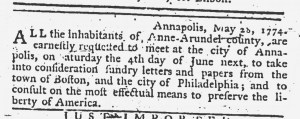
“Meet … to consult on the most effectual means to preserve the liberty of America.”
Advertisements in eighteenth-century newspapers served a variety of purposes. Sometimes they carried news. During the imperial crisis, colonizers used advertisements to help them organize. Consider a notice that ran in the June 2, 1774, edition of the Maryland Gazette. It advised, “ALL the inhabitants of Anne-Arundel county, are earnestly requested to meet at the city of Annapolis, on Saturday the 4th day of June next, to take into consideration sundry letters and papers from the town of Boston, and the city of Philadelphia.” The organizers also planned for the participants to “consult on the most effectual means to preserve the liberty of America.” Those “sundry letters and papers” referred to news of the Boston Port Act. As punishment for the Boston Tea Party, Parliament closed and blockaded Boston Harbor, starting June 1 and continuing until the residents of that town paid for the tea destroyed the previous December.
More details from some of those “sundry letters and papers” appeared elsewhere in that issue of the Maryland Gazette, including “Extracts of private letters from London, dated April 7 and 8, to private persons in New-York and Philadelphia” on the front page, yet the call to meeting was not among the news items. It appeared among the advertisements, though it received a privileged place as the first advertisement. It ran immediately after the list of vessels that entered and cleared the customs house in Annapolis, traditionally the final news item. The printers, Anne Catherine Green and Son, also ran a note that the “conclusion of the essay on the advantages of a classical education, is postponed for want of room” and “Advertisements omitted will be inserted next week.” Yet they not only made certain to include the advertisement about the meeting to discuss news related to the Boston Port Act and how to respond but also placed it where readers who might not read the advertisements as closely as the news and editorials would be more likely to see it. John Holt had done the same with a call to meeting that ran in the May 19 edition of the New-York Journal. The press played an important role in “preserv[ing] the liberty of America” during the era of the American Revolution, but not solely in the sections of newspapers that carried coverage of current events. Advertisements also contributed to keeping readers informed and mobilizing colonizers to resist legislation passed by Parliament.