
What was advertised in a colonial American newspaper 250 years ago this week?
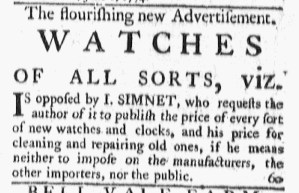
“The flourishing new Advertisement … IS opposed by I. SIMNET.”
The cantankerous John Simnet once again picked a fight in the public prints in the summer of 1774, having previously engaged in similar behavior targeting competitors in Portsmouth in the late 1760s and New York in the early 1770s. The watchmaker did not seem content simply promoting his own skill and merchandise, as he did in an advertisement for “WATCHES, NEAT AND PLAIN; GOLD, SILVER, SHAGREEN, and METAL” that first ran in the June 2, 1774, edition of Rivington’s New-York Gazetteer and appeared again a week later. In that notice, Simnet emphasized a novelty available at his shop, “the first in this country of the small new fashioned watches, the circumference of a British shilling.”
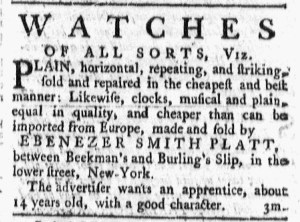
Yet Simnet did not believe that was not enough to distinguish him from his competitors. Instead, he placed a second advertisement in Rivington’s New-York Gazetteer on June 9, that one deriding “The flourishing new Advertisement” with a headline for “WATCHES OF ALL SORTS, viz.” that went on to list “PLAIN, horizontal, repeating, and striking.” Ebenezer Smith Platt had been running that advertisement in Rivington’s New-York Gazetteer, though Sinmet’s comment about “The flourishing new Advertisement” suggests that his competitor may have distributed handbills or broadsides as well. The part that really upset Simnet seems to have been Platt’s assertion that he made and sold watches and clocks “equal in quality, and cheaper than can be imported from Europe.” Even though artisans throughout the colonies, including clock- and watchmakers, often made such appeals, Simnet acted as though they applied solely to him and his business.
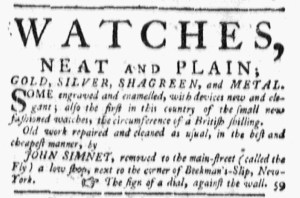
To that end, he quoted the headline of Platt’s advertisement and then trumpeted that he “IS opposed” to the claims made in it. Simnet went on to demand, though he framed it as a request, that “the author of it” (he did not mention Platt by name) “publish the price of every sort of new watches and clocks, and his price for cleaning and repairing old ones, if he means neither to impose on the manufacturers, the other importers, nor the public.” On occasion, Simnet had published the prices he charged for cleaning and repairs, though in his current advertisement he merely stated, “Old work repaired and cleaned as usual, in the best and cheapest manner.” He sought to hold Platt to a higher standard than he met, suggesting that he did so in service to “the public” that might have otherwise been duped by Platt. In an era when most advertisers promoted their own goods and services without engaging directly with their competitors, Simnet regularly took to the newspapers to demean others who followed his trade, especially those who ran their own advertisements. He apparently considered such means effective … or at least derived some form of satisfaction from such conduct.