
What was advertised in a colonial American newspaper 250 years ago today?
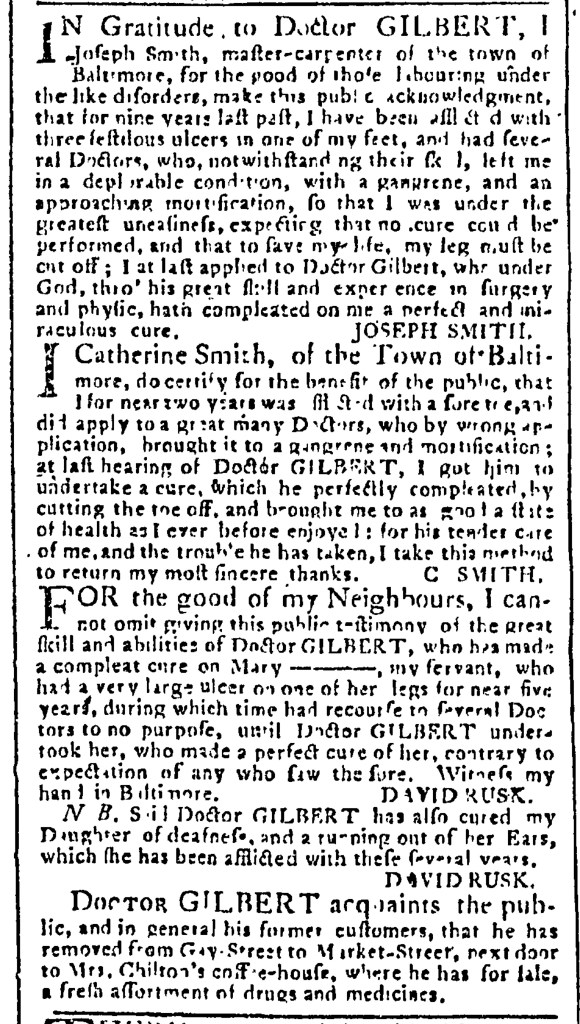
“IN Gratitude to Doctor GILBERT, I … make this public acknowledgment.”
When Doctor Gilbert moved to a new location on Market Street from Gay Street in Baltimore in 1774, he alerted “the public, and in general his former customers” in an advertisement in the Maryland Journal. Yet that information appeared at the end of a lengthy advertisement devoted primarily to testimonials from some of the patients he served. The advertisement began with Joseph Smith, “master-carpenter of the town of Baltimore,” expressing his gratitude to the doctor and doing so in the public prints “for the good of those labouring under the like disorders.” He then explained that for nine years he had suffered from ulcers that would not heal on one of his feet, despite the skill of other doctors he consulted. His condition reached such a “deplorable condition” that he feared that his leg would need to be amputated “to save my life.” Fortunately, he “applied to Doctor Gilbert” who “thro’ his great skill and experience in surgery and physic, hath completed on me a perfect and miraculous cure.”
Similarly, Catherine Smith offered an account of her experience with a “sore toe” that would not heal. She saw several doctors, but they unsuccessfully treated her and instead “brought it to a gangrene and mortification.” She turned to Gilbert. Although he could not save her toe, after he amputated it he “brought me to as good a state of health as I ever before enjoyed.” Smith offered her “most sincere thanks” for “his tender care of me,” making a statement in an advertisement “for the benefit of the public.” David Rusk felt a similar duty to report on how Gilbert aided members of his household. “FOR the good of my Neighbours,” he explained, “I cannot omit giving this public testimony of Doctor GILBERT.” His servant, Mary, had “a very large ulcer on one of her legs for near five years.” She had also seen many doctors “to no purpose,” but then Gilbert “made a perfect cure of her, contrary to expectation of any who saw the sore.” In addition, Gilbert cured Rusk’s daughter of deafness through treating “a running out of her Ears, which she has been afflicted with these several years.”
For his part, Gilbert did not describe his services or his training. He merely informed readers of his new location and mentioned that he sold “a fresh assortment of drugs and medicines.” He apparently believed that he did not need to expound on his credentials or his experience like others who provided medical services often did in their advertisements, figuring that testimonials from his former patients told a more compelling and more convincing story than anything he could say about himself. Those stories of successful treatments offered hope to prospective patients, a powerful motivation to seek Gilbert’s services.