
What was advertised in a colonial American newspaper 250 years ago today?
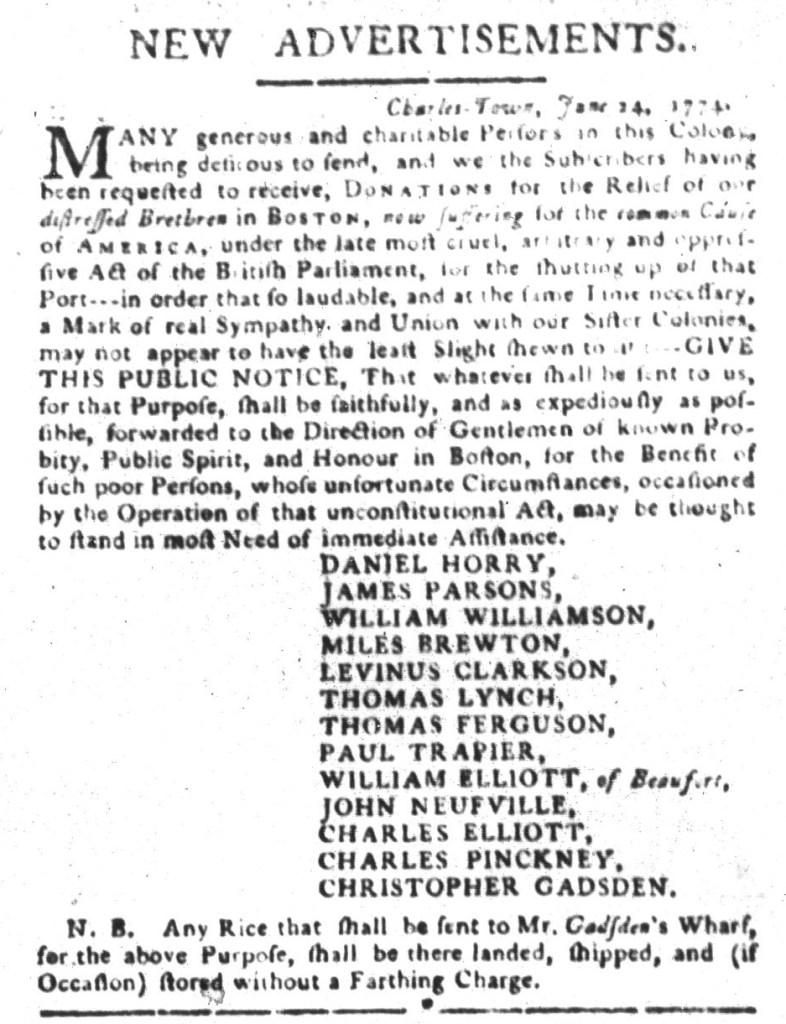
“DONATIONS for the Relief of our distressed Brethren in BOSTON, now suffering for the common Cause of AMERICA.”
Parliament intended to punish Boston when it closed and blockaded the harbor, effective June 1, 1774, as punishment for the destruction of the tea the previous December, yet colonizers from New England to Georgia protested what some described as “that unconstitutional Act.” The Boston Port Act halted trade in what had been a bustling port city. In early July, a dozen prominent residents of Charleston and other towns in South Carolina published an advertisement that outlined their plans to send aid to Massachusetts. They described how “MANY generous and charitable Persons in this Colony” were “desirous to send … DONATIONS for the Relief of our distressed Brethren in BOSTON, now suffering for the common Cause of AMERICA.” Parliament had miscalculated if it believed that other colonies would not react to the Boston Port Act and the other Coercive Acts. As many colonizers mobilized to protest, contemplating measures that included nonimportation agreements, some directed their attention to assisting the people of Boston whose patriotic spirit put them in the position of enduring Parliament’s retribution. Bostonians had acted in the interests of all colonizers, so they had earned the support of colonizers near and far.
The committee that collected donations in Charleston described the Boston Port Act as the “most cruel, arbitrary and oppressive Act of the British Parliament.” As they explained in their advertisement, it prompted them to organize a “laudable” and “necessary” plan to collect donations “for the Benefit of such poor Persons, whose unfortunate Circumstances, occasioned by the Operation of that unconstitutional Act, may be through to stand in most Need of immediate Assistance.” The committee encouraged other to participate in this endeavor as “a Mark of real Sympathy and Union with our Sister colonies.” They made that appeal at the same time that John Holt incorporated a “JOIN OR DIE” emblem into the masthead of the New-York Journal, another testament to belief in the “common cause of AMERICA.” The committee pledged to “faithfully, and as expediously as possible” send donations to “Gentlemen of known Probity, Public Spirit, and Honour in Boston” to distribute as they deemed appropriate. One member of the committee, Christopher Gadsden, even offered to store and ship rice donated in support of the people of Boston, likely hoping that gesture would inspire others to similar generosity.
News coverage of reactions to the Boston Port Act appeared elsewhere in the July 5 edition of the South-Carolina Gazette ad Country Journal, though the appeal from the committee ran among “NEW ADVERTISEMENTS.” Throughout the imperial crisis, advertisements often relayed news and opinion that supplemented articles and editorials. In this instance, the committee collecting aid for Boston made a forceful argument about politics and attempted to shape public opinion concerning current events. Their advertisement bolstered commentary that readers encountered throughout the newspaper, not solely in the portion for “freshest Advices, both Foreign and Domestic” selected by the printer.