
What was advertised in a colonial American newspaper 250 years ago today?
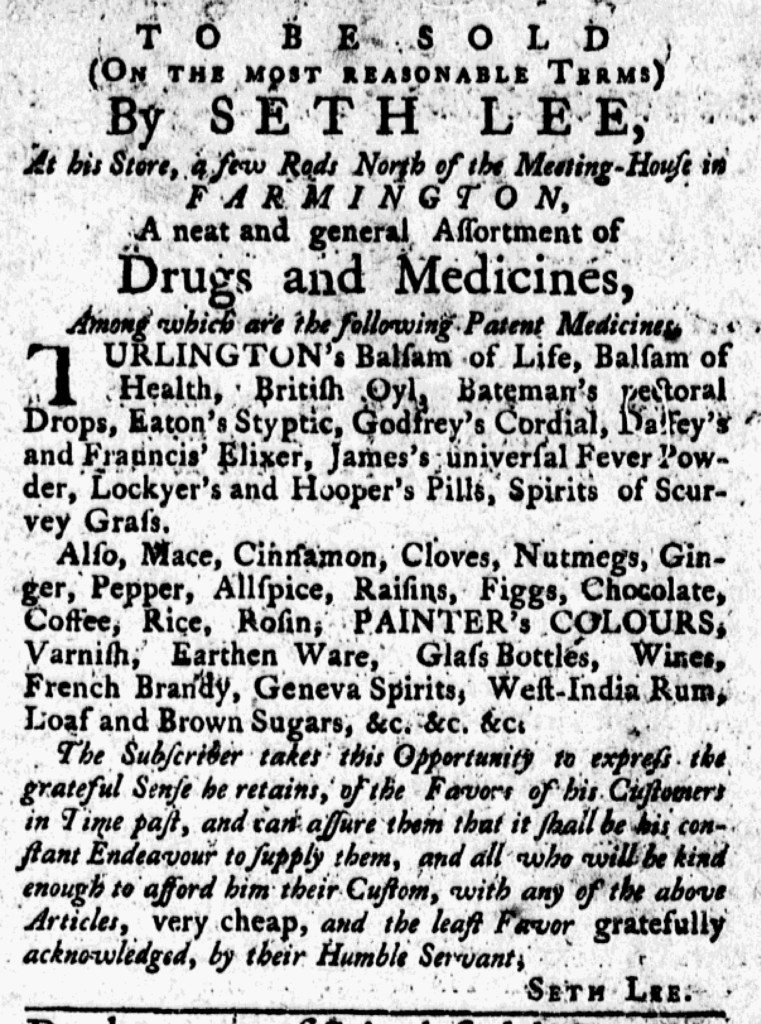
“Opportunity to express the grateful Sense he retains, of the Favors of his Customers in Time past.”
In the summer of 1774, Seth Lee of Farmington ran an advertisement for a “neat and general Assortment of Drugs and Medicines” in the Connecticut Courant. He advised prospective customers that he sold his wares “ON THE MOST REASONABLE TERMS,” hoping that the promise of bargains would entice them to shop at his store. His merchandise included a variety of patent medicines, each of them so familiar that Lee merely listed a dozen of them without indicating which symptoms they alleviated or maladies they supposedly cured. He also called attention to alcohol, groceries, paint, and other items that supplemented his inventory. Lee peddled two popular beverages, coffee and chocolate, but did not mention tea, an increasingly problematic commodity following the Boston Tea Party the previous December and the Coercive Acts passed by Parliament in response. Elsewhere in the August 2 edition, Amos Wadsworth and Fenn Wadsworth continued hawking “BOHEA TEA, (not infected with a duty),” while Samuel Wescote advertised “good TEA” without further explanation.
Rather than wade into consumer politics, Lee appended a note to his former customers and prospective new customers. He declared that he wished “to express the grateful Sense he retains, of the Favors of his Customers in Time past.” In addition to demonstrating his appreciation for their business, such sentiments also testified to his experience providing satisfactory service, an implicit appeal to new customers as Lee attempted to buttress his reputation. As he continued, Lee included prospective customers in the invitation he extended to readers to shop at his store. He addressed “all who will be kind enough to afford him their Custom,” pledging that “it shall be his constant Endeavour to supply them … with any of the above Articles, very cheap.” Furthermore, they would receive exemplary customer service, with “the least Favorgratefully acknowledged.” Lee highlighted prices at the beginning and end of his advertisement, but he did not make those “REASONABLE TERMS” the focus of his notice. Instead, he emphasized the relationships he cultivated with customers in the past and would endeavor to continue providing as “their Humble Servant.” Lee listed goods to attract attention, then sought to hold it by wooing readers with his devotion to customer service.