
What was advertised in a colonial American newspaper 250 years ago this week?
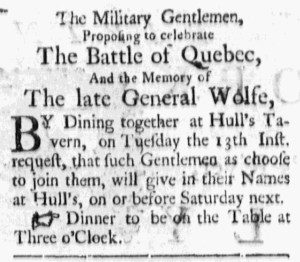
“Celebrate The Battle of Quebec, And the Memory of The late General Wolfe.”
Even as turmoil brewed in the wake of colonizers learning of the Coercive Acts and the Quebec Act in the spring and summer of 1774, most continued to embrace their British identity while condemning Parliament for its treatment of the colonies. As the First Continental Congress commenced its meetings in Philadelphia at the beginning of September, a notice in the September 8 edition of Rivington’s New-York Gazetteer advised “Military Gentlemen” of an upcoming dinner to celebrate “The Battle of Quebec, And the Memory of The late General Wolfe.” The event would take place at Hull’s Tavern on September 13, marking the fifteenth anniversary of the death of General James Wolfe on the Plains of Abraham outside the walled city of Quebec during the Seven Years War. Although Wolfe perished, the battle resulted in a British victory that ended the siege of Quebec, one of the most decisive moments of the war in North America.
At the end of the war, the French withdrew from the continent. The British Empire gained the territory France had claimed in Canada. English colonizers in America joined in memorializing Wolfe and celebrating such an important victory, emphasizing their own contributions throughout the war. In 1770, Benjamin West, an influential American painter who had migrated to England and settled in London in the 1760s, memorialized the battle and celebrated the British Empire in The Death of General Wolfe. It became his most famous history painting, frequently reproduced. In the colonies, Americans honored Wolfe in other ways. In Boston, for instance, William Murray marked the location of the shop where he sold an “Assortment of English Goods” with the “Sign of General WOLFE.” In New York, veterans of the war and others participated in commemorative dinners, no doubt making toasts in memory of Wolfe and in honor of the British Empire.
On the fifteenth anniversary of Wolfe’s death, most colonizers had not yet determined to separate from the British Empire. Instead, they sought a redress of their grievances against Parliament, many hoping that the king would intervene on their behalf. The conversations and the toasts at the dinner celebrating the battle likely included references to English liberties that colonizers believed they were entitled to enjoy as members of the British Empire. In remembering the Battle of Quebec and memorializing Wolfe, they demonstrated their continued attachment to the British Empire. As the First Continental Congress began its deliberations in September 1774, the rupture was not yet so significant that declaring independence was inevitable.
[…] Even as turmoil brewed in the wake of colonizers learning of the Coercive Acts and the Quebec Act in the spring and summer of 1774, most continued to embrace their British identity while condemning Parliament for its treatment of the colonies. As the First Continental Congress commenced its meetings in Philadelphia at the beginning of September, a notice in the September 8 edition of Rivington’s New-York Gazetteer advised “Military Gentlemen” of an upcoming dinner to celebrate “The Battle of Quebec, And the Memory of The late General Wolfe.” The event would take place at Hull’s Tavern on September 13, marking the fifteenth anniversary of the death of General James Wolfe on the Plains of Abraham outside the walled city of Quebec during the Seven Years War. Although Wolfe perished, the battle resulted in a British victory that ended the siege of Quebec, one of the most decisive moments of the war in North America. Read more… […]