
What was advertised in a colonial American newspaper 250 years ago this month?
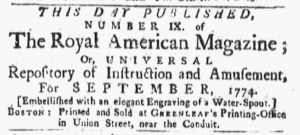
“THIS DAY PUBLISHED … The Royal American Magazine … For SEPTEMBER, 1774.”
Upon becoming the proprietor of the Royal American Magazine, Joseph Greenleaf set about publishing new issues to catch up with how many should have been distributed. Isaiah Thomas, the original proprietor, had fallen behind because of the “Distresses of the Town of Boston” when the Boston Port Act went into effect in the summer of 1774. Initially, Thomas intended to suspend the magazine until “the Affairs of this Country are a little better settled,” but then he decided to transfer it to Greenleaf. By that time, the magazine was several months behind schedule. Greenleaf took the July issue to press in September 1774. In October, he published two issues, the August issue near the beginning of the month and the September issue at the end of the month. Since magazine typically came out at the end of the month rather than the beginning, that meant that the Royal American Magazine was now only a month behind schedule. In keeping subscribers and the public apprised of the new issues, Greenleaf resorted to a greater number of advertisements in a greater number of newspapers in October than in September.
The Adverts 250 Project has examined advertisements for the Royal American Magazine that began with Thomas’s first mention of circulating subscription proposals in May 1773 and subsequent newspaper advertisements in June, July, August, September, October, November, and December 1773 and January, February, March, April, May, and June 1774. The “Distresses” meant no newspaper advertisements for the magazine in July 1774, but they resumed with the notices from Thomas and Greenleaf in August, September, and October.
A brief advertisement in the October 6 edition of the Massachusetts Spy announced, “To-morrow will be published, THE Royal American Magazine, No. 8. For AUGUST, 1774.” A more elaborate notice in the Massachusetts Gazette and Boston Weekly News-Letter on the same day proclaimed, “THIS DAY PUBLISHED … NUMBER VIII. of The Royal American Magazine.” That one noted that the issue was “Embellished with an elegant Engraving” to supplement the articles. It also encouraged new subscribers to submit their names to Greenleaf at his printing office on Hanover Street. Apparently, there had been a miscommunication with one of the printing offices concerning when the September issue would be ready for subscribers. That did not matter by the time the Boston Post-Boy ran the same “THIS DAY PUBLISHED” advertisement on October 10. Readers knew that “THIS DAY PUBLISHED” did not necessarily refer to a specific day but instead meant that a book, pamphlet, or other item was now available. The Boston-Gazette carried yet another version of Greenleaf’s advertisement, also on October 10. That one stated that he “JUST PUBLISHED” the magazine and promoted the engraving. Advertisements for the August issue of the Royal American Magazine appeared in four newspapers published in Boston, compared to advertisements for the July issue running in only two.
Those four newspapers each carried advertisements about the September issue of the magazine by the end of October. On October 20, Greenleaf inserted a notice in the Massachusetts Spy to inform the public that he moved his printing office to Union Street. In a nota bene, he stated, “The Magazine for September, will be out next week.” He ran the same notice in the Boston Evening-Post on October 24. A few days later, both the Massachusetts Gazette and Boston Weekly News-Letter and the Massachusetts Spy featured variant advertisements that declared, “To-Morrow will be published, THE Royal American Magazine, for September 1774.” On October 31, the Boston-Evening Post and the Boston-Gazette also ran similar, but not identical, advertisements that stated, “THIS DAY PUBLISHED … The Royal American Magazine … For SEPTEMBER 1774.” The version in the Boston Evening-Post promoted an “elegant Engraving of a Water-Spout” and directed readers to Greenleaf’s printing office. The one in the Boston-Gazette did not. Greenleaf got the word out about the latest issue of the magazine, produced incredibly quickly compared to previous issues, but did not resort to standard copy that he sent to the various newspapers in Boston.
**********
“THIS DAY PUBLISHED … NUMBER VIII”
- October 6 – Massachusetts Gazette and Boston Weekly News-Letter (first appearance)
- October 10 – Boston Evening-Post (first appearance)
- October 13 – Massachusetts Gazette and Boston Weekly News-Letter (second appearance)
- October 17 – Boston Evening-Post (second appearance)
“To-morrow will be published … No. 8”
- October 6 – Massachusetts Spy (first appearance)
- October 13 – Massachusetts Spy (second appearance)
“JUST PUBLISHED … NUMBER VIII”
- October 10 – Boston-Gazette (first appearance)
“The Magazine for September, will be out next week”
- October 20 – Massachusetts Spy (first appearance)
- October 24 – Boston Evening-Post (first appearance)
- October 27 – Massachusetts Spy (second appearance)
“TO-MORROW will be Published … Magazine … For SEPTEMBER”
- October 27 – Massachusetts Gazette and Boston Weekly News-Letter (first appearance)
“To-Morrow, will be published … Magazine … for September … by J. GREENLEAF”
- October 27 – Massachusetts Spy (first appearance)
“THIS DAY PUBLISHED … NUMBER IX … Embellished with an elegant Engraving”
- October 31 – Boston Evening-Post (first appearance)
“THIS DAY PUBLISHED … Magazine … For SEPTEMBER”
- October 31 – Boston-Gazette (first appearance)
[…] appeared in July 1774 because of the “Distresses,” yet they resumed in August, September, October, November, and […]