
GUEST CURATOR: James “Jack” Driscoll
Who was the subject of an advertisement in a colonial American newspaper 250 years ago today?
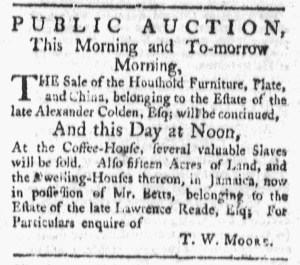
“PUBLIC AUCTION … several valuable Slaves will be sold.”
In this advertisement in Rivington’s New-York Gazetteer from January 26, 1775, T.W. Moore advertised a public auction being held “This Morning and To-Morrow Morning” to sell off the possessions of the late Alexander Colden to the highest bidder. In addition to these household items up for sale, Moore held another auction “this Day at Noon” for several enslaved people. This especially stood out to me because this shows public auctions, a competitive method, was a primary method of buying and selling goods, land, and even enslaved people in Revolutionary America. While people who were involved in the open market used auctions to sell off belongings and estates, enslavers used them as a way to reach a wider range of buyers in their efforts to make a profit off of enslaved people.
This advertisement shows that slave auctions happened even in New York. In “The Forgotten History of Slavery in New York,” Andrea C. Mosterman declares, “New York’s slavery past is still relatively unknown.” However, we can see by this advertisement, that these slaves for sale were an important part of Moore’s auctions. There was a high demand for enslaved people in New York before, during, and after the American Revolution. In 1788, Mosterman states, “Close to 75% of the free, white Kings County families enslaved people within their home.” The American Revolution did not result in freedom for everyone. Instead, some people would stand and look at other human beings being sold against their will along with everyday items like furniture and China dishes. By participating in these auctions, they treated enslaved people as property instead of as human beings.
**********
ADDITIONAL COMMENTARY: Carl Robert Keyes
In addition to selecting an advertisement to examine for the Adverts 250 Project, Jack is serving as guest curator for the Slavery Adverts 250 Project this week. Beyond this advertisement for “several valuable Slaves” up for bids at Moore’s auction on January 26, 1775, he identified eight other advertisements about enslaved people that appeared in the New-York Journal and Rivington’s New-York Gazetteer on the same day. As Jack makes clear, that auction was not an isolated incident. Instead, slavery was widely practiced in New York on the eve of the American Revolution and continued after thirteen colonies secured independence as a new nation.
Auctioneers like Moore represented part of the infrastructure for perpetuating slavery and the slave trade in New York. The printers who generated revenue by publishing these advertisements made significant contributions as well. Brokers, like William Tongue, played an important role as well. Tongue placed a lengthy advertisement enumerating “SLAVES,” “LANDS,” “HOUSES,” and “GOODS” for sale at his office “near the Exchange” in both the New-York Journal and Rivington’s New-York Gazetteer as well as the New-York Gazette and Weekly Mercury four days later. He listed and gave prices for ten enslaved men, women, and children, ranging in age from five to forty. They included a young woman who was “an useful domestic,” a man who was “a good farmer,” and a woman “with or without her son, 5 years old.” Tongue also noted that he “has likewise orders to purchase slaves of both sexes.”
Yet auctioneers and brokers were not alone in enlisting the services of printers in publishing advertisements for the purpose of buying and selling enslaved people. An anonymous advertiser offered a “LIKELY and handy Mulatto Boy” for sale in the New-York Journal. That youth had experience “waiting at Table” and could “attend a Gentleman on traveling.” The advertisement instructed reader to “Inquire of the Printer” for more details. Another advertisement featured an enslaved woman, “twenty-six Years of Age,” and an enslaved boy, “of twelve Years of Age,” for sale, again with directions to “Enquire of the Printer.” Still another described a “HEALTHY young Negro Girl … that can do all Kinds of House Work.” While auctioneers and brokers earned their livelihoods through buying and selling enslaved people, other colonizers made purchases and sales of one or two enslaved people at a time. Collectively, they made slavery a prevalent aspect of life in New York during the era of the American Revolution.