
What was advertised in a colonial American newspaper 250 years ago today?
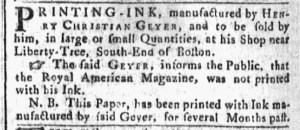
“The Royal American Magazine, was not printed with his Ink.”
The final mention of the Royal American Magazine in newspaper advertisements published in January 1775 may not have been the kind of coverage that Joseph Greenleaf, the printer, desired. Henry Christian Geyer once again inserted his notice for printing ink that he made and sold “at his Shop near Liberty-Tree” in Boston in the January 30 edition of the Massachusetts Gazette and Boston Post-Boy. In it, he noted to the public that “the Royal American Magazine, was not printed with his Ink.”
Beyond that squabble, Greenleaf did advertise the Royal American Magazine on eight occasions in three of the five newspapers printed in Boston that January. On January 5, he ran notices in both the Massachusetts Gazette and Boston Weekly News-Letter and the Massachusetts Spy. In the former, he announced that he “JUST PUBLISHED … NUMBER XII. of The Royal American Magazine … For DECEMBER, 1774.” To entice curiosity, he noted that issue was “Embellished with elegant Engravings.” He also stated that he continued to accept subscriptions at his printing office. That advertisement ran in three consecutive issues. As was his custom, he ran a shorter advertisement in the Massachusetts Spy. Extending only three lines, it advised, “This day was published, by J. GREENLEAF, THE Royal American Magazine, or Universal Repository, No. XII. for DECEMBER, 1774.” That advertisement in the Massachusetts Spy ran only twice. Another version appeared in the January 16 edition of the Boston Evening-Post, much closer in format to the one in the Massachusetts Gazette and Boston Weekly News-Letter except but without the call for new subscriptions.
That Greenleaf disseminated the December edition of the magazine in early January was a feat. In the eighteenth century, monthly magazines came out at the end of the month that bore their date or early in the next month, unlike modern magazines released in advance of the dates on their covers. When Greenleaf acquired the Royal American Magazine from Isaiah Thomas in August 1774, publication had fallen behind by two months because of the “Distresses of the Town of Boston, by the shutting up of our Port.” Over the next several months, Greenleaf steadily caught up on the overdue issues, delivering the December issue to subscribers right on time at the beginning of January.
On January 23, Greenleaf inserted a new advertisement in the Boston Evening-Post, this time alerting readers that he published “A SUPPLEMENT to The Royal American Magazine … With the Title-Page and Index to Vol. I. for 1774.” That supplement consisted of a two-page address to the subscribers, a seven-page index, and the next twenty-four pages of Thomas Hutchinson’s History of the Province of Massachusetts-Bay, a monthly feature and premium for subscribers. In the address, Greenleaf explained that since the magazine had been “suspended near two months by the original undertaker, I have been obliged to publish one oftner than once in three weeks.” Furthermore, he considered it “necessary to apologize for the poor appearance of the work the last six months.” He did not have type “so good as I could wish” and could not acquire more because of the “non-importation agreement, which it was MY DUTY to comply with.” Fortunately, a friend assisted him in obtaining “almost new” type for continuing to publish the magazine. He also acknowledged that the ink “has been poor, but as it was of AMERICAN MANUFACTURE my customers were not only willing but desirous I should use it.” When Geyer published advertisements that mentioned Greenleaf did not use his ink in printing the Royal American Magazine, it may have been just as much an attempt to distance his product from the “poor” appearance of the magazine as it was an effort to shame Greenleaf into purchasing from him in the future. The index concluded with “DIRECTIONS to the BOOK-BINDER for placing the PLATES, &c. in the ROYAL AMERICAN MAGAZINE, for 1774.” Bookbinders usually incorporated the copperplate engravings that accompanied eighteenth-century magazines yet removed the advertising wrappers that enclosed them.
Curiously, when an advertisement about the supplement ran in the January 26 edition of the Massachusetts Gazette and Boston Weekly News-Letter, it looked identical to the one in the Boston Evening-Post. If that was indeed the case, it was not the first time that those printing offices seemed to share type that had already been set, a matter for further investigation.
This entry continues an ongoing series in which the Adverts 250 Project has tracked advertisements for the Royal American Magazine from Thomas’s first notice, in May 1773, that he planned to distribute subscription proposals to newspapers advertisements in June, July, August, September, October, November, and December 1773 and January, February, March, April, May, and June1774. No magazine appeared in July 1774 because of the “Distresses,” yet they resumed in August, September, October, November, and December.
**********
“JUST PUBLISHED … Royal American Magazine … For DECEMBER, 1774”
- January 5 – Massachusetts Gazette and Boston Weekly News-Letter (first appearance)
- January 12 – Massachusetts Gazette and Boston Weekly News-Letter (second appearance)
- January 19 – Massachusetts Gazette and Boston Weekly News-Letter (third appearance)
“This day was published … Royal American Magazine … for DECEMBER, 1774”
- January 5 – Massachusetts Spy (first appearance)
- January 12 – Massachusetts Spy (second appearance)
“This Day is Published … Royal American Magazine … For DECEMBER, 1774”
- January 16 – Boston Evening-Post (first appearance)
“THIS DAY PUBLISHED … A SUPPLEMENT to The Royal American Magazine”
- January 23 – Boston Evening-Post (first appearance)
- January 26 – Massachusetts Gazette and Boston Weekly News-Letter (first appearance)
“Royal American Magazine, was not printed with his Ink”
- January 23 – Massachusetts Gazette and Boston Post-Boy (first appearance)
- January 30 – Massachusetts Gazette and Boston Post-Boy (second appearance)
[…] yet they resumed in August, September, October, November, and December 1774 and January and February […]