
What was advertised in a colonial American newspaper 250 years ago this week?
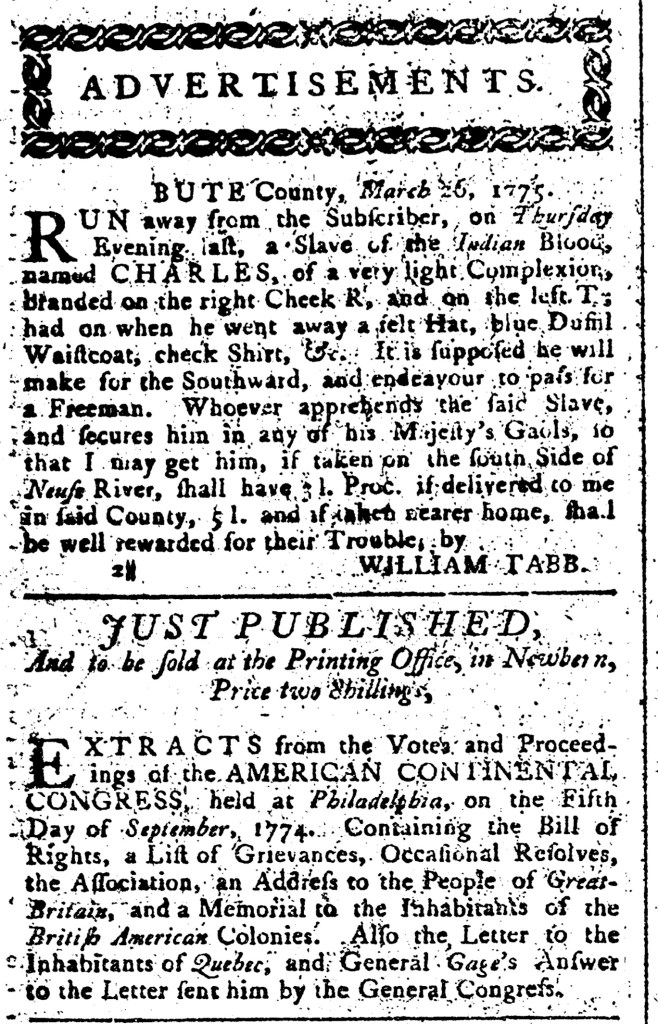
“EXTRACTS from the Votes and Proceedings of the AMERICAN CONTINENTAL CONGRESS.”
The North-Carolina Gazette, published by James Davis in New Bern from May 1768 through November 1778, with some interruptions, only made its first appearance in the Adverts 250 Project a couple of weeks ago because extant copies are so rare that few have been digitized and made more broadly accessible to scholars. America’s Historical Newspapers, the most comprehensive database of digitized eighteenth-century newspapers, includes only seven issues of the North-Carolina Gazette, all of them from 1775. Other databases do not include any.
As a result, the April 7 edition is the second issue of the North-Carolina Gazette available for inclusion in the Adverts 250 Project and the Slavery Adverts 250 Project. The first two advertisements in that issue drew my attention. The first described and offered a reward for “a Slave of the Indian Blood, named CHARLES” who liberated himself by running away from his enslaver. Charles’s story of resistance has been compiled with other advertisements about enslaved men, women, and children published in American newspapers on April 7, 1775, as part of the Slavery Adverts 250 Project.
The second promoted “EXTRACTS from the Votes and Proceedings of the AMERICAN CONTINENTAL CONGRESS, held at Philadelphia” in September and October 1774. The Adverts 250 Project has traced the publication and marketing of the Extracts, starting with William Bradford and Thomas Bradford’s edition in Philadelphia and continuing with local editions published in many other towns. This advertisement confirms that Davis sold the Extracts.
Did he print a local edition? Or did he sell copies that he received from another printer? The formulaic language in the advertisement — “JUST PUBLISHED, And to be sold at the Printing Office, in Newbern” — does not definitively answer those questions. The phrase “JUST PUBLISHED,” for instance, merely meant that a book, pamphlet, or almanac was available. When an advertisement first ran, “JUST PUBLISHED” meant that it had been published recently, but printers and booksellers sometimes ran advertisements for weeks or months without updating them. They did not consider setting type once again worth investing their time or attention. Eighteenth-century readers understood that “JUST PUBLISHED” did not always mean that the item was hot off the presses. Similarly, they separated “JUST PUBLISHED” and “to be sold at the Printing Office,” realizing that printers often peddled books, pamphlets, and almanacs “JUST PUBLISHED” by other printers.
This language suggests that Davis may or may not have printed the edition of the Extracts that he advertised. Some bibliographers, however, have trusted advertisements in the North-Carolina Gazette as sufficient proof that he did publish a local edition. In “James Davis: North Carolina’s First Printer,” a thesis submitted to the School of Information and Library Science of the University of North Carolina at Chapel Hill, Scott Aaron Reavis includes the Extracts among works printed on Davis’s press. He notes, “No copies are known to exist, however, it was advertised for sale in the North Carolina Gazette, 24 February 1775.”[1] By the time the subsequent advertisement ran in the April 7 edition, the Extracts were “JUST PUBLISHED” indeed! Charles Evans did not list Davis’s New Bern edition in American Bibliography: A Chronological Dictionary of All Books, Pamphlets, and Periodical Publications Printed in the United States of America from the Genesis of Printing in 1639 Down to and Including the Year 1820, but, according to Reavis, Douglas C. McMurtie included the Extracts in his “Bibliography of North Carolina Imprints.”[2] Given how many printers published local editions of the Extracts, I am inclined to agree with McMurtie and Reavis that Davis did as well. I disagree, however, with the date assigned to the work. Davis’s edition has been dated to 1775 based on an advertisement in one of the few extant issues of the North-Carolina Gazette. More likely, if Davis published the Extracts then he did so in November or December 1774, the same time that printers in other towns produced local editions, and occasionally inserted his advertisement that he had “JUST PUBLISHED” and sold the volume at his printing office several times over the next several months.
**********
[1] Scott Aaron Reavis, “James Davis: North Carolina’s First Printer” (master’s thesis, University of North Carolina at Chapel Hill, 2000), 44.
[2] Reavis, “James Davis,” 28.
[…] As had been the case in the April 7 edition, that advertisement ran alongside another that described an enslaved man who liberated himself by running away from his enslaver. In this instance, “a Negro Slave … named JEM,” was a fugitive from slavery who might have been “harboured or kept out by his Wife, named Rachel.” James Biggleston, Jem’s enslaver, suspected that Jem was “lurking in the Neighborhood” of the plantation where Rachel was enslaved. Biggleston offered a reward for the capture and return of Jem in a nota bene at the end of the advertisement, though the main body of the notice consisted of a warrant signed by “Two of his Majesty’s Justices of the Peace” that authorized that “if the said Jem doth not surrender himself, and return home immediately … that any Person or Persons may kill and destroy the said Slave … without Impeachment or Accusation of any Crime or Offence … or without incurring any Penalty.” Most readers of the North-Carolina Gazette and other newspapers compartmentalized the contents of those publications. They did so to such an extent that the juxtaposition of colonizers demanding freedom from oppression and enslaved people seeking liberty did not register as a contradiction. […]