
What was advertised in a revolutionary American newspaper 250 years ago today?
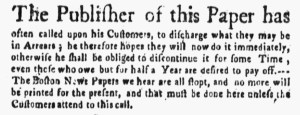
“The Boston News Papers we hear are all stopt.”
It was the sort of notice that printers throughout the colonies regularly inserted in their newspapers, though Daniel Fowle, the printer of the New-Hampshire Gazette in Portsmouth, may have done so with greater frequency than some of his counterparts in other towns. “The Publisher of this Paper,” he declared on April 28, 1775, “has often called upon his Customers, to discharge what they may be in Arrears.” This time, however, he did not threaten to stop sending copies to delinquent subscribers who did not pay their bills. Instead, he suggested that the entire enterprise was at stake, that if he did not receive those payments “immediately” then “he shall be obliged to discontinue [the newspaper] for some Time.” In other instances, printers addressed subscribers who had not paid in several years, but, again, this time was different. Fowle proclaimed that “even those who owe but for half a Year are desired to pay off.”
To demonstrate the gravity of the situation, he reported that the “Boston News Papers we hear are all stopt, and no more will be printed for the present.” Indeed, Fowle had heard correctly. Five newspapers were published in Boston at the beginning of the month, but none continued uninterrupted by the end of April. Isaiah Thomas removed the Massachusetts Spy to Worcester before the battles at Lexington and Concord on April 19. Other printers suspended publication of their newspapers, believing that they would do so only “till Matters are in a more settled State.” Yet it was the end for the Boston Evening-Post and the Massachusetts Gazette and Boston Post-Boy. The Boston-Gazette and the Massachusetts Gazette and Boston Weekly News-Letter did eventually resume publication, though only the Boston-Gazette survived the Revolutionary War.
At that moment, neither Fowle nor his subscribers knew the fate of Boston’s newspapers or the New-Hampshire Gazette. The printer asserted that he would cease publication “unless the Customers attend to this call.” He did so on the same page that carried more extensive coverage of the events at Lexington and Concord than he had been able to publish in the previous issue because of the “different and contrary Accounts of the late Bloody Scene” received in the printing office in the hours immediately after something momentous happened. When news about those engagements appeared in the April 28 edition, Fowle used thick black borders, usually associated with mourning, to draw attention. He also inserted a note at the bottom of the first page: “See the other Side of the Paper an Account of the late Battle.” In addition, instead of the usual four pages, that issue consisted of only two, an indication to readers that Fowle had limited resources. If they wanted to continue receiving coverage in print to supplement what they heard by word of mouth, subscribers needed to “discharge what they may be in Arrears” and “do it immediately.”
[…] April 28, 1775, Daniel Fowle, printer of the New-Hampshire Gazette, reported that the “Boston News Papers … are all stopt, and no more will be printed for the present” following the outbreak of hostilities at Lexington and Concord. He could have also mentioned […]
[…] may remain on the Minds of any Person whatever.” Given that Boston’s newspapers “are all stopt, and no more will be printed for the present,” as the printer of the New-Hampshire Gazette put it, some sort of coverage in the Essex Gazette, […]
[…] after the battles at Lexington and Concord, Daniel Fowle, the printer of the New-Hampshire Gazette placed a notice calling on subscribers and other customers “to discharge what they may be in Arrears” and to do […]
[…] “The Boston News Papers we hear are all stopt, and no more will be printed for the present,” Fowle noted, “and that must be done here unless the Customers attend to this call.” Two weeks later, he […]