
What was advertised in a revolutionary American newspaper 250 years ago today?
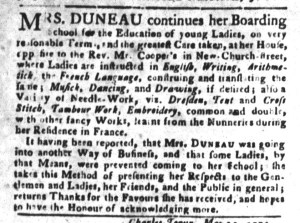
“MRS. DUNEAU continues her Boarding School for the Education of young Ladies.”
In an advertisement in the June 13, 1775, edition of the South-Carolina Gazette and Country Journal, Mrs. Duneau assured the public that she “continues her Boarding School for the Education of young Ladies … at her House, opposite to the Rev. Mr. Cooper’s in New-Church-street” in Charleston. She may have intended to suggest that her proximity to the minister contributed to the “greatest Care” that she took of her pupils. The schoolmistress also provided an overview of the curriculum at her school: “English, Writing, Arithmetic, the French Language, construing and translating the same; Musick, Dancing, and Drawing.” The education they received from Duneau helped in forming her students into genteel young ladies. In addition, they learned a “Variety of Needle-Work,” likely intended to demonstrate their devotion to leisurely pursuits rather prepare them occupations to support themselves. Those included “Dresden, Tent and Cross Stitch, Tambour Work, [and] Embroidery, common and double,” along with “other fancy Works” that Duneau “learnt from the Nunneries during her Residence in France.”
Although advertisements for boarding schools regularly appeared in newspapers published in Charleston on the eve of the American Revolution, Duneau may have considered it especially necessary to insert this notice to attract students. “It having been reported,” she stated, “that Mrs. DUNEAU was going into another Way of Business, … some Ladies, by that Means, were prevented coming to her School.” What kinds of reports had circulated? Who was responsible for suggesting that she planned to pursue another occupation, perhaps putting her skill with a needle to use in the marketplace? Had a rival schoolmistress spread rumors as a means of undercutting Duneau and enrolling students who otherwise would have attended her school? Duneau did not provide further details in her advertisement. Instead, she focused on “presenting her Respects to the Gentlemen and Ladies, her Friends, and the Public in general,” expressing her gratitude for “the Favours she has received” when entrusted with students in the past and requesting “the Honour of acknowledging more.” Whatever readers may have heard about whether Duneau continued to operate her school, she wanted the parents of prospective students to know that she was prepared to teach their daughters.