
What was advertised in a revolutionary American newspaper 250 years ago this week?
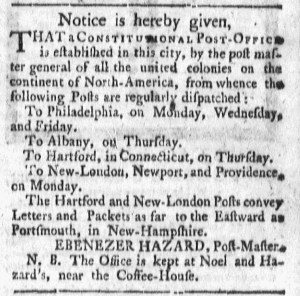
“A CONSTITUTIONAL POST-OFFICE is established in this city.”
Yet another advertisement for a “CONSTITUTIONAL POST-OFFICE,” an alternative to the British postal system, appeared in the public prints at the end of October 1775. It ran in Rivington’s New-York Gazetteer, despite the reputation of that newspaper and its printer, James Rivington, for expressing Loyalist sentiments. William Goddard originally envisioned the Constitutional Post and set about establishing local offices before the battles at Lexington and Concord, but after hostilities commenced the Second Continental Congress assumed responsibility for maintaining and expanding its services. That included appointing Benjamin Franklin as the postmaster general, much to the chagrin of Goddard. Ebenezer Hazard, a bookseller, became the postmaster in New York, though John Holt, the printer of the New-York Journal, lobbied for the position. According to the nota bene in the advertisement, “The Office is kept at Noel and Hazard’s, near the Coffee-House,” the same location where the new postmaster and his partner, Garrat Noel, stocked the “JOURNAL OF THE PROCEEDINGS” of the First Continental Congress.
The notice in Rivington’s New-York Gazetteer, signed by Hazard as the “Post-master,” informed the public that a “CONSTITUTIONAL POST-OFFICE” is established in this city, by the post master general of all the united colonies on the continent of North-America.” Hazard offered the most complete schedule of any that yet appeared in newspaper advertisements, stating that the “Posts are regularly dispatched” to Philadelphia on Mondays, Wednesdays, and Fridays, to Albany on Thursdays, to Hartford on Thursdays, and to New London, Newport, and Providence on Mondays. The routes to both Hartford and New London extended “as far to the Eastward” as Portsmouth, New Hampshire. Unlike some other postmasters, Hazard did not mention that service continued as far south as Georgia. He focused primarily on the network that connected New York to New England and Pennsylvania. As new advertisements for the Constitutional Post appeared in newspapers in multiple towns and cities, the public became more aware of an enterprise that competed with the imperial postal system to carry “Letters and Packets,” delivering news and information without interference from British authorities.