
Who was the subject of an advertisement in a revolutionary American newspaper 250 years ago today?
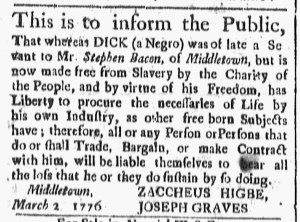
“DICK (a Negro) … is now made free from Slavery by the Charity of the People.”
It was an unusual advertisement about an enslaved person that ran in the April 5, 1776, edition of the Connecticut Gazette. In the decade prior to the colonies declaring independence from Great Britain, more than thirty thousand advertisements about enslaved men, women, and children ran in American newspapers. Almost all of them belonged to one of two categories: buying and selling enslaved people or capturing and returning enslaved people who liberated themselves by running away from their enslavers. In the first category, most notices offered enslaved people for sale, though some offered to hire them out by the month or year and others sought to purchase enslaved people. In the second category, most advertisements described enslaved people who liberated themselves and offered rewards for their capture and return with a smaller number giving descriptions of Black people confined to jails and workhouses on suspicion of running away and asking their enslavers to claim them and pay expenses. The April 5 edition of the Connecticut Gazette carried an advertisement about “a Melatto Fellow named SY” who liberated himself from Joshua Powers and another that offered to sell “A Negro Man Servant, at a very reasonable Price.”
It also featured a notice “to inform the Public, That … DICK (a Negro) was of late a Servant to Mr. Stephen Bacon, of Middletown, but is now made free from Slavery by the Charity of the People, and by virtue of his Freedom, has Liberty to procure the necessaries of Life by his own Industry, as other free born Subjects have.” The advertisement did not go into detail about the circumstance of Dick receiving his freedom, though it suggested that residents of Middletown took up a collection to purchase him from Bacon. During the era of the American Revolution, some colonizers in New England recognized the enslavement of African, African American, and Indigenous people as inconsistent with the rhetoric of freedom that they embraced concerning their own experiences within the British Empire. In the spring of 1775, for instance, Black people in the counties of Bristol and Worcester “petitioned the Committees of Correspondence for the county of Worcester … to assist them in obtaining their freedom.” According to a notice in the June 21 edition of the Massachusetts Spy, the colonizers who gathered for a county convention passed a resolution stated that “we abhor the enslaving of any of the human race, and particularly of the NEGROES in this country.” Accordingly, “whenever there shall be a door opened, or opportunity present for anything to be done toward the emancipating the NEGROES; we will use our influence and endeavour that such a thing may be effected.”
Stephen Bacon of Middletown, Connecticut, did not seem to share those sentiments. Perhaps members of his community did not either, but at the very least they apparently formed some sort of bond with Dick that prompted them to seek his freedom. The announcement that ran in the Connecticut Gazette came with a caveat. The men who placed it, Zaccheus Higbe and Joseph Graves, cautioned that “all or any Person or Persons that do or shall Trade, Bargain, or make Contract with [Dick], will be liable themselves to bear all the loss that he or they do sustain by so doing.” Higbe and Graves did not specify what role, if any, they played in Dick becoming free, nor did they indicate their primary motivation for placing the advertisement. Was it to aid Dick in asserting his new status? Or to caution anyone who might do business with him that Bacon was no longer ultimately responsible for Dick’s “own Industry”? Whatever their intention, the advertisement in Connecticut Gazette supplemented other documents testifying to his freedom that Dick almost certainly safeguarded in society where enslavement continued.