
What was advertised in a colonial American newspaper 250 years ago today?
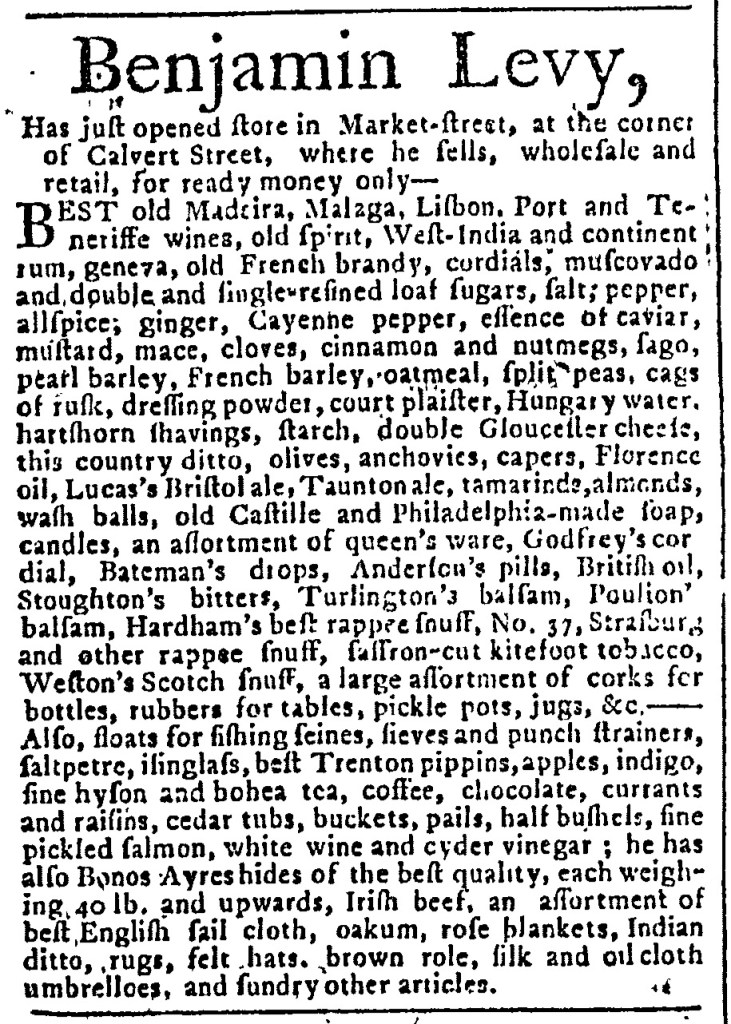
“Fine hyson and bohea tea.”
Benjamin Levy advertised a variety of groceries, including “fine hyson and bohea tea,” available at his store on Market Street in Baltimore in the December 18, 1773, edition of the Maryland Journal. Two nights earlier, colonizers disguised as Indians boarded ships in Boston and tossed tea shipped by the East India Company into the harbor to protest the Tea Act. While it would take a little time for that news to reach Baltimore, the newspaper carried other news about the escalating crisis.
The first page featured news from Boston, dated November 29: “Yesterday morning arrived here the ship Dartmouth, Capt. Hall, in 8 weeks from London, with 114 chests of the long expected and much talked of TEA.” The following morning, a handbill posted around town proclaimed, “FRIENDS! BRETHREN! COUNTRYMEN! THAT worst of plagues, the detested TEA, shipped for this port by the East-India Company, is now arrived in this harbour; the hour of destruction or manly opposition to the machinations of tyranny stares you in the face.” In the face of this threat, “every friend to his country, to himself and posterity, is now called upon to meet at Faneuil Hall … to make a united and successful resistance to this last, worst and most destructive measure of administration.” The remainder of the page and two columns on the second page provided an overview of the meeting, a response from the governor and Loyalist merchants, and a resolution from the town meeting stating that “if any person or persons shall hereafter import Tea from Great-Britain … until the said unrighteous Act shall be repealed, he or they shall be deemed by this body, an enemy of his country.” In addition, “we will prevent the landing and sale of the same, and the payment of any duty thereon. And we will effect the return thereof to the place from whence it shall come.” Another resolution called for “the foregoing vote to be printed and sent to England, and all the sea-ports in this province.” That news made it far beyond other ports in Massachusetts.
A much shorter piece followed the accounts from Boston. A condescending note to women suggested that their enjoyment of tea played a significant role in precipitating the crisis, ignoring the fact that both men and women, poor, middling, and wealthy, all consumed tea. “LADIES,” it declared, “HOWEVER coolly some of you may now esteem your husband, it might be worth your while to consider, whether by abandoning the accursed TEA, you will preserve your country and posterity in peace and good order, or expose twenty-five thousand of them to spill their blood, in defence of their undoubted birth-right.” The anonymous correspondent anticipated an armed conflict over the English liberties that colonizers were supposed to possess, arguing that if that did indeed come to pass then women would be at fault for not abstaining from tea. This echoed a sentiment so often expressed among the editorials in newspapers during the imperial crisis: women presented dangers both political and cultural through their consumption of tea and other goods.
The Maryland Journal even included an inaccurate account of what occurred in Massachusetts: “A Gentleman just come to Town from Boston assures us, That the East India Company’s TEA, lately arrived at that Place, in several Ships, from London, for the Purpose of enslaving and impoverishing, if not poisoning, the People, was all sent back to the Proprietors, conformable to the noble and Spirited Resolves of the brave Inhabitants of the Town of Boston.” That was not what happened at all, as colonizers in Baltimore would soon learn. Even as Benjamin Levy advertised “fine hyson and bohea tea” for sale at his store in Baltimore, tea shipped by the East India Company floated in Boston Harbor. A new stage of the imperial crisis was brewing as colonizers faced repercussions from Parliament for that act of protest.