
What was advertised in a colonial American newspaper 250 years ago this week?
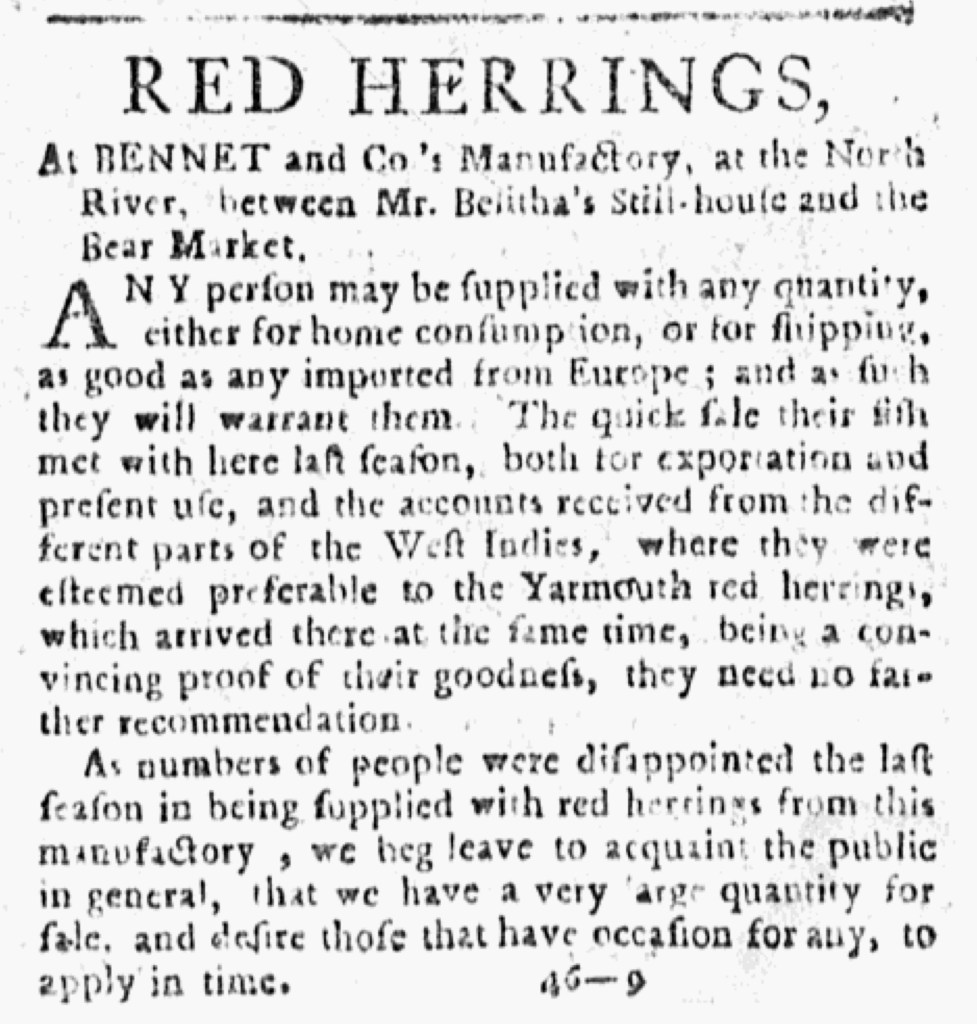
“The quick sale their fish met with here last season … being a convincing proof of their goodness.”
Bennet and Company offered a superior product that consumers did not want to miss. That was their claim in an advertisement for “RED HERRINGS” that first appeared in the July 21, 1774, edition of the New-York Journal and continued for several weeks. Bennet and Company began by comparing their herrings to imported alternatives, asserting that whether customers purchased them “for home consumption, or for shipping,” they would find them “as good as any imported from Europe.” They were so confident in that claim that they “will warrant them” as such, extending a promise and a nonbinding guarantee.
Yet prospective customers did not have to take their word for it. Bennet and Company offered other evidence to convince readers to choose their herrings over others. They emphasized the “quick sale their fish met with here last season, both for exportation and present use.” In addition, “the accounts received from the different parts of the West Indies … being a convincing proof of their goodness, they need no farther recommendation.” Apparently, herrings from “BENNET and Co.’s Manufactory” in New York arrived in ports in the Caribbean at the same time as “Yarmouth red herrings” and consumers preferred the former over the latter. Bennet and Company sought to build on that reputation.
To further make their case, they reported that “numbers of people were disappointed in the last season in being supplied with red herrings from this manufactory.” Bennet and Company sold out before they could meet the demand for their product. Keeping that in mind, they “acquaint[ed] the public in general, that we have a very large quantity for sale, and desire those that have occasion for any, to apply in time.” In other words, Bennet and Company wished to serve as many customers as possible, but they could do so only while inventory lasted. Readers had a limited time to purchase red herrings from Bennet and Company, the amount of time determined not by the producers themselves but by the speed of sales as consumers clamored for the popular product. The advertisers highlighted demand as a strategy for inciting even greater demand.