April 4

What was advertised in a colonial American newspaper 250 years ago this week?
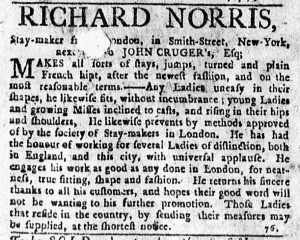
New-York Journal (April 1, 1773).

“Any Ladies uneasy in their shapes, he likewise fits, without incumbrance.”

Richard Norris billed himself as a “Stay-maker from London” even though he had resided and worked in New York for several years by the time he published his advertisement in the April 1, 1773, edition of the New-York Journal.  He considered his connection to the largest and most cosmopolitan city in the empire a selling point.  Norris informed readers that he previously served the best sorts of clients on both sides of the Atlantic, declaring that he “has had the honour of working for several Ladies of distinction, both in England, and this city.”  The quality of his stays (or corsets) and his skill in producing them yielded “universal applause” from his clients.

Although Norris had been in New York for some time, he also suggested that he maintained his connection to London.  For instance, he made stays “after the newest fashion” in that city.  In another advertisement, he described how he “acquires the first fashions of the court of London by a correspondent he has settled there.”  Furthermore, he adhered to “methods approved of by the society of Stay-makers in London” in designing and making his stays, especially those for “young Ladies and growing Misses inclined to casts, and rising in their hips and shoulders.”

Norris frequently coupled appeals to the latest fashions from London with attempts to make women feel anxious about their bodies.  “Any Ladies uneasy in their shapes, he likewise fits, without incumbrance,” the staymaker asserted in 1768 and reiterated in 1770 and 1773.  In return for helping them address purported physical shortcomings that he helped them to overcome (or at least disguise) with his stays, Norris asked his clients to recommend him to others.  He extended “his sincere thanks to all his customers, and hopes their good word will not be wanting to his further promotion.  Not unlike modern marketing for clothing and beauty products, Norris encouraged “young Ladies and growing Misses” to feel uncomfortable with their bodies, purchase his product to ease their anxieties, and reward him for his part in addressing a supposed shortcoming that he highlighted and did not allow them to overlook.
January 14

What was advertised in a colonial American newspaper 250 years ago this week?

Jan 14 - 1:11:1770 New-York Journal
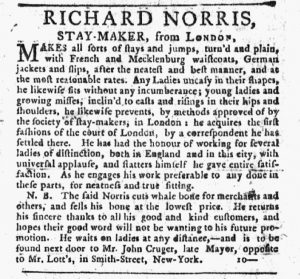
New-York Journal (January 11, 1770).

“Any Ladies uneasy in their shapes, he likewise fits without any incumberance.”

Richard Norris, “STAY-MAKER, from LONDON,” made a variety of appeals to prospective customers in an advertisement he inserted in the January 11, 1770, edition of the New-York Journal. When it came to making stays (corsets) and other garments, he promised high quality (“the neatest and best manner”) and low prices (“the most reasonable rates”). He proclaimed the superiority of his work compared to local competitors, stating that his stays were “preferable to any done in these parts, for neatness and true fitting.”

Norris developed two appeals in even greater detail. In one, he emphasized his London origins and continuing connections to the empire’s largest city. Despite political tensions between Parliament and the colonies, London remained the metropolitan center of fashion. Norris assured prospective clients that “he acquires the first fashions of the court of London, by a correspondent settled there.” Although the staymaker had migrated to the colonies, he maintained access to the latest styles in the most cosmopolitan of cities in the British Atlantic world. He also underscored that he constructed stays according to “methods approved of by the society of stay-makers, in London,” implying that his training and experience in that city ranked him above any of his rivals in New York.

While most of these appeals focused on Norris and his abilities, the other strategy that he developed in greater detail targeted female readers of the New-York Journal. He attempted to incite demand for his services by prompting women to feel “uneasy in their shapes.” He made a special point of exhorting “young ladies and growing misses” to question whether they were “inclin’d to casts and risings in their hips and shoulders,” compelling them to imagine that their bodies were misshapen. Young women could hide such imperfections from observers by wearing the stays that Norris made and sold, even though they would retain the knowledge that there was supposedly something wrong or undesirable about their bodies. In eighteenth-century America, quite like today, advertisers often relied on provoking anxieties among consumers, especially young women, and offering to reduce those anxieties as a means of promoting their products.